

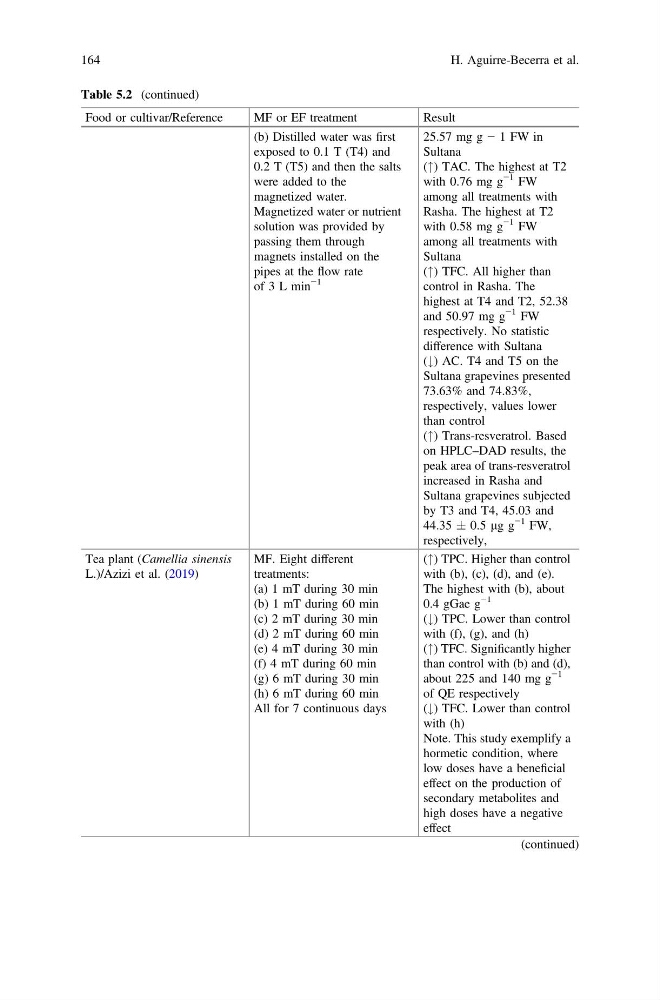
Table 5.2 (continued)
Food or cultivar/Reference
MF or EF treatment
Result
(b) Distilled water was first
exposed to 0.1 T (T4) and
0.2 T (T5) and then the salts
were added to the
magnetized water.
Magnetized water or nutrient
solution was provided by
passing them through
magnets installed on the
pipes at the flow rate
of 3 L min
−1
25.57 mg g − 1 FW in
Sultana
(") TAC. The highest at T2
with 0.76 mg g
−1 FW
among all treatments with
Rasha. The highest at T2
with 0.58 mg g
−1 FW
among all treatments with
Sultana
(") TFC. All higher than
control in Rasha. The
highest at T4 and T2, 52.38
and 50.97 mg g
−1 FW
respectively. No statistic
difference with Sultana
(#) AC. T4 and T5 on the
Sultana grapevines presented
73.63% and 74.83%,
respectively, values lower
than control
(") Trans-resveratrol. Based
on HPLC–DAD results, the
peak area of trans-resveratrol
increased in Rasha and
Sultana grapevines subjected
by T3 and T4, 45.03 and
44.35 ± 0.5 lg g
−1 FW,
respectively,
Tea plant (Camellia sinensis
L.)/Azizi et al. (2019)
MF. Eight different
treatments:
(a) 1 mT during 30 min
(b) 1 mT during 60 min
(c) 2 mT during 30 min
(d) 2 mT during 60 min
(e) 4 mT during 30 min
(f) 4 mT during 60 min
(g) 6 mT during 30 min
(h) 6 mT during 60 min
All for 7 continuous days
(") TPC. Higher than control
with (b), (c), (d), and (e).
The highest with (b), about
0.4 gGae g
−1
(#) TPC. Lower than control
with (f), (g), and (h)
(") TFC. Significantly higher
than control with (b) and (d),
about 225 and 140 mg g
−1
of QE respectively
(#) TFC. Lower than control
with (h)
Note. This study exemplify a
hormetic condition, where
low doses have a beneficial
effect on the production of
secondary metabolites and
high doses have a negative
effect
(continued)
164
H. Aguirre-Becerra et al.
Food or cultivar/Reference
MF or EF treatment
Result
(b) Distilled water was first
exposed to 0.1 T (T4) and
0.2 T (T5) and then the salts
were added to the
magnetized water.
Magnetized water or nutrient
solution was provided by
passing them through
magnets installed on the
pipes at the flow rate
of 3 L min
−1
25.57 mg g − 1 FW in
Sultana
(") TAC. The highest at T2
with 0.76 mg g
−1 FW
among all treatments with
Rasha. The highest at T2
with 0.58 mg g
−1 FW
among all treatments with
Sultana
(") TFC. All higher than
control in Rasha. The
highest at T4 and T2, 52.38
and 50.97 mg g
−1 FW
respectively. No statistic
difference with Sultana
(#) AC. T4 and T5 on the
Sultana grapevines presented
73.63% and 74.83%,
respectively, values lower
than control
(") Trans-resveratrol. Based
on HPLC–DAD results, the
peak area of trans-resveratrol
increased in Rasha and
Sultana grapevines subjected
by T3 and T4, 45.03 and
44.35 ± 0.5 lg g
−1 FW,
respectively,
Tea plant (Camellia sinensis
L.)/Azizi et al. (2019)
MF. Eight different
treatments:
(a) 1 mT during 30 min
(b) 1 mT during 60 min
(c) 2 mT during 30 min
(d) 2 mT during 60 min
(e) 4 mT during 30 min
(f) 4 mT during 60 min
(g) 6 mT during 30 min
(h) 6 mT during 60 min
All for 7 continuous days
(") TPC. Higher than control
with (b), (c), (d), and (e).
The highest with (b), about
0.4 gGae g
−1
(#) TPC. Lower than control
with (f), (g), and (h)
(") TFC. Significantly higher
than control with (b) and (d),
about 225 and 140 mg g
−1
of QE respectively
(#) TFC. Lower than control
with (h)
Note. This study exemplify a
hormetic condition, where
low doses have a beneficial
effect on the production of
secondary metabolites and
high doses have a negative
effect
(continued)
164
H. Aguirre-Becerra et al.