

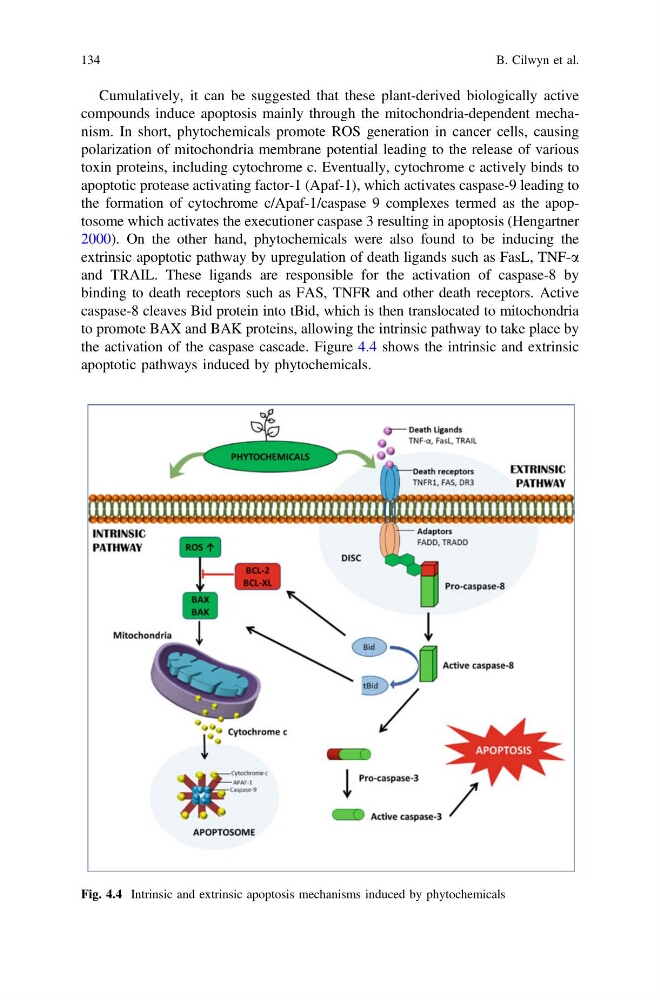
Cumulatively, it can be suggested that these plant-derived biologically active
compounds induce apoptosis mainly through the mitochondria-dependent mechanism. In short, phytochemicals promote ROS generation in cancer cells, causing
polarization of mitochondria membrane potential leading to the release of various
toxin proteins, including cytochrome c. Eventually, cytochrome c actively binds to
apoptotic protease activating factor-1 (Apaf-1), which activates caspase-9 leading to
the formation of cytochrome c/Apaf-1/caspase 9 complexes termed as the apoptosome which activates the executioner caspase 3 resulting in apoptosis (Hengartner
2000). On the other hand, phytochemicals were also found to be inducing the
extrinsic apoptotic pathway by upregulation of death ligands such as FasL, TNF-a
and TRAIL. These ligands are responsible for the activation of caspase-8 by
binding to death receptors such as FAS, TNFR and other death receptors. Active
caspase-8 cleaves Bid protein into tBid, which is then translocated to mitochondria
to promote BAX and BAK proteins, allowing the intrinsic pathway to take place by
the activation of the caspase cascade. Figure 4.4 shows the intrinsic and extrinsic
apoptotic pathways induced by phytochemicals.
Fig. 4.4 Intrinsic and extrinsic apoptosis mechanisms induced by phytochemicals
134
B. Cilwyn et al.
compounds induce apoptosis mainly through the mitochondria-dependent mechanism. In short, phytochemicals promote ROS generation in cancer cells, causing
polarization of mitochondria membrane potential leading to the release of various
toxin proteins, including cytochrome c. Eventually, cytochrome c actively binds to
apoptotic protease activating factor-1 (Apaf-1), which activates caspase-9 leading to
the formation of cytochrome c/Apaf-1/caspase 9 complexes termed as the apoptosome which activates the executioner caspase 3 resulting in apoptosis (Hengartner
2000). On the other hand, phytochemicals were also found to be inducing the
extrinsic apoptotic pathway by upregulation of death ligands such as FasL, TNF-a
and TRAIL. These ligands are responsible for the activation of caspase-8 by
binding to death receptors such as FAS, TNFR and other death receptors. Active
caspase-8 cleaves Bid protein into tBid, which is then translocated to mitochondria
to promote BAX and BAK proteins, allowing the intrinsic pathway to take place by
the activation of the caspase cascade. Figure 4.4 shows the intrinsic and extrinsic
apoptotic pathways induced by phytochemicals.
Fig. 4.4 Intrinsic and extrinsic apoptosis mechanisms induced by phytochemicals
134
B. Cilwyn et al.