

A New Era in Smelting Sustainability—Intensification …
69
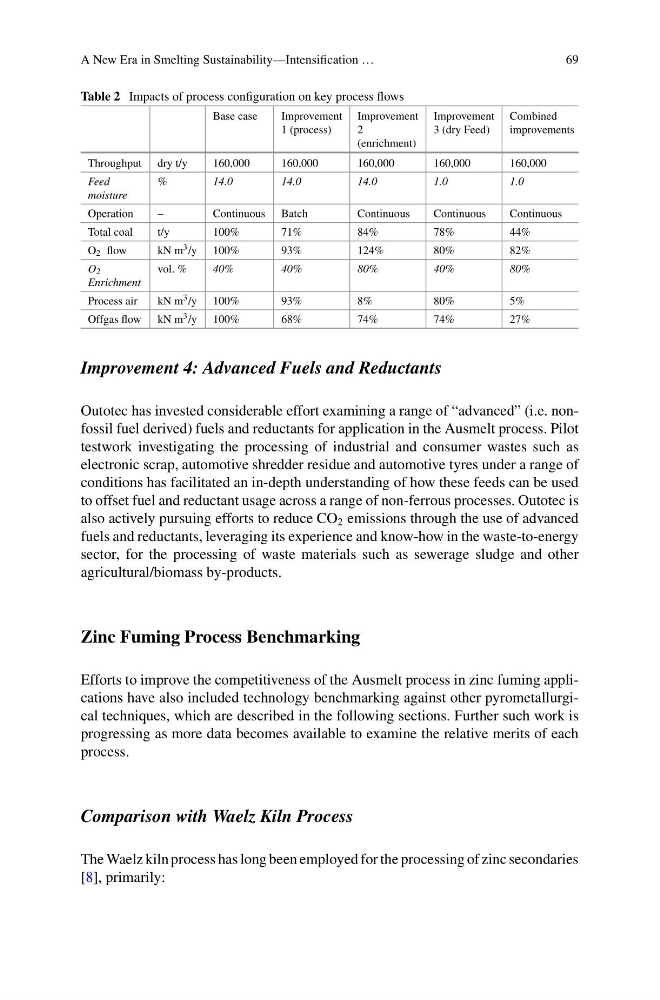
Table 2 Impacts of process configuration on key process flows
Base case
Improvement
1 (process)
Improvement
2
(enrichment)
Improvement
3 (dry Feed)
Combined
improvements
Throughput dry t/y
160,000
160,000
160,000
160,000
160,000
Feed
moisture
%
14.0
14.0
14.0
1.0
1.0
Operation
–
Continuous Batch
Continuous
Continuous
Continuous
Total coal
t/y
100%
71%
84%
78%
44%
O 2 flow
kN m 3 /y 100%
93%
124%
80%
82%
O 2
Enrichment
vol. %
40%
40%
80%
40%
80%
Process air
kN m 3 /y 100%
93%
8%
80%
5%
Offgas flow kN m 3 /y 100%
68%
74%
74%
27%
Improvement 4: Advanced Fuels and Reductants
Outotec has invested considerable effort examining a range of “advanced” (i.e. nonfossil fuel derived) fuels and reductants for application in the Ausmelt process. Pilot
testwork investigating the processing of industrial and consumer wastes such as
electronic scrap, automotive shredder residue and automotive tyres under a range of
conditions has facilitated an in-depth understanding of how these feeds can be used
to offset fuel and reductant usage across a range of non-ferrous processes. Outotec is
also actively pursuing efforts to reduce CO 2 emissions through the use of advanced
fuels and reductants, leveraging its experience and know-how in the waste-to-energy
sector, for the processing of waste materials such as sewerage sludge and other
agricultural/biomass by-products.
Zinc Fuming Process Benchmarking
Efforts to improve the competitiveness of the Ausmelt process in zinc fuming applications have also included technology benchmarking against other pyrometallurgical techniques, which are described in the following sections. Further such work is
progressing as more data becomes available to examine the relative merits of each
process.
Comparison with Waelz Kiln Process
The Waelz kiln process has long been employed for the processing of zinc secondaries
[8], primarily:
69
Table 2 Impacts of process configuration on key process flows
Base case
Improvement
1 (process)
Improvement
2
(enrichment)
Improvement
3 (dry Feed)
Combined
improvements
Throughput dry t/y
160,000
160,000
160,000
160,000
160,000
Feed
moisture
%
14.0
14.0
14.0
1.0
1.0
Operation
–
Continuous Batch
Continuous
Continuous
Continuous
Total coal
t/y
100%
71%
84%
78%
44%
O 2 flow
kN m 3 /y 100%
93%
124%
80%
82%
O 2
Enrichment
vol. %
40%
40%
80%
40%
80%
Process air
kN m 3 /y 100%
93%
8%
80%
5%
Offgas flow kN m 3 /y 100%
68%
74%
74%
27%
Improvement 4: Advanced Fuels and Reductants
Outotec has invested considerable effort examining a range of “advanced” (i.e. nonfossil fuel derived) fuels and reductants for application in the Ausmelt process. Pilot
testwork investigating the processing of industrial and consumer wastes such as
electronic scrap, automotive shredder residue and automotive tyres under a range of
conditions has facilitated an in-depth understanding of how these feeds can be used
to offset fuel and reductant usage across a range of non-ferrous processes. Outotec is
also actively pursuing efforts to reduce CO 2 emissions through the use of advanced
fuels and reductants, leveraging its experience and know-how in the waste-to-energy
sector, for the processing of waste materials such as sewerage sludge and other
agricultural/biomass by-products.
Zinc Fuming Process Benchmarking
Efforts to improve the competitiveness of the Ausmelt process in zinc fuming applications have also included technology benchmarking against other pyrometallurgical techniques, which are described in the following sections. Further such work is
progressing as more data becomes available to examine the relative merits of each
process.
Comparison with Waelz Kiln Process
The Waelz kiln process has long been employed for the processing of zinc secondaries
[8], primarily: