

880
L. Chen
0
0.5
1
1.5
2
2.5
3
0
20
40
60
80
100 120 140 160 180 200 220
PH
Temperature /
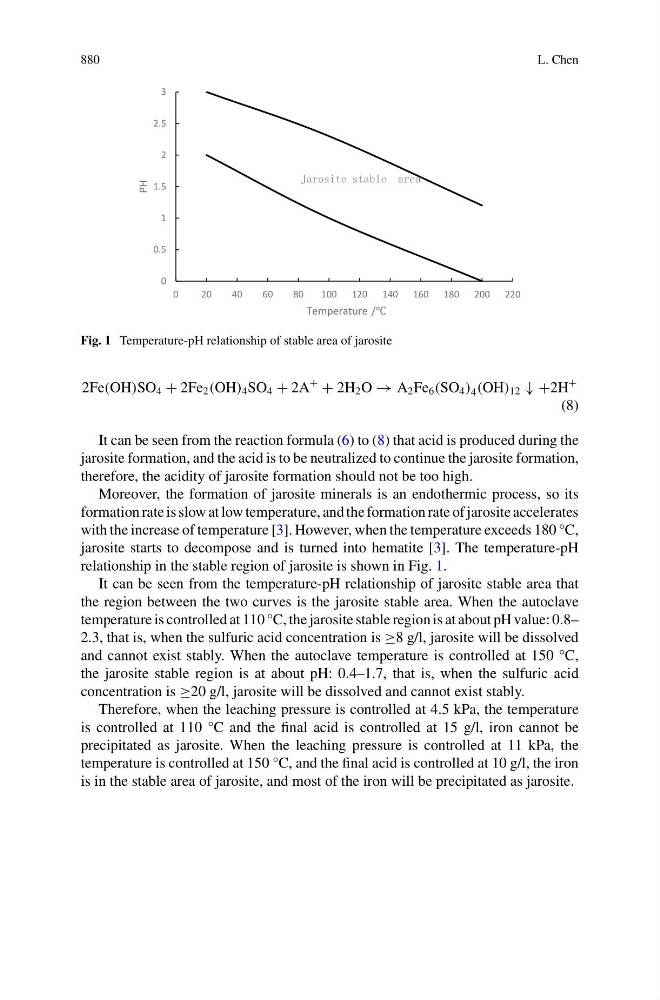
Fig. 1 Temperature-pH relationship of stable area of jarosite
2Fe(OH)SO 4 + 2Fe 2 (OH) 4 SO 4 + 2A
+
+ 2H 2 O → A 2 Fe 6 (SO 4 ) 4 (OH) 12 ↓ +2H
+
(8)
It can be seen from the reaction formula (6) to (8) that acid is produced during the
jarosite formation, and the acid is to be neutralized to continue the jarosite formation,
therefore, the acidity of jarosite formation should not be too high.
Moreover, the formation of jarosite minerals is an endothermic process, so its
formation rate is slow at low temperature, and the formation rate of jarosite accelerates
with the increase of temperature [3]. However, when the temperature exceeds 180 °C,
jarosite starts to decompose and is turned into hematite [3]. The temperature-pH
relationship in the stable region of jarosite is shown in Fig. 1.
It can be seen from the temperature-pH relationship of jarosite stable area that
the region between the two curves is the jarosite stable area. When the autoclave
temperature is controlled at 110 °C, the jarosite stable region is at about pH value: 0.8–
2.3, that is, when the sulfuric acid concentration is ≥8 g/l, jarosite will be dissolved
and cannot exist stably. When the autoclave temperature is controlled at 150 °C,
the jarosite stable region is at about pH: 0.4–1.7, that is, when the sulfuric acid
concentration is ≥20 g/l, jarosite will be dissolved and cannot exist stably.
Therefore, when the leaching pressure is controlled at 4.5 kPa, the temperature
is controlled at 110 °C and the final acid is controlled at 15 g/l, iron cannot be
precipitated as jarosite. When the leaching pressure is controlled at 11 kPa, the
temperature is controlled at 150 °C, and the final acid is controlled at 10 g/l, the iron
is in the stable area of jarosite, and most of the iron will be precipitated as jarosite.