

868
D. Matsuura et al.
Table 1 Components of the by-products
Components
Fe
Zn
Pb
SiO 2
Cu
As
%
%
%
%
%
%
Zinc leach residue
23.1
23.2
6.0
6.6
0.7
0.4
Pb/Ag residue
1.8
3.0
23.2
25.3
0.2
–
First neutralizing gypsum
–
0.2
–
–
–
–
Copper arsenide
–
0.5
–
–
63.2
27.3
Second neutralizing gypsum
–
–
–
–
1.0
–
Hematite
54.1
0.6
–
–
–
–
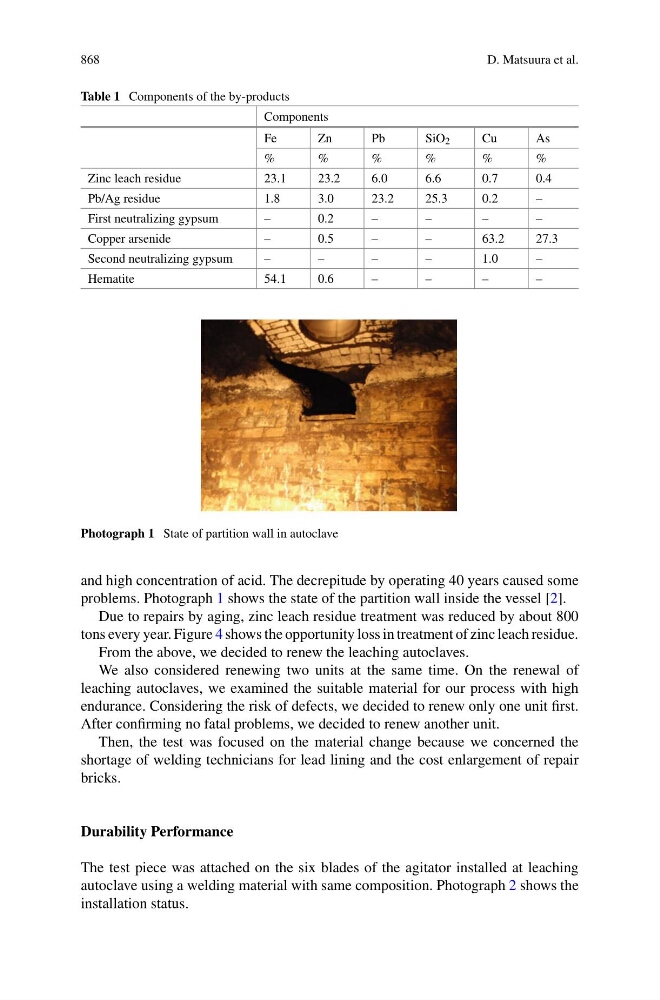
Photograph 1 State of partition wall in autoclave
and high concentration of acid. The decrepitude by operating 40 years caused some
problems. Photograph 1 shows the state of the partition wall inside the vessel [2].
Due to repairs by aging, zinc leach residue treatment was reduced by about 800
tons every year. Figure 4 shows the opportunity loss in treatment of zinc leach residue.
From the above, we decided to renew the leaching autoclaves.
We also considered renewing two units at the same time. On the renewal of
leaching autoclaves, we examined the suitable material for our process with high
endurance. Considering the risk of defects, we decided to renew only one unit first.
After confirming no fatal problems, we decided to renew another unit.
Then, the test was focused on the material change because we concerned the
shortage of welding technicians for lead lining and the cost enlargement of repair
bricks.
Durability Performance
The test piece was attached on the six blades of the agitator installed at leaching
autoclave using a welding material with same composition. Photograph 2 shows the
installation status.