

Experimental Study on Pressure Leaching of Zinc Sulfide …
861
close to the limit in the H 2 SO 4 /Zn ratio range, excessive acid is going to leach the
iron-containing mineral, resulting in the largely increased iron leaching rate. When
the H 2 SO 4 /Zn ratio continues to increase, the iron leaching rate tends to be the same.
Residue Phase Analysis
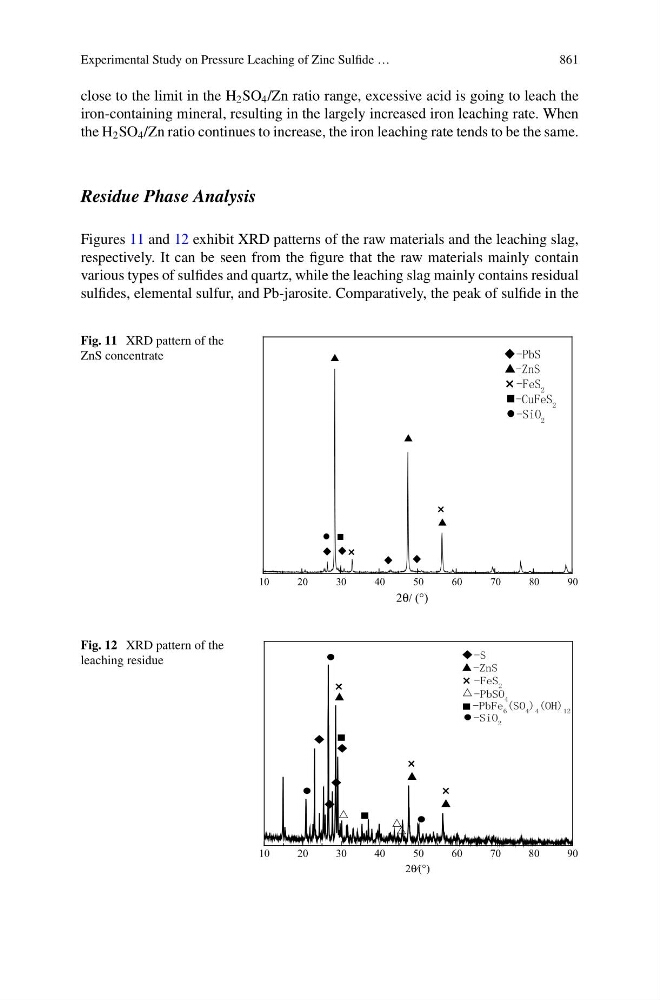
Figures 11 and 12 exhibit XRD patterns of the raw materials and the leaching slag,
respectively. It can be seen from the figure that the raw materials mainly contain
various types of sulfides and quartz, while the leaching slag mainly contains residual
sulfides, elemental sulfur, and Pb-jarosite. Comparatively, the peak of sulfide in the
Fig. 11 XRD pattern of the
ZnS concentrate
10
20
30
40
50
60
70
80
90
p
p
p
2θ/ (°)
p
Fig. 12 XRD pattern of the
leaching residue
10
20
30
40
50
60
70
80
90
r
r
r
p
p
p
2θ⁄(°)
p
r