

Experimental Study on Pressure Leaching of Zinc Sulfide …
859
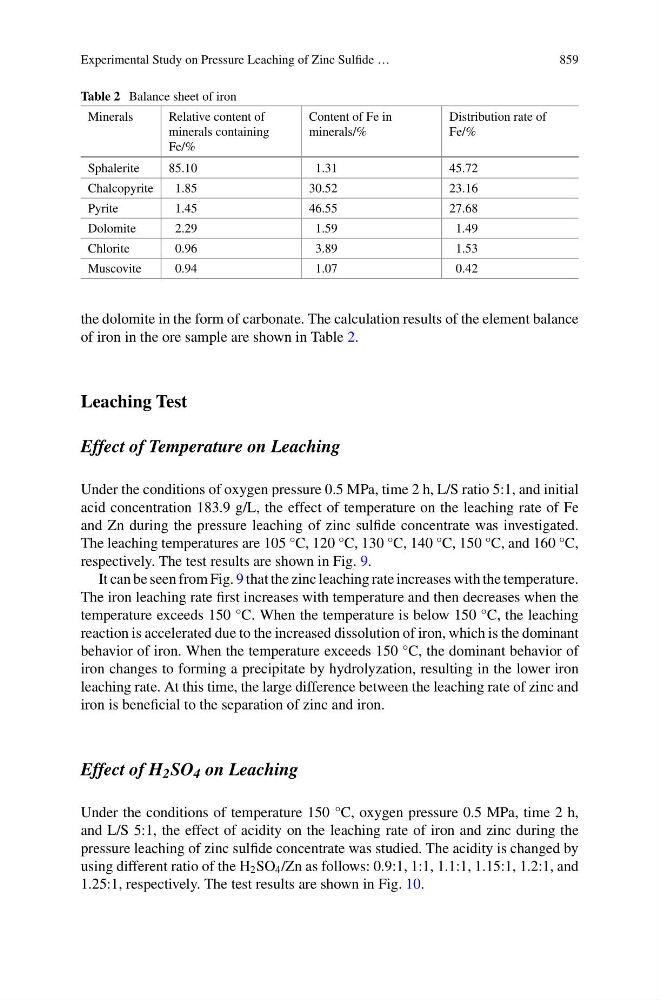
Table 2 Balance sheet of iron
Minerals
Relative content of
minerals containing
Fe/%
Content of Fe in
minerals/%
Distribution rate of
Fe/%
Sphalerite
85.10
1.31
45.72
Chalcopyrite
1.85
30.52
23.16
Pyrite
1.45
46.55
27.68
Dolomite
2.29
1.59
1.49
Chlorite
0.96
3.89
1.53
Muscovite
0.94
1.07
0.42
the dolomite in the form of carbonate. The calculation results of the element balance
of iron in the ore sample are shown in Table 2.
Leaching Test
Effect of Temperature on Leaching
Under the conditions of oxygen pressure 0.5 MPa, time 2 h, L/S ratio 5:1, and initial
acid concentration 183.9 g/L, the effect of temperature on the leaching rate of Fe
and Zn during the pressure leaching of zinc sulfide concentrate was investigated.
The leaching temperatures are 105 °C, 120 °C, 130 °C, 140 °C, 150 °C, and 160 °C,
respectively. The test results are shown in Fig. 9.
It can be seen from Fig. 9 that the zinc leaching rate increases with the temperature.
The iron leaching rate first increases with temperature and then decreases when the
temperature exceeds 150 °C. When the temperature is below 150 °C, the leaching
reaction is accelerated due to the increased dissolution of iron, which is the dominant
behavior of iron. When the temperature exceeds 150 °C, the dominant behavior of
iron changes to forming a precipitate by hydrolyzation, resulting in the lower iron
leaching rate. At this time, the large difference between the leaching rate of zinc and
iron is beneficial to the separation of zinc and iron.
Effect of H 2 SO 4 on Leaching
Under the conditions of temperature 150 °C, oxygen pressure 0.5 MPa, time 2 h,
and L/S 5:1, the effect of acidity on the leaching rate of iron and zinc during the
pressure leaching of zinc sulfide concentrate was studied. The acidity is changed by
using different ratio of the H 2 SO 4 /Zn as follows: 0.9:1, 1:1, 1.1:1, 1.15:1, 1.2:1, and
1.25:1, respectively. The test results are shown in Fig. 10.