

Study of a Novel Chloride Volatilization Process …
837
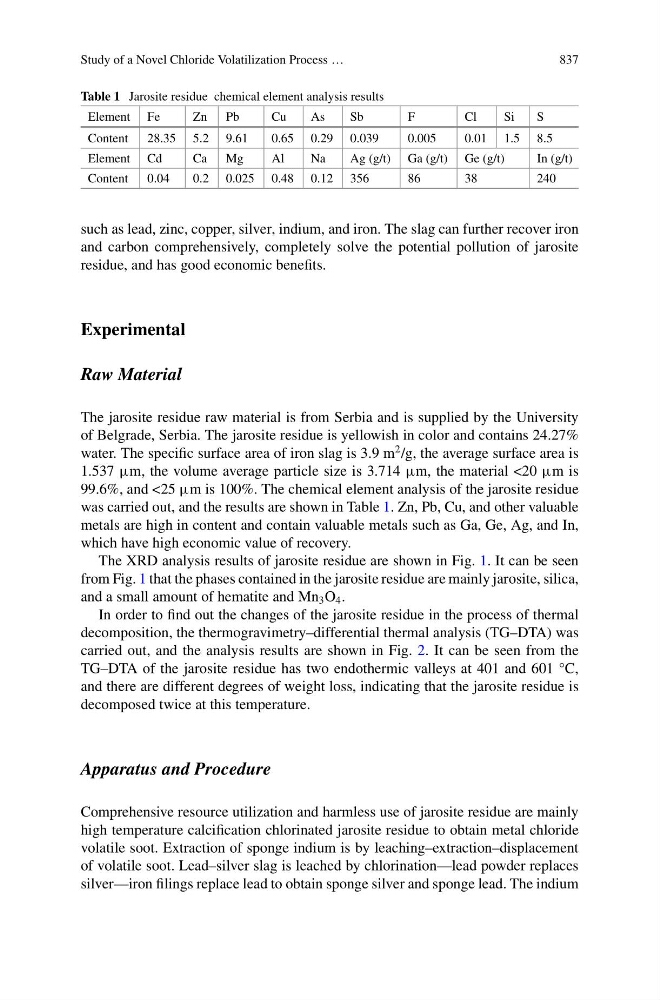
Table 1 Jarosite residue chemical element analysis results
Element Fe
Zn Pb
Cu
As
Sb
F
Cl
Si
S
Content
28.35 5.2 9.61
0.65 0.29 0.039
0.005
0.01 1.5 8.5
Element Cd
Ca Mg
Al
Na
Ag (g/t) Ga (g/t) Ge (g/t)
In (g/t)
Content
0.04
0.2 0.025 0.48 0.12 356
86
38
240
such as lead, zinc, copper, silver, indium, and iron. The slag can further recover iron
and carbon comprehensively, completely solve the potential pollution of jarosite
residue, and has good economic benefits.
Experimental
Raw Material
The jarosite residue raw material is from Serbia and is supplied by the University
of Belgrade, Serbia. The jarosite residue is yellowish in color and contains 24.27%
water. The specific surface area of iron slag is 3.9 m
2 /g, the average surface area is
1.537 µm, the volume average particle size is 3.714 µm, the material <20 µm is
99.6%, and <25 µm is 100%. The chemical element analysis of the jarosite residue
was carried out, and the results are shown in Table 1. Zn, Pb, Cu, and other valuable
metals are high in content and contain valuable metals such as Ga, Ge, Ag, and In,
which have high economic value of recovery.
The XRD analysis results of jarosite residue are shown in Fig. 1. It can be seen
from Fig. 1 that the phases contained in the jarosite residue are mainly jarosite, silica,
and a small amount of hematite and Mn 3 O 4 .
In order to find out the changes of the jarosite residue in the process of thermal
decomposition, the thermogravimetry–differential thermal analysis (TG–DTA) was
carried out, and the analysis results are shown in Fig. 2. It can be seen from the
TG–DTA of the jarosite residue has two endothermic valleys at 401 and 601 °C,
and there are different degrees of weight loss, indicating that the jarosite residue is
decomposed twice at this temperature.
Apparatus and Procedure
Comprehensive resource utilization and harmless use of jarosite residue are mainly
high temperature calcification chlorinated jarosite residue to obtain metal chloride
volatile soot. Extraction of sponge indium is by leaching–extraction–displacement
of volatile soot. Lead–silver slag is leached by chlorination—lead powder replaces
silver—iron filings replace lead to obtain sponge silver and sponge lead. The indium