

Phase Evolution During the Oxidation Process of Low …
59
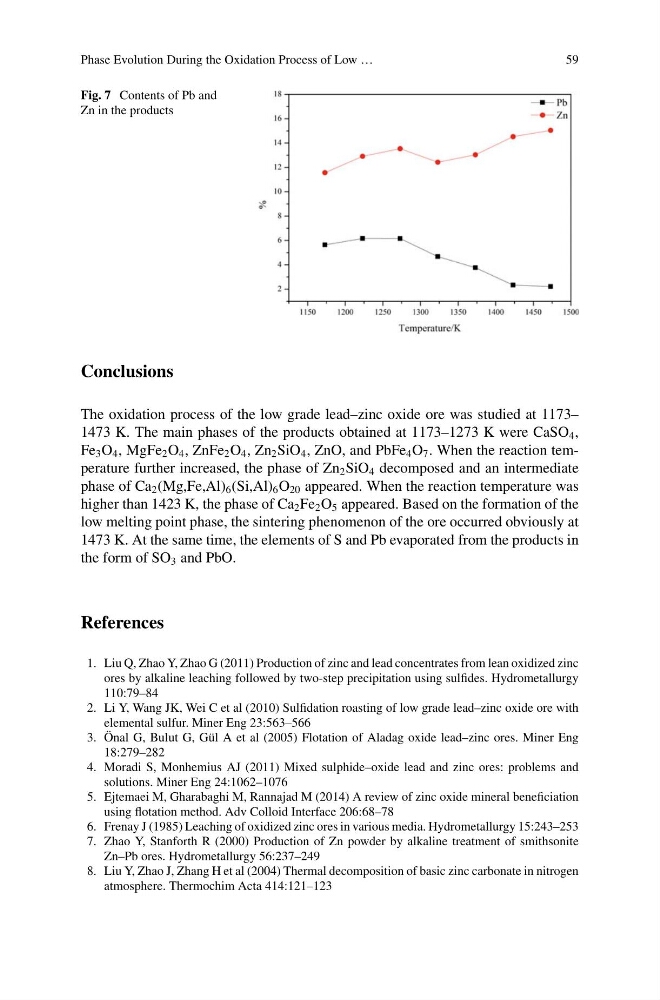
Fig. 7 Contents of Pb and
Zn in the products
Conclusions
The oxidation process of the low grade lead–zinc oxide ore was studied at 1173–
1473 K. The main phases of the products obtained at 1173–1273 K were CaSO 4 ,
Fe 3 O 4 , MgFe 2 O 4 , ZnFe 2 O 4 , Zn 2 SiO 4 , ZnO, and PbFe 4 O 7 . When the reaction temperature further increased, the phase of Zn 2 SiO 4 decomposed and an intermediate
phase of Ca 2 (Mg,Fe,Al) 6 (Si,Al) 6 O 20 appeared. When the reaction temperature was
higher than 1423 K, the phase of Ca 2 Fe 2 O 5 appeared. Based on the formation of the
low melting point phase, the sintering phenomenon of the ore occurred obviously at
1473 K. At the same time, the elements of S and Pb evaporated from the products in
the form of SO 3 and PbO.
References
1. Liu Q, Zhao Y, Zhao G (2011) Production of zinc and lead concentrates from lean oxidized zinc
ores by alkaline leaching followed by two-step precipitation using sulfides. Hydrometallurgy
110:79–84
2. Li Y, Wang JK, Wei C et al (2010) Sulfidation roasting of low grade lead–zinc oxide ore with
elemental sulfur. Miner Eng 23:563–566
3. Önal G, Bulut G, Gül A et al (2005) Flotation of Aladag oxide lead–zinc ores. Miner Eng
18:279–282
4. Moradi S, Monhemius AJ (2011) Mixed sulphide–oxide lead and zinc ores: problems and
solutions. Miner Eng 24:1062–1076
5. Ejtemaei M, Gharabaghi M, Rannajad M (2014) A review of zinc oxide mineral beneficiation
using flotation method. Adv Colloid Interface 206:68–78
6. Frenay J (1985) Leaching of oxidized zinc ores in various media. Hydrometallurgy 15:243–253
7. Zhao Y, Stanforth R (2000) Production of Zn powder by alkaline treatment of smithsonite
Zn–Pb ores. Hydrometallurgy 56:237–249
8. Liu Y, Zhao J, Zhang H et al (2004) Thermal decomposition of basic zinc carbonate in nitrogen
atmosphere. Thermochim Acta 414:121–123
59
Fig. 7 Contents of Pb and
Zn in the products
Conclusions
The oxidation process of the low grade lead–zinc oxide ore was studied at 1173–
1473 K. The main phases of the products obtained at 1173–1273 K were CaSO 4 ,
Fe 3 O 4 , MgFe 2 O 4 , ZnFe 2 O 4 , Zn 2 SiO 4 , ZnO, and PbFe 4 O 7 . When the reaction temperature further increased, the phase of Zn 2 SiO 4 decomposed and an intermediate
phase of Ca 2 (Mg,Fe,Al) 6 (Si,Al) 6 O 20 appeared. When the reaction temperature was
higher than 1423 K, the phase of Ca 2 Fe 2 O 5 appeared. Based on the formation of the
low melting point phase, the sintering phenomenon of the ore occurred obviously at
1473 K. At the same time, the elements of S and Pb evaporated from the products in
the form of SO 3 and PbO.
References
1. Liu Q, Zhao Y, Zhao G (2011) Production of zinc and lead concentrates from lean oxidized zinc
ores by alkaline leaching followed by two-step precipitation using sulfides. Hydrometallurgy
110:79–84
2. Li Y, Wang JK, Wei C et al (2010) Sulfidation roasting of low grade lead–zinc oxide ore with
elemental sulfur. Miner Eng 23:563–566
3. Önal G, Bulut G, Gül A et al (2005) Flotation of Aladag oxide lead–zinc ores. Miner Eng
18:279–282
4. Moradi S, Monhemius AJ (2011) Mixed sulphide–oxide lead and zinc ores: problems and
solutions. Miner Eng 24:1062–1076
5. Ejtemaei M, Gharabaghi M, Rannajad M (2014) A review of zinc oxide mineral beneficiation
using flotation method. Adv Colloid Interface 206:68–78
6. Frenay J (1985) Leaching of oxidized zinc ores in various media. Hydrometallurgy 15:243–253
7. Zhao Y, Stanforth R (2000) Production of Zn powder by alkaline treatment of smithsonite
Zn–Pb ores. Hydrometallurgy 56:237–249
8. Liu Y, Zhao J, Zhang H et al (2004) Thermal decomposition of basic zinc carbonate in nitrogen
atmosphere. Thermochim Acta 414:121–123