

822
S. Alam et al.
Experimental
Leaching of Zinc
Leaching tests were carried out batch wise in a 4 L stainless steel container at 90 °C,
where a 500 g galvanized steel scrap was added to 1 L of 200 g/L sodium hydroxide
solution. Peroxide was used as an oxidizing agent. After 30 min of agitation, scrap
was removed and a fresh 500 g scrap was added to this leach liquor and leaching
was continued. At every stage, sample was collected for analysis. Percentage of zinc
recovered in leach was found to be 92.45%, and the zinc was leached as sodium
zincate, Zn(ONa) 2 in the PLS.
Solvent Extraction (SX) of Zinc
A series of SX tests were carried out to recover zinc from PLS using different kinds
of organic extractants containing oxine derivatives (e.g. Kelex 100, LIX-26). Initially
Kelex 100 was tested for zinc recovery from alkaline media. Scoping tests showed
that Kelex 100 extracts zinc from caustic solution; however, since the production of
Kelex 100 was stopped, a similar kind of extractant named LIX-26 has been used.
Extraction test was carried out at 40 °C using different concentrated extractants at
different organic/aqueous (O/A) ratio. In all cases, 5 vol% EXXAL 13 alcohol was
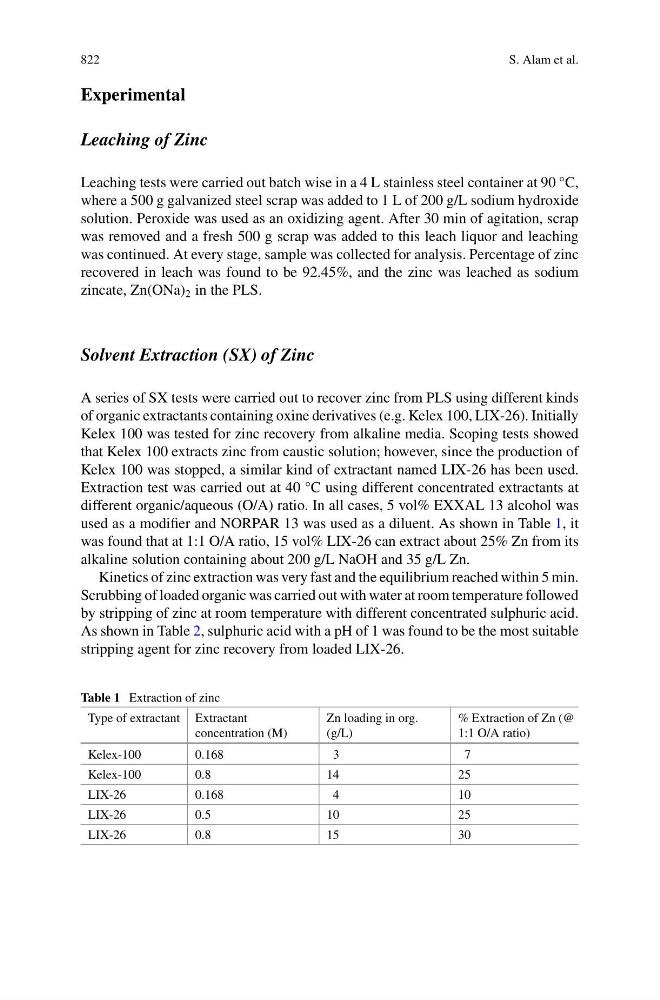
used as a modifier and NORPAR 13 was used as a diluent. As shown in Table 1, it
was found that at 1:1 O/A ratio, 15 vol% LIX-26 can extract about 25% Zn from its
alkaline solution containing about 200 g/L NaOH and 35 g/L Zn.
Kinetics of zinc extraction was very fast and the equilibrium reached within 5 min.
Scrubbing of loaded organic was carried out with water at room temperature followed
by stripping of zinc at room temperature with different concentrated sulphuric acid.
As shown in Table 2, sulphuric acid with a pH of 1 was found to be the most suitable
stripping agent for zinc recovery from loaded LIX-26.
Table 1 Extraction of zinc
Type of extractant Extractant
concentration (M)
Zn loading in org.
(g/L)
% Extraction of Zn (@
1:1 O/A ratio)
Kelex-100
0.168
3
7
Kelex-100
0.8
14
25
LIX-26
0.168
4
10
LIX-26
0.5
10
25
LIX-26
0.8
15
30