

Zinc Reduction/Vaporisation Behaviour from Metallurgical Wastes
815
Results and Discussion
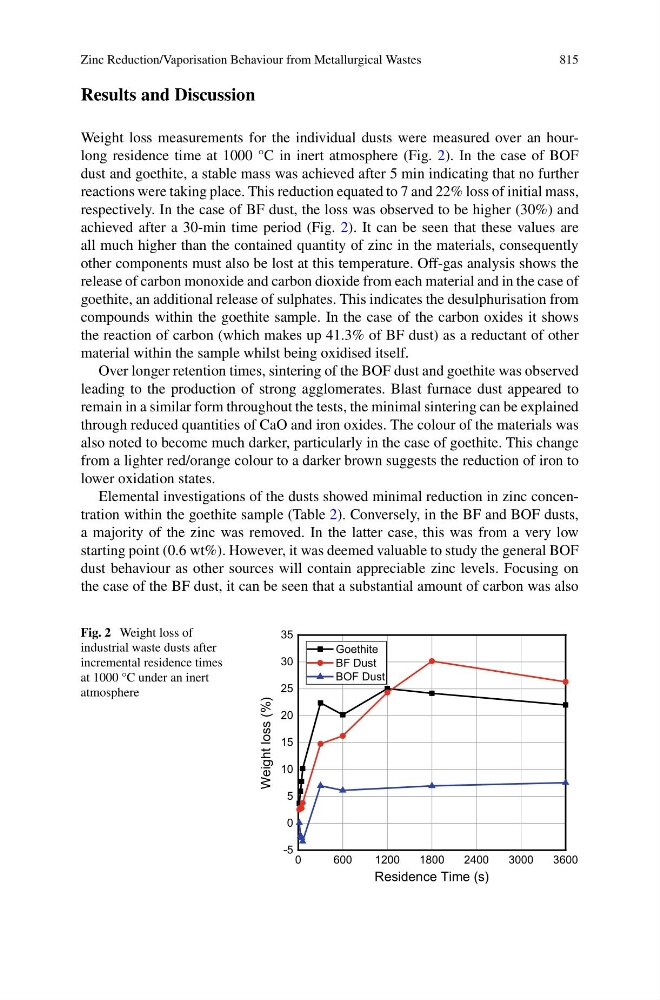
Weight loss measurements for the individual dusts were measured over an hourlong residence time at 1000 °C in inert atmosphere (Fig. 2). In the case of BOF
dust and goethite, a stable mass was achieved after 5 min indicating that no further
reactions were taking place. This reduction equated to 7 and 22% loss of initial mass,
respectively. In the case of BF dust, the loss was observed to be higher (30%) and
achieved after a 30-min time period (Fig. 2). It can be seen that these values are
all much higher than the contained quantity of zinc in the materials, consequently
other components must also be lost at this temperature. Off-gas analysis shows the
release of carbon monoxide and carbon dioxide from each material and in the case of
goethite, an additional release of sulphates. This indicates the desulphurisation from
compounds within the goethite sample. In the case of the carbon oxides it shows
the reaction of carbon (which makes up 41.3% of BF dust) as a reductant of other
material within the sample whilst being oxidised itself.
Over longer retention times, sintering of the BOF dust and goethite was observed
leading to the production of strong agglomerates. Blast furnace dust appeared to
remain in a similar form throughout the tests, the minimal sintering can be explained
through reduced quantities of CaO and iron oxides. The colour of the materials was
also noted to become much darker, particularly in the case of goethite. This change
from a lighter red/orange colour to a darker brown suggests the reduction of iron to
lower oxidation states.
Elemental investigations of the dusts showed minimal reduction in zinc concentration within the goethite sample (Table 2). Conversely, in the BF and BOF dusts,
a majority of the zinc was removed. In the latter case, this was from a very low
starting point (0.6 wt%). However, it was deemed valuable to study the general BOF
dust behaviour as other sources will contain appreciable zinc levels. Focusing on
the case of the BF dust, it can be seen that a substantial amount of carbon was also
Fig. 2 Weight loss of
industrial waste dusts after
incremental residence times
at 1000 °C under an inert
atmosphere
0
600
1200
1800
2400
3000
3600
-5
0
5
10
15
20
25
30
35
Weight loss (%)
Residence Time (s)
Goethite
BF Dust
BOF Dust