

Zinc Reduction/Vaporisation Behaviour from Metallurgical Wastes
813
reduction behaviour can be investigated. Consequently, the behaviour of individual
dusts and also proposed mixtures have been studied to optimise the delivery of the
zinc-containing material to the furnace cyclone.
Experimental
Blast furnace dust and basic oxygen furnace dust were received from Tata Steel
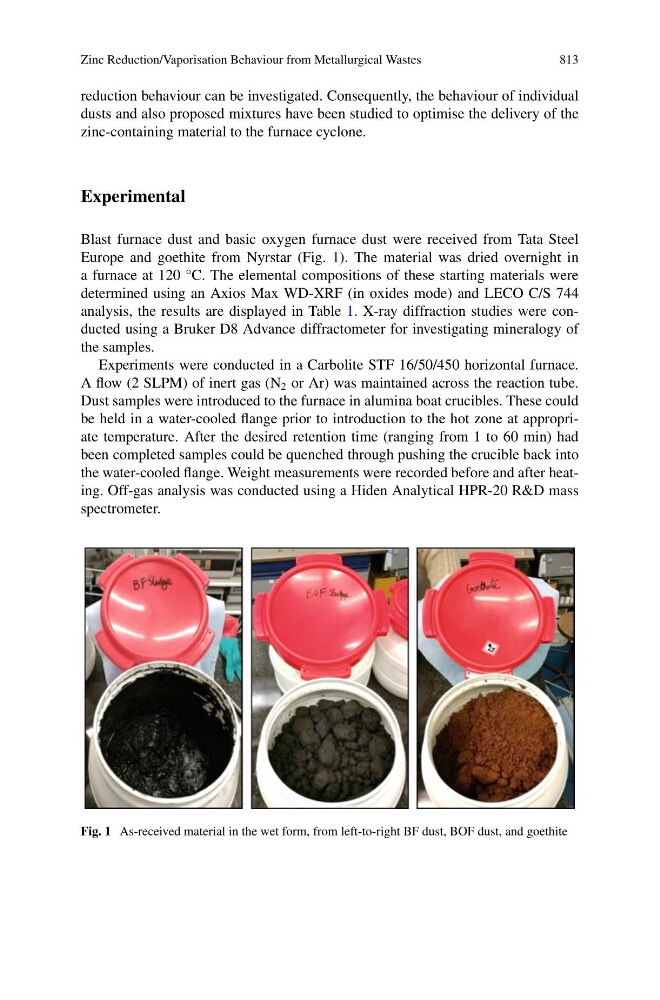
Europe and goethite from Nyrstar (Fig. 1). The material was dried overnight in
a furnace at 120 °C. The elemental compositions of these starting materials were
determined using an Axios Max WD-XRF (in oxides mode) and LECO C/S 744
analysis, the results are displayed in Table 1. X-ray diffraction studies were conducted using a Bruker D8 Advance diffractometer for investigating mineralogy of
the samples.
Experiments were conducted in a Carbolite STF 16/50/450 horizontal furnace.
A flow (2 SLPM) of inert gas (N 2 or Ar) was maintained across the reaction tube.
Dust samples were introduced to the furnace in alumina boat crucibles. These could
be held in a water-cooled flange prior to introduction to the hot zone at appropriate temperature. After the desired retention time (ranging from 1 to 60 min) had
been completed samples could be quenched through pushing the crucible back into
the water-cooled flange. Weight measurements were recorded before and after heating. Off-gas analysis was conducted using a Hiden Analytical HPR-20 R&D mass
spectrometer.
Fig. 1 As-received material in the wet form, from left-to-right BF dust, BOF dust, and goethite