

Phase Evolution During the Oxidation Process of Low …
53
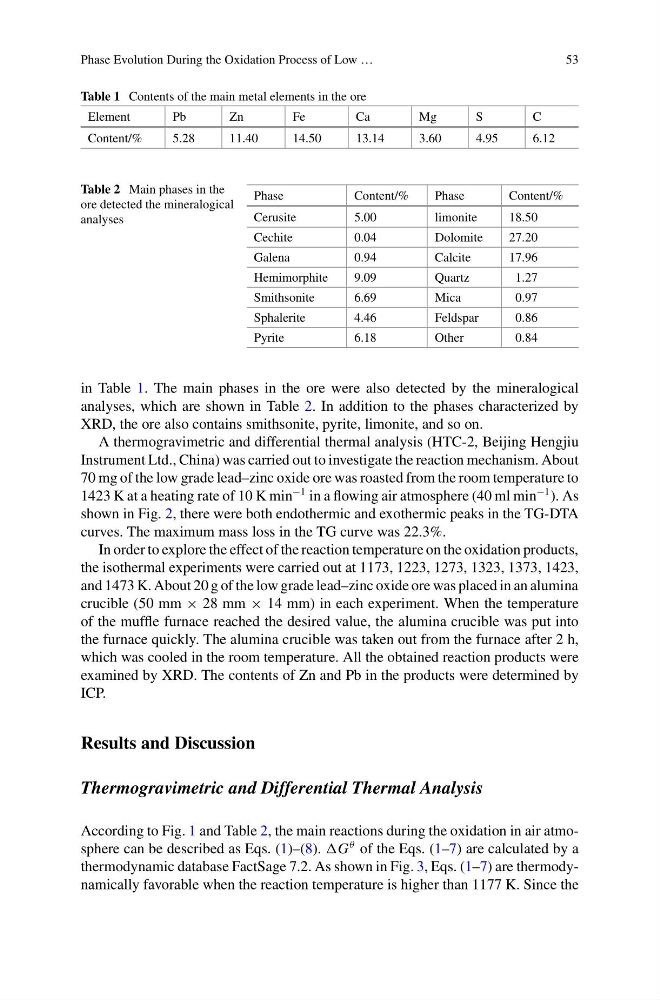
Table 1 Contents of the main metal elements in the ore
Element
Pb
Zn
Fe
Ca
Mg
S
C
Content/%
5.28
11.40
14.50
13.14
3.60
4.95
6.12
Table 2 Main phases in the
ore detected the mineralogical
analyses
Phase
Content/%
Phase
Content/%
Cerusite
5.00
limonite
18.50
Cechite
0.04
Dolomite
27.20
Galena
0.94
Calcite
17.96
Hemimorphite
9.09
Quartz
1.27
Smithsonite
6.69
Mica
0.97
Sphalerite
4.46
Feldspar
0.86
Pyrite
6.18
Other
0.84
in Table 1. The main phases in the ore were also detected by the mineralogical
analyses, which are shown in Table 2. In addition to the phases characterized by
XRD, the ore also contains smithsonite, pyrite, limonite, and so on.
A thermogravimetric and differential thermal analysis (HTC-2, Beijing Hengjiu
Instrument Ltd., China) was carried out to investigate the reaction mechanism. About
70 mg of the low grade lead–zinc oxide ore was roasted from the room temperature to
1423 K at a heating rate of 10 K min
−1 in a flowing air atmosphere (40 ml min
−1 ). As
shown in Fig. 2, there were both endothermic and exothermic peaks in the TG-DTA
curves. The maximum mass loss in the TG curve was 22.3%.
In order to explore the effect of the reaction temperature on the oxidation products,
the isothermal experiments were carried out at 1173, 1223, 1273, 1323, 1373, 1423,
and 1473 K. About 20 g of the low grade lead–zinc oxide ore was placed in an alumina
crucible (50 mm × 28 mm × 14 mm) in each experiment. When the temperature
of the muffle furnace reached the desired value, the alumina crucible was put into
the furnace quickly. The alumina crucible was taken out from the furnace after 2 h,
which was cooled in the room temperature. All the obtained reaction products were
examined by XRD. The contents of Zn and Pb in the products were determined by
ICP.
Results and Discussion
Thermogravimetric and Differential Thermal Analysis
According to Fig. 1 and Table 2, the main reactions during the oxidation in air atmosphere can be described as Eqs. (1)–(8). G
θ of the Eqs. (1–7) are calculated by a
thermodynamic database FactSage 7.2. As shown in Fig. 3, Eqs. (1–7) are thermodynamically favorable when the reaction temperature is higher than 1177 K. Since the
53
Table 1 Contents of the main metal elements in the ore
Element
Pb
Zn
Fe
Ca
Mg
S
C
Content/%
5.28
11.40
14.50
13.14
3.60
4.95
6.12
Table 2 Main phases in the
ore detected the mineralogical
analyses
Phase
Content/%
Phase
Content/%
Cerusite
5.00
limonite
18.50
Cechite
0.04
Dolomite
27.20
Galena
0.94
Calcite
17.96
Hemimorphite
9.09
Quartz
1.27
Smithsonite
6.69
Mica
0.97
Sphalerite
4.46
Feldspar
0.86
Pyrite
6.18
Other
0.84
in Table 1. The main phases in the ore were also detected by the mineralogical
analyses, which are shown in Table 2. In addition to the phases characterized by
XRD, the ore also contains smithsonite, pyrite, limonite, and so on.
A thermogravimetric and differential thermal analysis (HTC-2, Beijing Hengjiu
Instrument Ltd., China) was carried out to investigate the reaction mechanism. About
70 mg of the low grade lead–zinc oxide ore was roasted from the room temperature to
1423 K at a heating rate of 10 K min
−1 in a flowing air atmosphere (40 ml min
−1 ). As
shown in Fig. 2, there were both endothermic and exothermic peaks in the TG-DTA
curves. The maximum mass loss in the TG curve was 22.3%.
In order to explore the effect of the reaction temperature on the oxidation products,
the isothermal experiments were carried out at 1173, 1223, 1273, 1323, 1373, 1423,
and 1473 K. About 20 g of the low grade lead–zinc oxide ore was placed in an alumina
crucible (50 mm × 28 mm × 14 mm) in each experiment. When the temperature
of the muffle furnace reached the desired value, the alumina crucible was put into
the furnace quickly. The alumina crucible was taken out from the furnace after 2 h,
which was cooled in the room temperature. All the obtained reaction products were
examined by XRD. The contents of Zn and Pb in the products were determined by
ICP.
Results and Discussion
Thermogravimetric and Differential Thermal Analysis
According to Fig. 1 and Table 2, the main reactions during the oxidation in air atmosphere can be described as Eqs. (1)–(8). G
θ of the Eqs. (1–7) are calculated by a
thermodynamic database FactSage 7.2. As shown in Fig. 3, Eqs. (1–7) are thermodynamically favorable when the reaction temperature is higher than 1177 K. Since the