

Tin Treatment in Kosaka Lead Smelting
761
Increase of Sn Input
In recent years, tin input to lead smelting section has been increased.
For copper smelting section, the main smelter was changed from flush smelting
furnace to TSL furnace on 2008, focusing on recycled materials. The dust from
copper smelting section became containing more tin because of raw material shift
from ores to E-scraps. And the characteristics of Kosaka’s TSL furnace also led to
tin increase: both oxidation and reduction processes are continuously conducted at
one furnace.
In addition, zinc concentrate also contains more tin as impurities because of tight
zinc concentrate market.
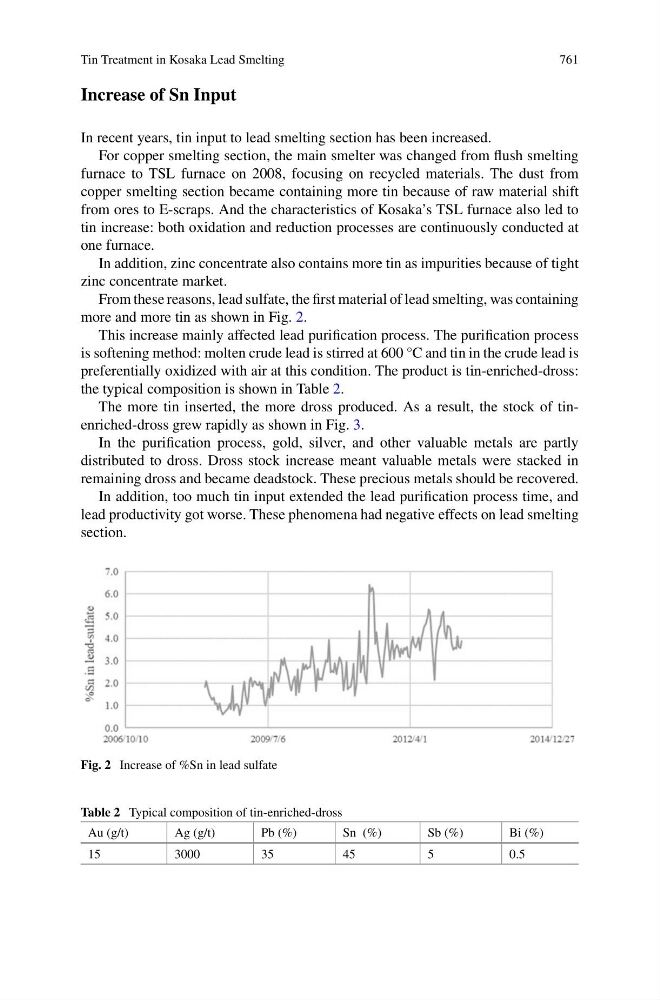
From these reasons, lead sulfate, the first material of lead smelting, was containing
more and more tin as shown in Fig. 2.
This increase mainly affected lead purification process. The purification process
is softening method: molten crude lead is stirred at 600 °C and tin in the crude lead is
preferentially oxidized with air at this condition. The product is tin-enriched-dross:
the typical composition is shown in Table 2.
The more tin inserted, the more dross produced. As a result, the stock of tinenriched-dross grew rapidly as shown in Fig. 3.
In the purification process, gold, silver, and other valuable metals are partly
distributed to dross. Dross stock increase meant valuable metals were stacked in
remaining dross and became deadstock. These precious metals should be recovered.
In addition, too much tin input extended the lead purification process time, and
lead productivity got worse. These phenomena had negative effects on lead smelting
section.
Fig. 2 Increase of %Sn in lead sulfate
Table 2 Typical composition of tin-enriched-dross
Au (g/t)
Ag (g/t)
Pb (%)
Sn (%)
Sb (%)
Bi (%)
15
3000
35
45
5
0.5