

756
C. Zschiesche and I. Bauer
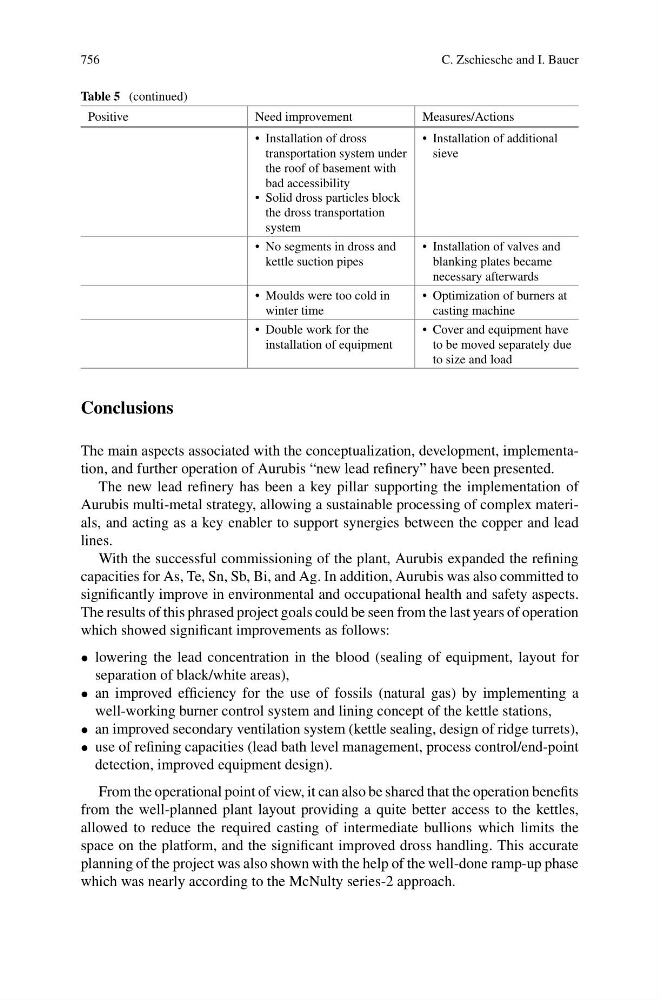
Table 5 (continued)
Positive
Need improvement
Measures/Actions
• Installation of dross
transportation system under
the roof of basement with
bad accessibility
• Solid dross particles block
the dross transportation
system
• Installation of additional
sieve
• No segments in dross and
kettle suction pipes
• Installation of valves and
blanking plates became
necessary afterwards
• Moulds were too cold in
winter time
• Optimization of burners at
casting machine
• Double work for the
installation of equipment
• Cover and equipment have
to be moved separately due
to size and load
Conclusions
The main aspects associated with the conceptualization, development, implementation, and further operation of Aurubis “new lead refinery” have been presented.
The new lead refinery has been a key pillar supporting the implementation of
Aurubis multi-metal strategy, allowing a sustainable processing of complex materials, and acting as a key enabler to support synergies between the copper and lead
lines.
With the successful commissioning of the plant, Aurubis expanded the refining
capacities for As, Te, Sn, Sb, Bi, and Ag. In addition, Aurubis was also committed to
significantly improve in environmental and occupational health and safety aspects.
The results of this phrased project goals could be seen from the last years of operation
which showed significant improvements as follows:
• lowering the lead concentration in the blood (sealing of equipment, layout for
separation of black/white areas),
• an improved efficiency for the use of fossils (natural gas) by implementing a
well-working burner control system and lining concept of the kettle stations,
• an improved secondary ventilation system (kettle sealing, design of ridge turrets),
• use of refining capacities (lead bath level management, process control/end-point
detection, improved equipment design).
From the operational point of view, it can also be shared that the operation benefits
from the well-planned plant layout providing a quite better access to the kettles,
allowed to reduce the required casting of intermediate bullions which limits the
space on the platform, and the significant improved dross handling. This accurate
planning of the project was also shown with the help of the well-done ramp-up phase
which was nearly according to the McNulty series-2 approach.