

748
C. Zschiesche and I. Bauer
above this, a quite large layer of this special concrete mix was added. To address
the daily work with heavy equipment, the mechanical resistance was realized by
implementing steel needles for a proper reinforcement.
Process Control Improvements
A fundamental knowledge for end-point control for the subsequent refining procedures is from the importance to improve the overall efficiency of the lead refinery.
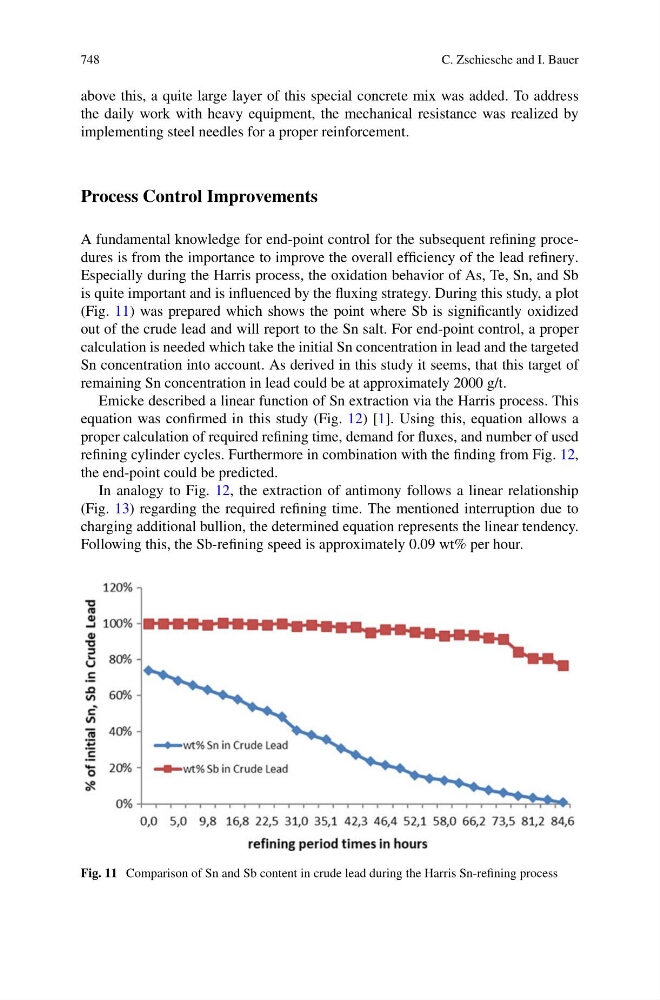
Especially during the Harris process, the oxidation behavior of As, Te, Sn, and Sb
is quite important and is influenced by the fluxing strategy. During this study, a plot
(Fig. 11) was prepared which shows the point where Sb is significantly oxidized
out of the crude lead and will report to the Sn salt. For end-point control, a proper
calculation is needed which take the initial Sn concentration in lead and the targeted
Sn concentration into account. As derived in this study it seems, that this target of
remaining Sn concentration in lead could be at approximately 2000 g/t.
Emicke described a linear function of Sn extraction via the Harris process. This
equation was confirmed in this study (Fig. 12) [1]. Using this, equation allows a
proper calculation of required refining time, demand for fluxes, and number of used
refining cylinder cycles. Furthermore in combination with the finding from Fig. 12,
the end-point could be predicted.
In analogy to Fig. 12, the extraction of antimony follows a linear relationship
(Fig. 13) regarding the required refining time. The mentioned interruption due to
charging additional bullion, the determined equation represents the linear tendency.
Following this, the Sb-refining speed is approximately 0.09 wt% per hour.
Fig. 11 Comparison of Sn and Sb content in crude lead during the Harris Sn-refining process