

New Technology for Copper Removal from Lead by …
735
The chemical analysis of the Al–Cu drosses performed during the microscopic
analysis shows a large increase in the sulfur content. For the analysed Al–Cu drosses,
sulfur content was approx. 4% and was two times higher than for Al–Cu drosses
obtained in the previous years, which was not higher than 2% sulfur.
Such high sulfur content in Al–Cu drosses may initiate thermite reaction—reduction of metal oxides with aluminum. Sulfur, magnesium, and saltpeters, i.e. NaNO 3 ,
are also used as catalyst. Therefore, it is desirable to reduce the sulfur content in
Al–Cu drosses.
The tests of drying of Al–Cu drosses with different drying agents have been
performed in order to eliminate the flammable materials, i.e. battery spacers and
sawdust. The main suitability criterion during the selection of the drying material for
the drying process was to obtain loose Al–Cu drosses which will not ignite inside
the furnace. The following materials have been analyzed:
• milled limestone CaCO 3 ,
• slaked lime—Ca(OH) 2 ,
• quicklime—CaO,
• sodium carbonate Na 2 CO 3 .
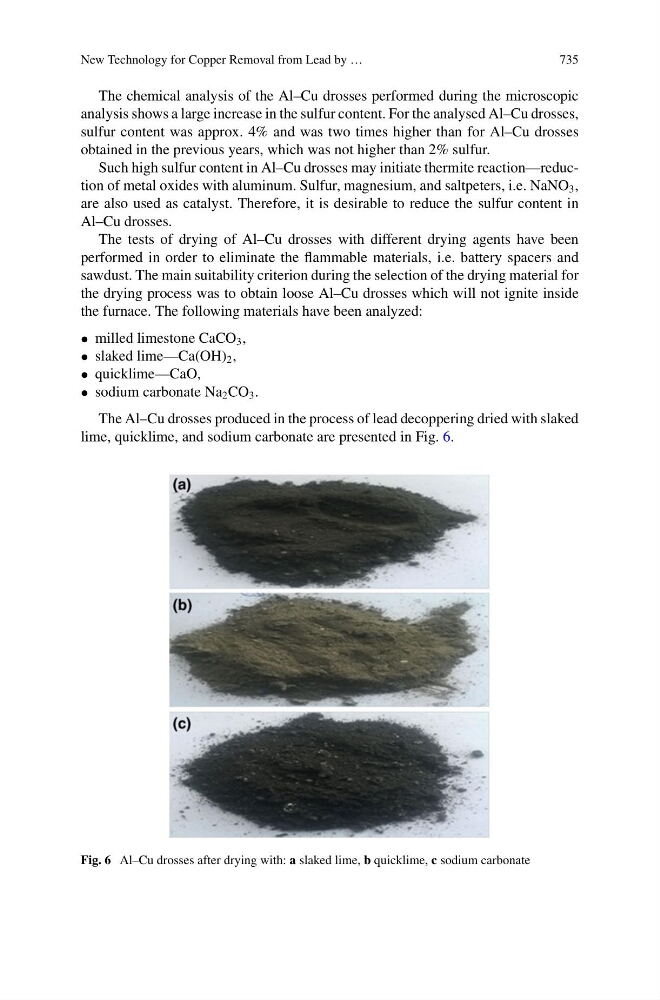
The Al–Cu drosses produced in the process of lead decoppering dried with slaked
lime, quicklime, and sodium carbonate are presented in Fig. 6.
Fig. 6 Al–Cu drosses after drying with: a slaked lime, b quicklime, c sodium carbonate