

Slag Reduction Kinetics of a Lead Slag …
49
0
2
4
6
8
10
0
200
400
600
800
1000
1200
1400
0
2
4
6
8
Off Gas Composition (vol%)
Temperature (°C)
Time (h)
Temperature
CO vol%
CO₂ vol%
-30
-25
-20
-15
-10
-5
0
0
200
400
600
800
1000
1200
1400
0
2
4
6
8
Off Gas Composition (vol%)
Temperature (°C)
Time (h)
Temperature
CO/CO₂ Reaction Couple
Fe/FeO Reaction Couple
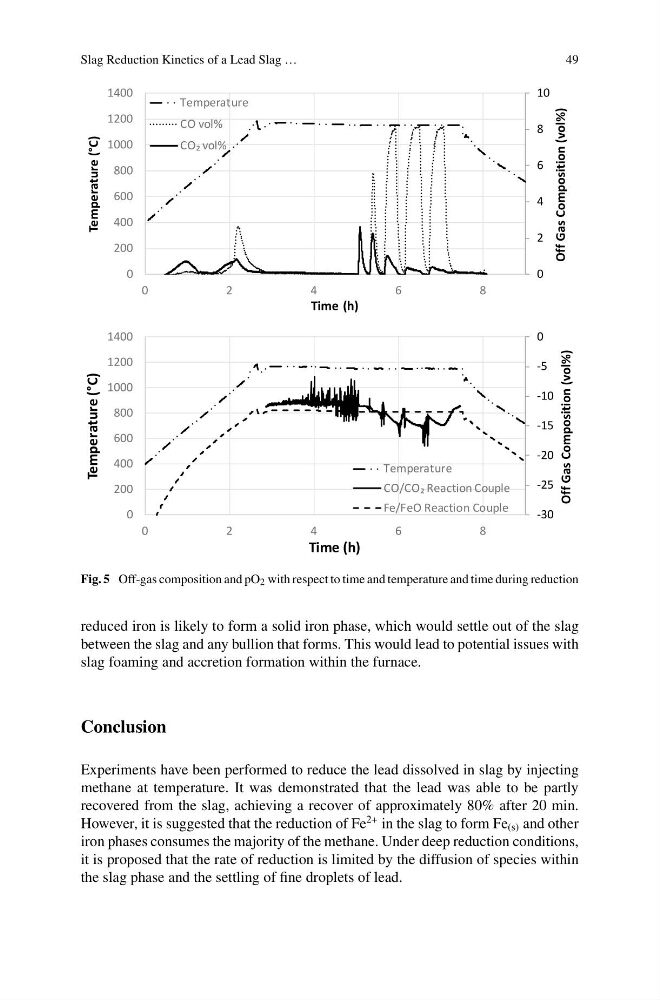
Fig. 5 Off-gas composition and pO 2 with respect to time and temperature and time during reduction
reduced iron is likely to form a solid iron phase, which would settle out of the slag
between the slag and any bullion that forms. This would lead to potential issues with
slag foaming and accretion formation within the furnace.
Conclusion
Experiments have been performed to reduce the lead dissolved in slag by injecting
methane at temperature. It was demonstrated that the lead was able to be partly
recovered from the slag, achieving a recover of approximately 80% after 20 min.
However, it is suggested that the reduction of Fe
2+ in the slag to form Fe (s) and other
iron phases consumes the majority of the methane. Under deep reduction conditions,
it is proposed that the rate of reduction is limited by the diffusion of species within
the slag phase and the settling of fine droplets of lead.
49
0
2
4
6
8
10
0
200
400
600
800
1000
1200
1400
0
2
4
6
8
Off Gas Composition (vol%)
Temperature (°C)
Time (h)
Temperature
CO vol%
CO₂ vol%
-30
-25
-20
-15
-10
-5
0
0
200
400
600
800
1000
1200
1400
0
2
4
6
8
Off Gas Composition (vol%)
Temperature (°C)
Time (h)
Temperature
CO/CO₂ Reaction Couple
Fe/FeO Reaction Couple
Fig. 5 Off-gas composition and pO 2 with respect to time and temperature and time during reduction
reduced iron is likely to form a solid iron phase, which would settle out of the slag
between the slag and any bullion that forms. This would lead to potential issues with
slag foaming and accretion formation within the furnace.
Conclusion
Experiments have been performed to reduce the lead dissolved in slag by injecting
methane at temperature. It was demonstrated that the lead was able to be partly
recovered from the slag, achieving a recover of approximately 80% after 20 min.
However, it is suggested that the reduction of Fe
2+ in the slag to form Fe (s) and other
iron phases consumes the majority of the methane. Under deep reduction conditions,
it is proposed that the rate of reduction is limited by the diffusion of species within
the slag phase and the settling of fine droplets of lead.