

Review of Waste Water Treatment Technologies …
697
Iron Co-precipitation
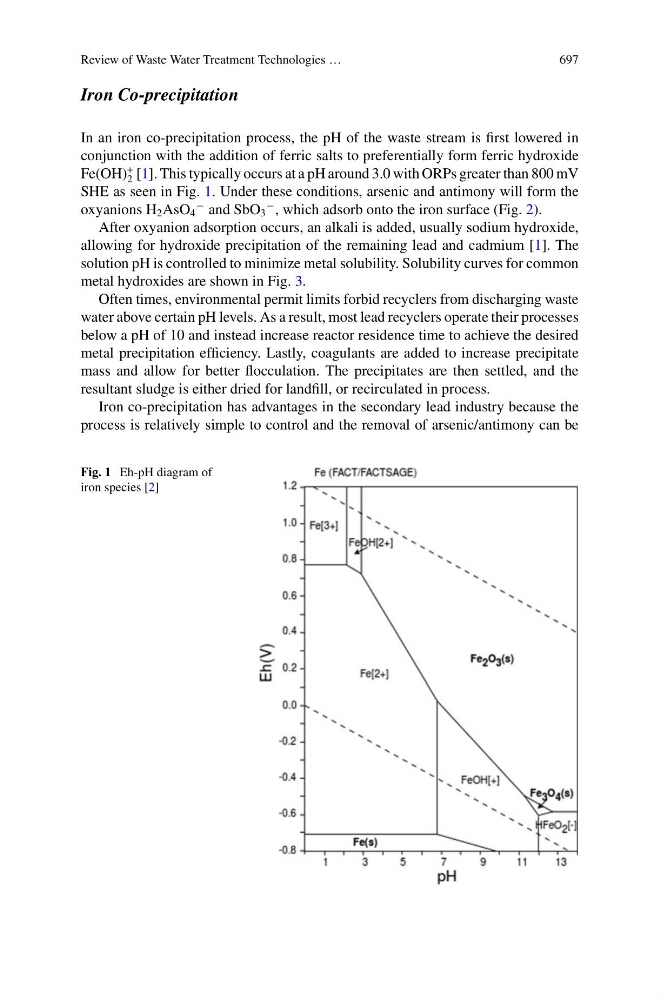
In an iron co-precipitation process, the pH of the waste stream is first lowered in
conjunction with the addition of ferric salts to preferentially form ferric hydroxide
Fe(OH)
+
2 [1]. This typically occurs at a pH around 3.0 with ORPs greater than 800 mV
SHE as seen in Fig. 1. Under these conditions, arsenic and antimony will form the
oxyanions H 2 AsO 4
− and SbO 3
− , which adsorb onto the iron surface (Fig. 2).
After oxyanion adsorption occurs, an alkali is added, usually sodium hydroxide,
allowing for hydroxide precipitation of the remaining lead and cadmium [1]. The
solution pH is controlled to minimize metal solubility. Solubility curves for common
metal hydroxides are shown in Fig. 3.
Often times, environmental permit limits forbid recyclers from discharging waste
water above certain pH levels. As a result, most lead recyclers operate their processes
below a pH of 10 and instead increase reactor residence time to achieve the desired
metal precipitation efficiency. Lastly, coagulants are added to increase precipitate
mass and allow for better flocculation. The precipitates are then settled, and the
resultant sludge is either dried for landfill, or recirculated in process.
Iron co-precipitation has advantages in the secondary lead industry because the
process is relatively simple to control and the removal of arsenic/antimony can be
Fig. 1 Eh-pH diagram of
iron species [2]