

Slag Reduction Kinetics of a Lead Slag …
47
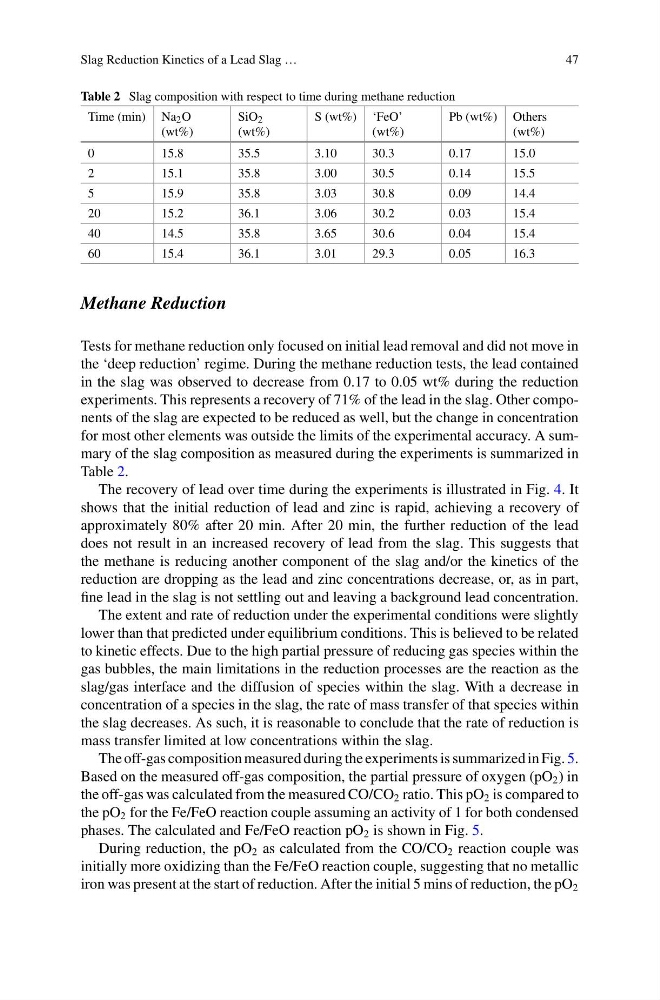
Table 2 Slag composition with respect to time during methane reduction
Time (min) Na 2 O
(wt%)
SiO 2
(wt%)
S (wt%) ‘FeO’
(wt%)
Pb (wt%) Others
(wt%)
0
15.8
35.5
3.10
30.3
0.17
15.0
2
15.1
35.8
3.00
30.5
0.14
15.5
5
15.9
35.8
3.03
30.8
0.09
14.4
20
15.2
36.1
3.06
30.2
0.03
15.4
40
14.5
35.8
3.65
30.6
0.04
15.4
60
15.4
36.1
3.01
29.3
0.05
16.3
Methane Reduction
Tests for methane reduction only focused on initial lead removal and did not move in
the ‘deep reduction’ regime. During the methane reduction tests, the lead contained
in the slag was observed to decrease from 0.17 to 0.05 wt% during the reduction
experiments. This represents a recovery of 71% of the lead in the slag. Other components of the slag are expected to be reduced as well, but the change in concentration
for most other elements was outside the limits of the experimental accuracy. A summary of the slag composition as measured during the experiments is summarized in
Table 2.
The recovery of lead over time during the experiments is illustrated in Fig. 4. It
shows that the initial reduction of lead and zinc is rapid, achieving a recovery of
approximately 80% after 20 min. After 20 min, the further reduction of the lead
does not result in an increased recovery of lead from the slag. This suggests that
the methane is reducing another component of the slag and/or the kinetics of the
reduction are dropping as the lead and zinc concentrations decrease, or, as in part,
fine lead in the slag is not settling out and leaving a background lead concentration.
The extent and rate of reduction under the experimental conditions were slightly
lower than that predicted under equilibrium conditions. This is believed to be related
to kinetic effects. Due to the high partial pressure of reducing gas species within the
gas bubbles, the main limitations in the reduction processes are the reaction as the
slag/gas interface and the diffusion of species within the slag. With a decrease in
concentration of a species in the slag, the rate of mass transfer of that species within
the slag decreases. As such, it is reasonable to conclude that the rate of reduction is
mass transfer limited at low concentrations within the slag.
The off-gas composition measured during the experiments is summarized in Fig. 5.
Based on the measured off-gas composition, the partial pressure of oxygen (pO 2 ) in
the off-gas was calculated from the measured CO/CO 2 ratio. This pO 2 is compared to
the pO 2 for the Fe/FeO reaction couple assuming an activity of 1 for both condensed
phases. The calculated and Fe/FeO reaction pO 2 is shown in Fig. 5.
During reduction, the pO 2 as calculated from the CO/CO 2 reaction couple was
initially more oxidizing than the Fe/FeO reaction couple, suggesting that no metallic
iron was present at the start of reduction. After the initial 5 mins of reduction, the pO 2
47
Table 2 Slag composition with respect to time during methane reduction
Time (min) Na 2 O
(wt%)
SiO 2
(wt%)
S (wt%) ‘FeO’
(wt%)
Pb (wt%) Others
(wt%)
0
15.8
35.5
3.10
30.3
0.17
15.0
2
15.1
35.8
3.00
30.5
0.14
15.5
5
15.9
35.8
3.03
30.8
0.09
14.4
20
15.2
36.1
3.06
30.2
0.03
15.4
40
14.5
35.8
3.65
30.6
0.04
15.4
60
15.4
36.1
3.01
29.3
0.05
16.3
Methane Reduction
Tests for methane reduction only focused on initial lead removal and did not move in
the ‘deep reduction’ regime. During the methane reduction tests, the lead contained
in the slag was observed to decrease from 0.17 to 0.05 wt% during the reduction
experiments. This represents a recovery of 71% of the lead in the slag. Other components of the slag are expected to be reduced as well, but the change in concentration
for most other elements was outside the limits of the experimental accuracy. A summary of the slag composition as measured during the experiments is summarized in
Table 2.
The recovery of lead over time during the experiments is illustrated in Fig. 4. It
shows that the initial reduction of lead and zinc is rapid, achieving a recovery of
approximately 80% after 20 min. After 20 min, the further reduction of the lead
does not result in an increased recovery of lead from the slag. This suggests that
the methane is reducing another component of the slag and/or the kinetics of the
reduction are dropping as the lead and zinc concentrations decrease, or, as in part,
fine lead in the slag is not settling out and leaving a background lead concentration.
The extent and rate of reduction under the experimental conditions were slightly
lower than that predicted under equilibrium conditions. This is believed to be related
to kinetic effects. Due to the high partial pressure of reducing gas species within the
gas bubbles, the main limitations in the reduction processes are the reaction as the
slag/gas interface and the diffusion of species within the slag. With a decrease in
concentration of a species in the slag, the rate of mass transfer of that species within
the slag decreases. As such, it is reasonable to conclude that the rate of reduction is
mass transfer limited at low concentrations within the slag.
The off-gas composition measured during the experiments is summarized in Fig. 5.
Based on the measured off-gas composition, the partial pressure of oxygen (pO 2 ) in
the off-gas was calculated from the measured CO/CO 2 ratio. This pO 2 is compared to
the pO 2 for the Fe/FeO reaction couple assuming an activity of 1 for both condensed
phases. The calculated and Fe/FeO reaction pO 2 is shown in Fig. 5.
During reduction, the pO 2 as calculated from the CO/CO 2 reaction couple was
initially more oxidizing than the Fe/FeO reaction couple, suggesting that no metallic
iron was present at the start of reduction. After the initial 5 mins of reduction, the pO 2