

ILTEC Technology—New Pathways Towards Safe and Effective Cooling
687
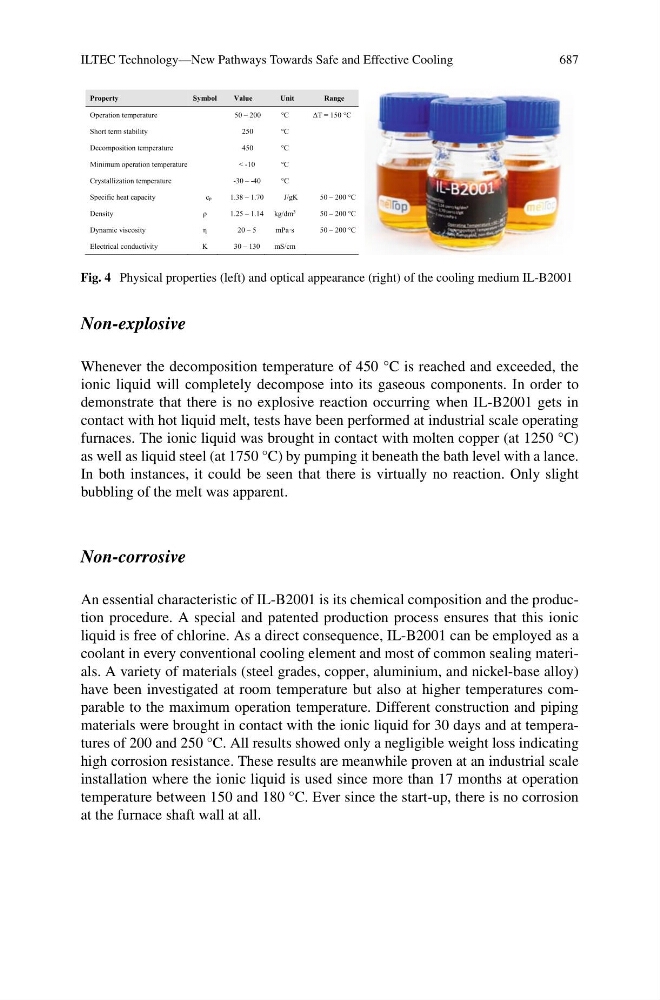
Property
Symbol
Value
Unit
Range
Operation temperature
50 – 200
°C
ΔT = 150 °C
Short term stability
250
°C
Decomposition temperature
450
°C
Minimum operation temperature
< -10
°C
Crystallization temperature
-30 – -40
°C
Specific heat capacity
cp
1.38 – 1.70
J/gK
50 – 200 °C
Density
ρ
1.25 – 1.14 kg/dm 3
50 – 200 °C
Dynamic viscosity
η
20 – 5
mPa·s
50 – 200 °C
Electrical conductivity
Κ
30 – 130
mS/cm
Fig. 4 Physical properties (left) and optical appearance (right) of the cooling medium IL-B2001
Non-explosive
Whenever the decomposition temperature of 450 °C is reached and exceeded, the
ionic liquid will completely decompose into its gaseous components. In order to
demonstrate that there is no explosive reaction occurring when IL-B2001 gets in
contact with hot liquid melt, tests have been performed at industrial scale operating
furnaces. The ionic liquid was brought in contact with molten copper (at 1250 °C)
as well as liquid steel (at 1750 °C) by pumping it beneath the bath level with a lance.
In both instances, it could be seen that there is virtually no reaction. Only slight
bubbling of the melt was apparent.
Non-corrosive
An essential characteristic of IL-B2001 is its chemical composition and the production procedure. A special and patented production process ensures that this ionic
liquid is free of chlorine. As a direct consequence, IL-B2001 can be employed as a
coolant in every conventional cooling element and most of common sealing materials. A variety of materials (steel grades, copper, aluminium, and nickel-base alloy)
have been investigated at room temperature but also at higher temperatures comparable to the maximum operation temperature. Different construction and piping
materials were brought in contact with the ionic liquid for 30 days and at temperatures of 200 and 250 °C. All results showed only a negligible weight loss indicating
high corrosion resistance. These results are meanwhile proven at an industrial scale
installation where the ionic liquid is used since more than 17 months at operation
temperature between 150 and 180 °C. Ever since the start-up, there is no corrosion
at the furnace shaft wall at all.