

ILTEC Technology—New Pathways Towards Safe and Effective Cooling
685
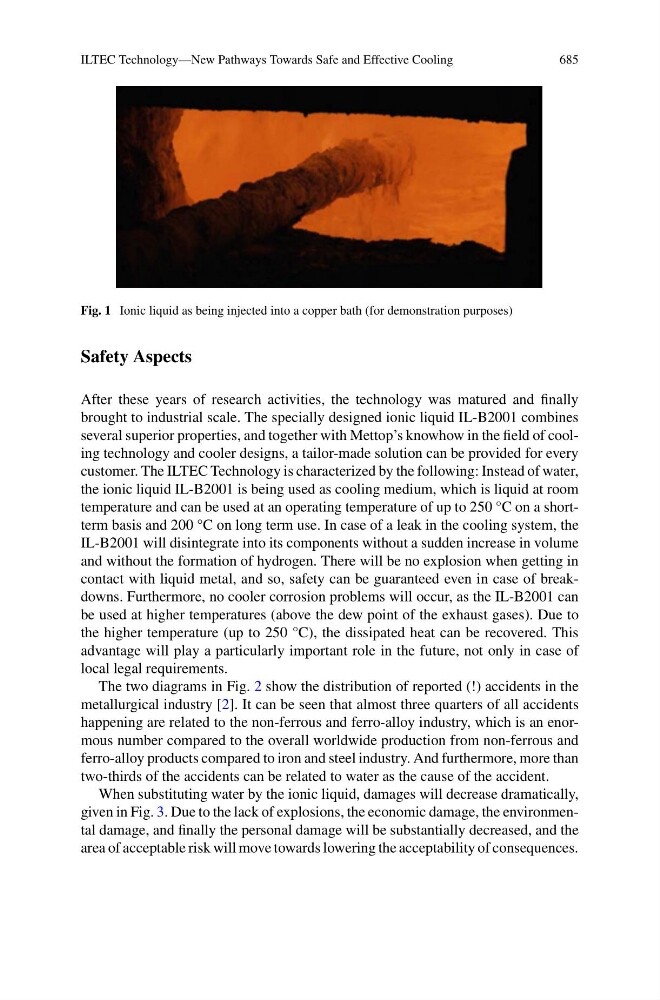
Fig. 1 Ionic liquid as being injected into a copper bath (for demonstration purposes)
Safety Aspects
After these years of research activities, the technology was matured and finally
brought to industrial scale. The specially designed ionic liquid IL-B2001 combines
several superior properties, and together with Mettop’s knowhow in the field of cooling technology and cooler designs, a tailor-made solution can be provided for every
customer. The ILTEC Technology is characterized by the following: Instead of water,
the ionic liquid IL-B2001 is being used as cooling medium, which is liquid at room
temperature and can be used at an operating temperature of up to 250 °C on a shortterm basis and 200 °C on long term use. In case of a leak in the cooling system, the
IL-B2001 will disintegrate into its components without a sudden increase in volume
and without the formation of hydrogen. There will be no explosion when getting in
contact with liquid metal, and so, safety can be guaranteed even in case of breakdowns. Furthermore, no cooler corrosion problems will occur, as the IL-B2001 can
be used at higher temperatures (above the dew point of the exhaust gases). Due to
the higher temperature (up to 250 °C), the dissipated heat can be recovered. This
advantage will play a particularly important role in the future, not only in case of
local legal requirements.
The two diagrams in Fig. 2 show the distribution of reported (!) accidents in the
metallurgical industry [2]. It can be seen that almost three quarters of all accidents
happening are related to the non-ferrous and ferro-alloy industry, which is an enormous number compared to the overall worldwide production from non-ferrous and
ferro-alloy products compared to iron and steel industry. And furthermore, more than
two-thirds of the accidents can be related to water as the cause of the accident.
When substituting water by the ionic liquid, damages will decrease dramatically,
given in Fig. 3. Due to the lack of explosions, the economic damage, the environmental damage, and finally the personal damage will be substantially decreased, and the
area of acceptable risk will move towards lowering the acceptability of consequences.