

Slag Reduction Kinetics of a Lead Slag …
45
slag model was used for the liquid slag. The FeS phase was selected as this solution
model most accurately simulated the matte phase composition generated during the
reduction experiments. The oxygen potential (using Fe 2 O 3 ) was adjusted at the start
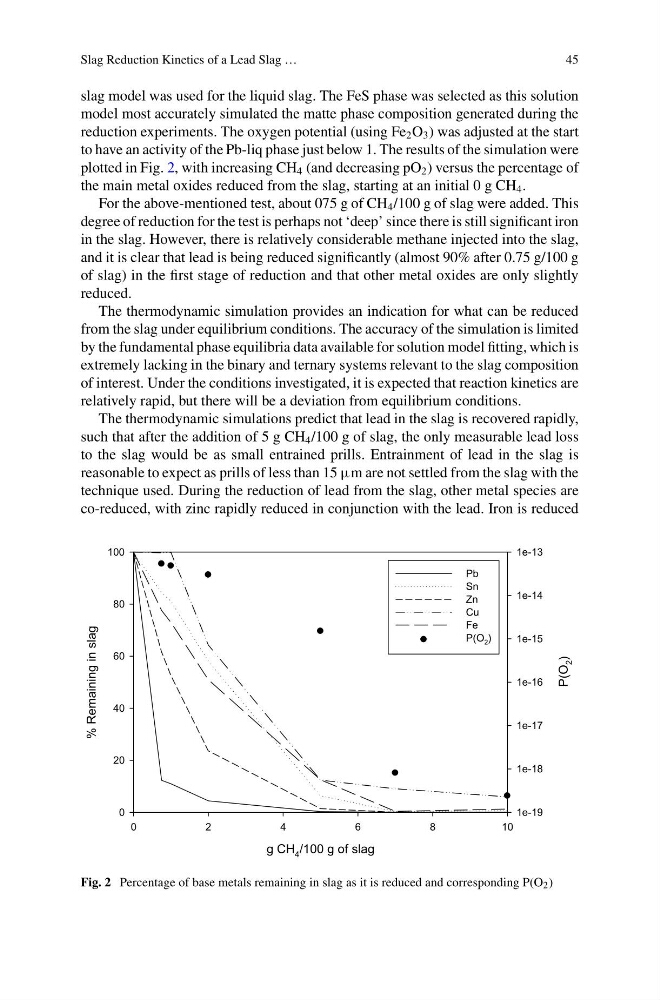
to have an activity of the Pb-liq phase just below 1. The results of the simulation were
plotted in Fig. 2, with increasing CH 4 (and decreasing pO 2 ) versus the percentage of
the main metal oxides reduced from the slag, starting at an initial 0 g CH 4 .
For the above-mentioned test, about 075 g of CH 4 /100 g of slag were added. This
degree of reduction for the test is perhaps not ‘deep’ since there is still significant iron
in the slag. However, there is relatively considerable methane injected into the slag,
and it is clear that lead is being reduced significantly (almost 90% after 0.75 g/100 g
of slag) in the first stage of reduction and that other metal oxides are only slightly
reduced.
The thermodynamic simulation provides an indication for what can be reduced
from the slag under equilibrium conditions. The accuracy of the simulation is limited
by the fundamental phase equilibria data available for solution model fitting, which is
extremely lacking in the binary and ternary systems relevant to the slag composition
of interest. Under the conditions investigated, it is expected that reaction kinetics are
relatively rapid, but there will be a deviation from equilibrium conditions.
The thermodynamic simulations predict that lead in the slag is recovered rapidly,
such that after the addition of 5 g CH 4 /100 g of slag, the only measurable lead loss
to the slag would be as small entrained prills. Entrainment of lead in the slag is
reasonable to expect as prills of less than 15 µm are not settled from the slag with the
technique used. During the reduction of lead from the slag, other metal species are
co-reduced, with zinc rapidly reduced in conjunction with the lead. Iron is reduced
g CH 4 /100 g of slag
0
2
4
6
8
1 0
% Remaining in slag
0
20
40
60
80
100
P(O
2 )
1e-19
1e-18
1e-17
1e-16
1e-15
1e-14
1e-13
Pb
Sn
Zn
Cu
Fe
P(O 2 )
Fig. 2 Percentage of base metals remaining in slag as it is reduced and corresponding P(O 2 )
45
slag model was used for the liquid slag. The FeS phase was selected as this solution
model most accurately simulated the matte phase composition generated during the
reduction experiments. The oxygen potential (using Fe 2 O 3 ) was adjusted at the start
to have an activity of the Pb-liq phase just below 1. The results of the simulation were
plotted in Fig. 2, with increasing CH 4 (and decreasing pO 2 ) versus the percentage of
the main metal oxides reduced from the slag, starting at an initial 0 g CH 4 .
For the above-mentioned test, about 075 g of CH 4 /100 g of slag were added. This
degree of reduction for the test is perhaps not ‘deep’ since there is still significant iron
in the slag. However, there is relatively considerable methane injected into the slag,
and it is clear that lead is being reduced significantly (almost 90% after 0.75 g/100 g
of slag) in the first stage of reduction and that other metal oxides are only slightly
reduced.
The thermodynamic simulation provides an indication for what can be reduced
from the slag under equilibrium conditions. The accuracy of the simulation is limited
by the fundamental phase equilibria data available for solution model fitting, which is
extremely lacking in the binary and ternary systems relevant to the slag composition
of interest. Under the conditions investigated, it is expected that reaction kinetics are
relatively rapid, but there will be a deviation from equilibrium conditions.
The thermodynamic simulations predict that lead in the slag is recovered rapidly,
such that after the addition of 5 g CH 4 /100 g of slag, the only measurable lead loss
to the slag would be as small entrained prills. Entrainment of lead in the slag is
reasonable to expect as prills of less than 15 µm are not settled from the slag with the
technique used. During the reduction of lead from the slag, other metal species are
co-reduced, with zinc rapidly reduced in conjunction with the lead. Iron is reduced
g CH 4 /100 g of slag
0
2
4
6
8
1 0
% Remaining in slag
0
20
40
60
80
100
P(O
2 )
1e-19
1e-18
1e-17
1e-16
1e-15
1e-14
1e-13
Pb
Sn
Zn
Cu
Fe
P(O 2 )
Fig. 2 Percentage of base metals remaining in slag as it is reduced and corresponding P(O 2 )