

670
T. Ebner et al.
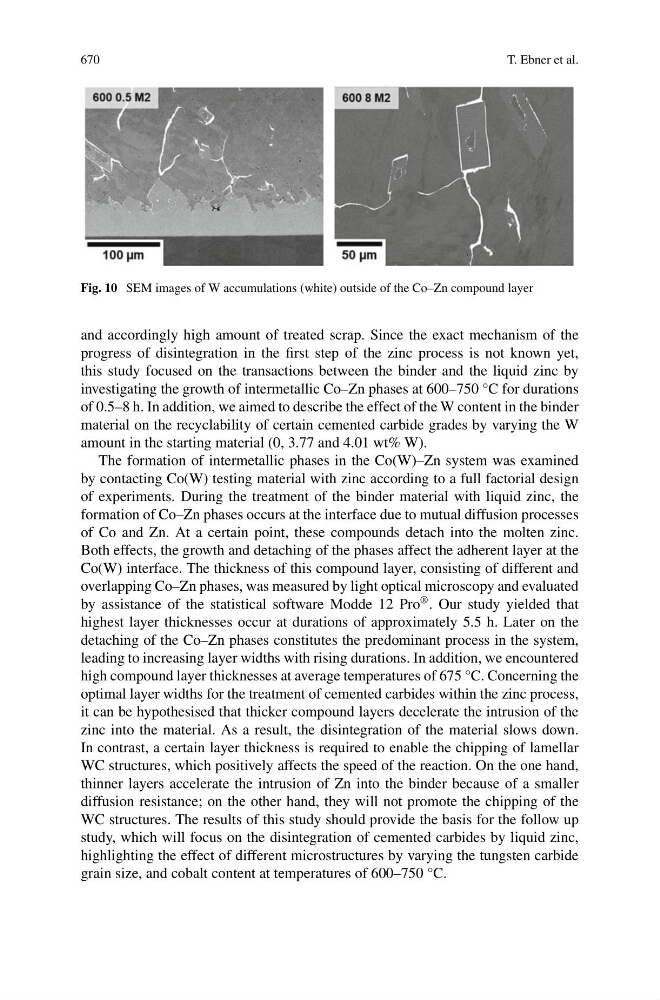
Fig. 10 SEM images of W accumulations (white) outside of the Co–Zn compound layer
and accordingly high amount of treated scrap. Since the exact mechanism of the
progress of disintegration in the first step of the zinc process is not known yet,
this study focused on the transactions between the binder and the liquid zinc by
investigating the growth of intermetallic Co–Zn phases at 600–750 °C for durations
of 0.5–8 h. In addition, we aimed to describe the effect of the W content in the binder
material on the recyclability of certain cemented carbide grades by varying the W
amount in the starting material (0, 3.77 and 4.01 wt% W).
The formation of intermetallic phases in the Co(W)–Zn system was examined
by contacting Co(W) testing material with zinc according to a full factorial design
of experiments. During the treatment of the binder material with liquid zinc, the
formation of Co–Zn phases occurs at the interface due to mutual diffusion processes
of Co and Zn. At a certain point, these compounds detach into the molten zinc.
Both effects, the growth and detaching of the phases affect the adherent layer at the
Co(W) interface. The thickness of this compound layer, consisting of different and
overlapping Co–Zn phases, was measured by light optical microscopy and evaluated
by assistance of the statistical software Modde 12 Pro
® . Our study yielded that
highest layer thicknesses occur at durations of approximately 5.5 h. Later on the
detaching of the Co–Zn phases constitutes the predominant process in the system,
leading to increasing layer widths with rising durations. In addition, we encountered
high compound layer thicknesses at average temperatures of 675 °C. Concerning the
optimal layer widths for the treatment of cemented carbides within the zinc process,
it can be hypothesised that thicker compound layers decelerate the intrusion of the
zinc into the material. As a result, the disintegration of the material slows down.
In contrast, a certain layer thickness is required to enable the chipping of lamellar
WC structures, which positively affects the speed of the reaction. On the one hand,
thinner layers accelerate the intrusion of Zn into the binder because of a smaller
diffusion resistance; on the other hand, they will not promote the chipping of the
WC structures. The results of this study should provide the basis for the follow up
study, which will focus on the disintegration of cemented carbides by liquid zinc,
highlighting the effect of different microstructures by varying the tungsten carbide
grain size, and cobalt content at temperatures of 600–750 °C.