

662
T. Ebner et al.
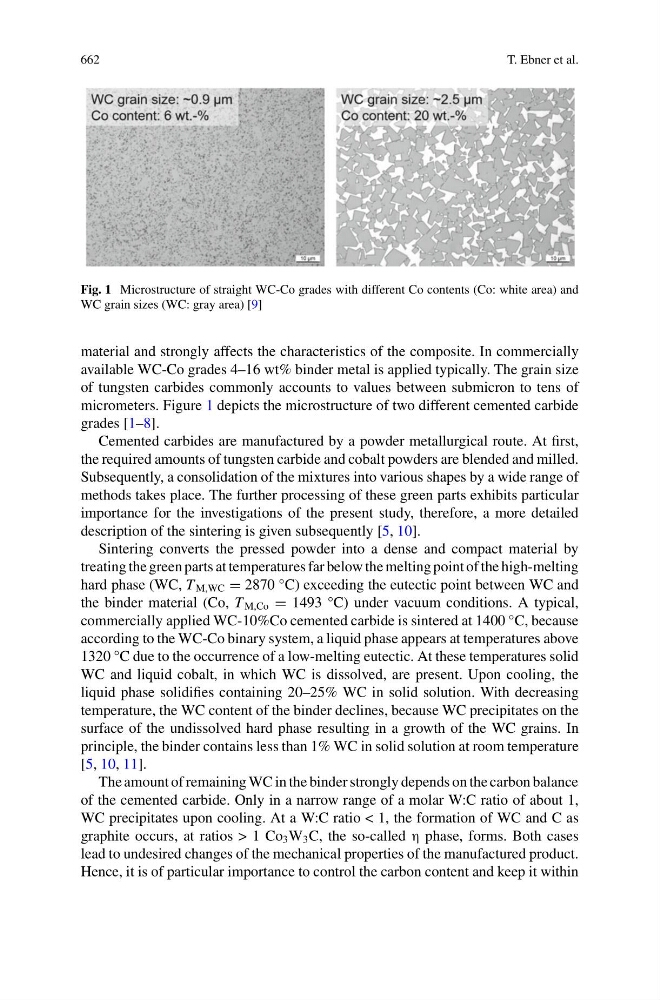
Fig. 1 Microstructure of straight WC-Co grades with different Co contents (Co: white area) and
WC grain sizes (WC: gray area) [9]
material and strongly affects the characteristics of the composite. In commercially
available WC-Co grades 4–16 wt% binder metal is applied typically. The grain size
of tungsten carbides commonly accounts to values between submicron to tens of
micrometers. Figure 1 depicts the microstructure of two different cemented carbide
grades [1–8].
Cemented carbides are manufactured by a powder metallurgical route. At first,
the required amounts of tungsten carbide and cobalt powders are blended and milled.
Subsequently, a consolidation of the mixtures into various shapes by a wide range of
methods takes place. The further processing of these green parts exhibits particular
importance for the investigations of the present study, therefore, a more detailed
description of the sintering is given subsequently [5, 10].
Sintering converts the pressed powder into a dense and compact material by
treating the green parts at temperatures far below the melting point of the high-melting
hard phase (WC, T M,WC = 2870 °C) exceeding the eutectic point between WC and
the binder material (Co, T M,Co = 1493 °C) under vacuum conditions. A typical,
commercially applied WC-10%Co cemented carbide is sintered at 1400 °C, because
according to the WC-Co binary system, a liquid phase appears at temperatures above
1320 °C due to the occurrence of a low-melting eutectic. At these temperatures solid
WC and liquid cobalt, in which WC is dissolved, are present. Upon cooling, the
liquid phase solidifies containing 20–25% WC in solid solution. With decreasing
temperature, the WC content of the binder declines, because WC precipitates on the
surface of the undissolved hard phase resulting in a growth of the WC grains. In
principle, the binder contains less than 1% WC in solid solution at room temperature
[5, 10, 11].
The amount of remaining WC in the binder strongly depends on the carbon balance
of the cemented carbide. Only in a narrow range of a molar W:C ratio of about 1,
WC precipitates upon cooling. At a W:C ratio < 1, the formation of WC and C as
graphite occurs, at ratios > 1 Co 3 W 3 C, the so-called η phase, forms. Both cases
lead to undesired changes of the mechanical properties of the manufactured product.
Hence, it is of particular importance to control the carbon content and keep it within