

The Recovery of Pb and Zn in Antimony Smelting Slag
659
CaO content in the dust collected from boiler is higher, which does not appear during
molten slag treatment. The reason is that some slag goes to waste heat boiler directly
rather than falls into bath when they are fed into fuming furnace during cold slag
treatment due to small particle size of granulated slag. The melting point of Fe, SiO 2 ,
and CaO is high, and such compound is with lower volatilization, so they appear as
solids in the offgas and collected by gravity from waste heat boiler.
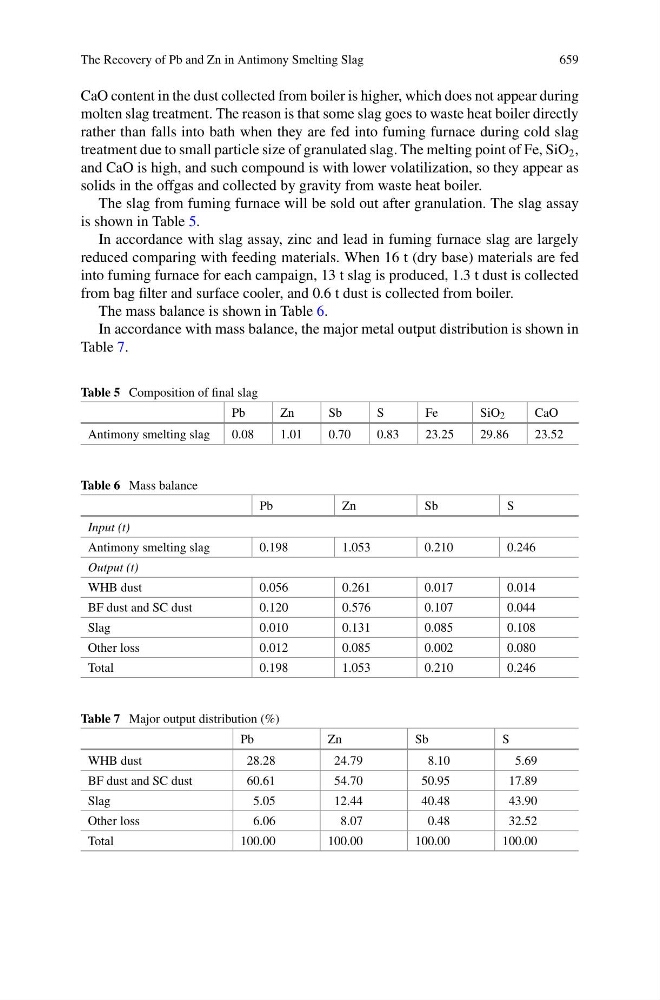
The slag from fuming furnace will be sold out after granulation. The slag assay
is shown in Table 5.
In accordance with slag assay, zinc and lead in fuming furnace slag are largely
reduced comparing with feeding materials. When 16 t (dry base) materials are fed
into fuming furnace for each campaign, 13 t slag is produced, 1.3 t dust is collected
from bag filter and surface cooler, and 0.6 t dust is collected from boiler.
The mass balance is shown in Table 6.
In accordance with mass balance, the major metal output distribution is shown in
Table 7.
Table 5 Composition of final slag
Pb
Zn
Sb
S
Fe
SiO 2
CaO
Antimony smelting slag
0.08
1.01
0.70
0.83
23.25
29.86
23.52
Table 6 Mass balance
Pb
Zn
Sb
S
Input (t)
Antimony smelting slag
0.198
1.053
0.210
0.246
Output (t)
WHB dust
0.056
0.261
0.017
0.014
BF dust and SC dust
0.120
0.576
0.107
0.044
Slag
0.010
0.131
0.085
0.108
Other loss
0.012
0.085
0.002
0.080
Total
0.198
1.053
0.210
0.246
Table 7 Major output distribution (%)
Pb
Zn
Sb
S
WHB dust
28.28
24.79
8.10
5.69
BF dust and SC dust
60.61
54.70
50.95
17.89
Slag
5.05
12.44
40.48
43.90
Other loss
6.06
8.07
0.48
32.52
Total
100.00
100.00
100.00
100.00