

Slag Reduction Kinetics of a Lead Slag …
43
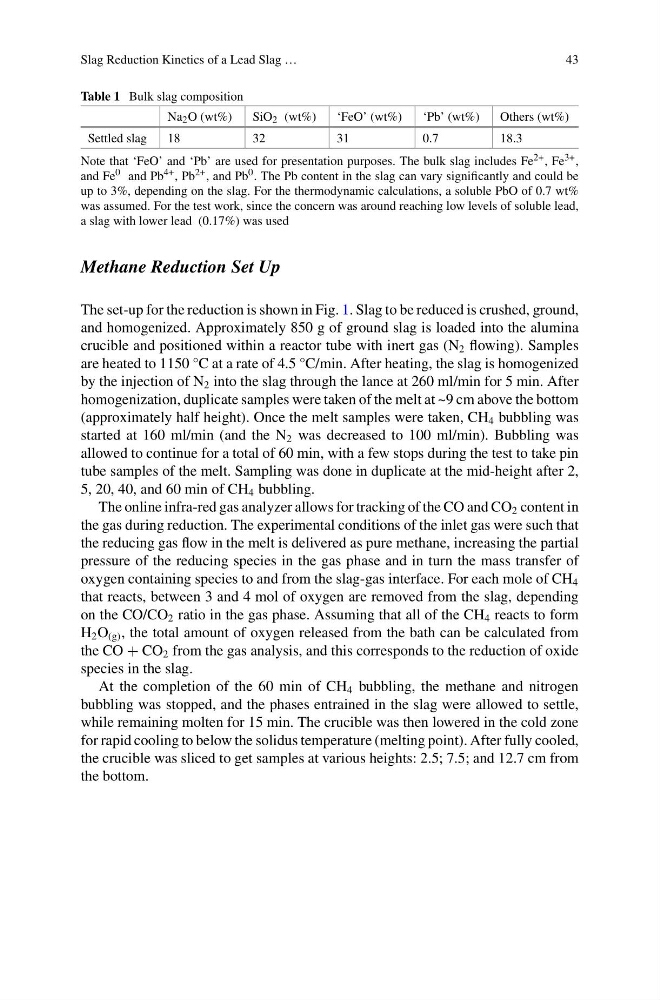
Table 1 Bulk slag composition
Na 2 O (wt%)
SiO 2 (wt%)
‘FeO’ (wt%)
‘Pb’ (wt%)
Others (wt%)
Settled slag
18
32
31
0.7
18.3
Note that ‘FeO’ and ‘Pb’ are used for presentation purposes. The bulk slag includes Fe 2+ , Fe 3+ ,
and Fe 0 and Pb 4+ , Pb 2+ , and Pb 0 . The Pb content in the slag can vary significantly and could be
up to 3%, depending on the slag. For the thermodynamic calculations, a soluble PbO of 0.7 wt%
was assumed. For the test work, since the concern was around reaching low levels of soluble lead,
a slag with lower lead (0.17%) was used
Methane Reduction Set Up
The set-up for the reduction is shown in Fig. 1. Slag to be reduced is crushed, ground,
and homogenized. Approximately 850 g of ground slag is loaded into the alumina
crucible and positioned within a reactor tube with inert gas (N 2 flowing). Samples
are heated to 1150 °C at a rate of 4.5 °C/min. After heating, the slag is homogenized
by the injection of N 2 into the slag through the lance at 260 ml/min for 5 min. After
homogenization, duplicate samples were taken of the melt at ~9 cm above the bottom
(approximately half height). Once the melt samples were taken, CH 4 bubbling was
started at 160 ml/min (and the N 2 was decreased to 100 ml/min). Bubbling was
allowed to continue for a total of 60 min, with a few stops during the test to take pin
tube samples of the melt. Sampling was done in duplicate at the mid-height after 2,
5, 20, 40, and 60 min of CH 4 bubbling.
The online infra-red gas analyzer allows for tracking of the CO and CO 2 content in
the gas during reduction. The experimental conditions of the inlet gas were such that
the reducing gas flow in the melt is delivered as pure methane, increasing the partial
pressure of the reducing species in the gas phase and in turn the mass transfer of
oxygen containing species to and from the slag-gas interface. For each mole of CH 4
that reacts, between 3 and 4 mol of oxygen are removed from the slag, depending
on the CO/CO 2 ratio in the gas phase. Assuming that all of the CH 4 reacts to form
H 2 O (g) , the total amount of oxygen released from the bath can be calculated from
the CO + CO 2 from the gas analysis, and this corresponds to the reduction of oxide
species in the slag.
At the completion of the 60 min of CH 4 bubbling, the methane and nitrogen
bubbling was stopped, and the phases entrained in the slag were allowed to settle,
while remaining molten for 15 min. The crucible was then lowered in the cold zone
for rapid cooling to below the solidus temperature (melting point). After fully cooled,
the crucible was sliced to get samples at various heights: 2.5; 7.5; and 12.7 cm from
the bottom.
43
Table 1 Bulk slag composition
Na 2 O (wt%)
SiO 2 (wt%)
‘FeO’ (wt%)
‘Pb’ (wt%)
Others (wt%)
Settled slag
18
32
31
0.7
18.3
Note that ‘FeO’ and ‘Pb’ are used for presentation purposes. The bulk slag includes Fe 2+ , Fe 3+ ,
and Fe 0 and Pb 4+ , Pb 2+ , and Pb 0 . The Pb content in the slag can vary significantly and could be
up to 3%, depending on the slag. For the thermodynamic calculations, a soluble PbO of 0.7 wt%
was assumed. For the test work, since the concern was around reaching low levels of soluble lead,
a slag with lower lead (0.17%) was used
Methane Reduction Set Up
The set-up for the reduction is shown in Fig. 1. Slag to be reduced is crushed, ground,
and homogenized. Approximately 850 g of ground slag is loaded into the alumina
crucible and positioned within a reactor tube with inert gas (N 2 flowing). Samples
are heated to 1150 °C at a rate of 4.5 °C/min. After heating, the slag is homogenized
by the injection of N 2 into the slag through the lance at 260 ml/min for 5 min. After
homogenization, duplicate samples were taken of the melt at ~9 cm above the bottom
(approximately half height). Once the melt samples were taken, CH 4 bubbling was
started at 160 ml/min (and the N 2 was decreased to 100 ml/min). Bubbling was
allowed to continue for a total of 60 min, with a few stops during the test to take pin
tube samples of the melt. Sampling was done in duplicate at the mid-height after 2,
5, 20, 40, and 60 min of CH 4 bubbling.
The online infra-red gas analyzer allows for tracking of the CO and CO 2 content in
the gas during reduction. The experimental conditions of the inlet gas were such that
the reducing gas flow in the melt is delivered as pure methane, increasing the partial
pressure of the reducing species in the gas phase and in turn the mass transfer of
oxygen containing species to and from the slag-gas interface. For each mole of CH 4
that reacts, between 3 and 4 mol of oxygen are removed from the slag, depending
on the CO/CO 2 ratio in the gas phase. Assuming that all of the CH 4 reacts to form
H 2 O (g) , the total amount of oxygen released from the bath can be calculated from
the CO + CO 2 from the gas analysis, and this corresponds to the reduction of oxide
species in the slag.
At the completion of the 60 min of CH 4 bubbling, the methane and nitrogen
bubbling was stopped, and the phases entrained in the slag were allowed to settle,
while remaining molten for 15 min. The crucible was then lowered in the cold zone
for rapid cooling to below the solidus temperature (melting point). After fully cooled,
the crucible was sliced to get samples at various heights: 2.5; 7.5; and 12.7 cm from
the bottom.