

A Novel Collector 5–(Butylthio)–1,3,4–Thiadiazole–2–Thiol …
639
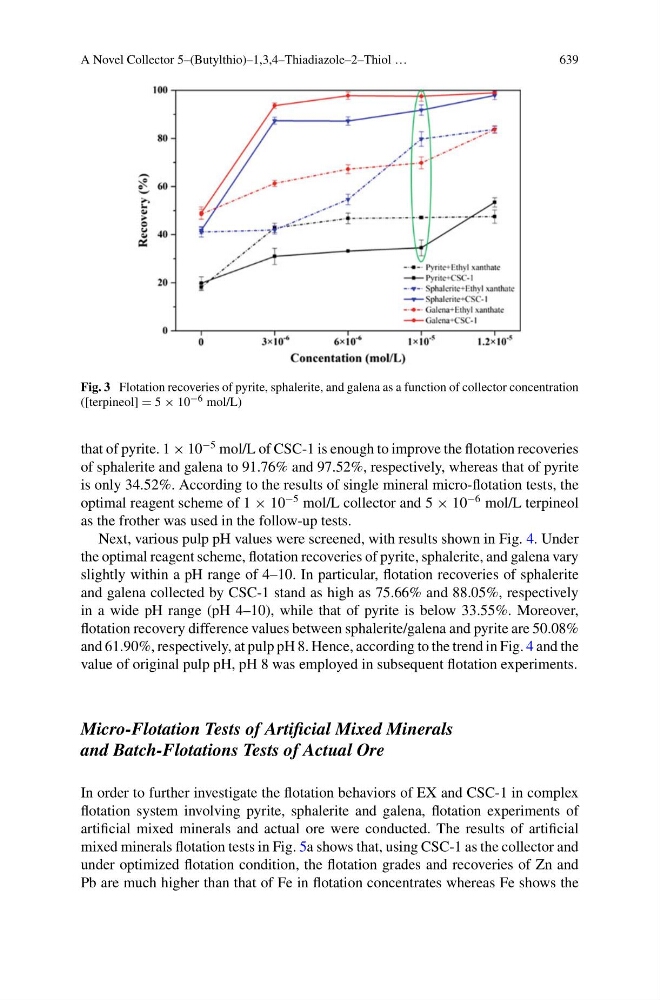
Fig. 3 Flotation recoveries of pyrite, sphalerite, and galena as a function of collector concentration
([terpineol] = 5 × 10 −6 mol/L)
that of pyrite. 1 × 10
−5 mol/L of CSC-1 is enough to improve the flotation recoveries
of sphalerite and galena to 91.76% and 97.52%, respectively, whereas that of pyrite
is only 34.52%. According to the results of single mineral micro-flotation tests, the
optimal reagent scheme of 1 × 10
−5 mol/L collector and 5 × 10
−6 mol/L terpineol
as the frother was used in the follow-up tests.
Next, various pulp pH values were screened, with results shown in Fig. 4. Under
the optimal reagent scheme, flotation recoveries of pyrite, sphalerite, and galena vary
slightly within a pH range of 4–10. In particular, flotation recoveries of sphalerite
and galena collected by CSC-1 stand as high as 75.66% and 88.05%, respectively
in a wide pH range (pH 4–10), while that of pyrite is below 33.55%. Moreover,
flotation recovery difference values between sphalerite/galena and pyrite are 50.08%
and 61.90%, respectively, at pulp pH 8. Hence, according to the trend in Fig. 4 and the
value of original pulp pH, pH 8 was employed in subsequent flotation experiments.
Micro-Flotation Tests of Artificial Mixed Minerals
and Batch-Flotations Tests of Actual Ore
In order to further investigate the flotation behaviors of EX and CSC-1 in complex
flotation system involving pyrite, sphalerite and galena, flotation experiments of
artificial mixed minerals and actual ore were conducted. The results of artificial
mixed minerals flotation tests in Fig. 5a shows that, using CSC-1 as the collector and
under optimized flotation condition, the flotation grades and recoveries of Zn and
Pb are much higher than that of Fe in flotation concentrates whereas Fe shows the
639
Fig. 3 Flotation recoveries of pyrite, sphalerite, and galena as a function of collector concentration
([terpineol] = 5 × 10 −6 mol/L)
that of pyrite. 1 × 10
−5 mol/L of CSC-1 is enough to improve the flotation recoveries
of sphalerite and galena to 91.76% and 97.52%, respectively, whereas that of pyrite
is only 34.52%. According to the results of single mineral micro-flotation tests, the
optimal reagent scheme of 1 × 10
−5 mol/L collector and 5 × 10
−6 mol/L terpineol
as the frother was used in the follow-up tests.
Next, various pulp pH values were screened, with results shown in Fig. 4. Under
the optimal reagent scheme, flotation recoveries of pyrite, sphalerite, and galena vary
slightly within a pH range of 4–10. In particular, flotation recoveries of sphalerite
and galena collected by CSC-1 stand as high as 75.66% and 88.05%, respectively
in a wide pH range (pH 4–10), while that of pyrite is below 33.55%. Moreover,
flotation recovery difference values between sphalerite/galena and pyrite are 50.08%
and 61.90%, respectively, at pulp pH 8. Hence, according to the trend in Fig. 4 and the
value of original pulp pH, pH 8 was employed in subsequent flotation experiments.
Micro-Flotation Tests of Artificial Mixed Minerals
and Batch-Flotations Tests of Actual Ore
In order to further investigate the flotation behaviors of EX and CSC-1 in complex
flotation system involving pyrite, sphalerite and galena, flotation experiments of
artificial mixed minerals and actual ore were conducted. The results of artificial
mixed minerals flotation tests in Fig. 5a shows that, using CSC-1 as the collector and
under optimized flotation condition, the flotation grades and recoveries of Zn and
Pb are much higher than that of Fe in flotation concentrates whereas Fe shows the