

Refractory Corrosion Comparison Through …
607
Methods
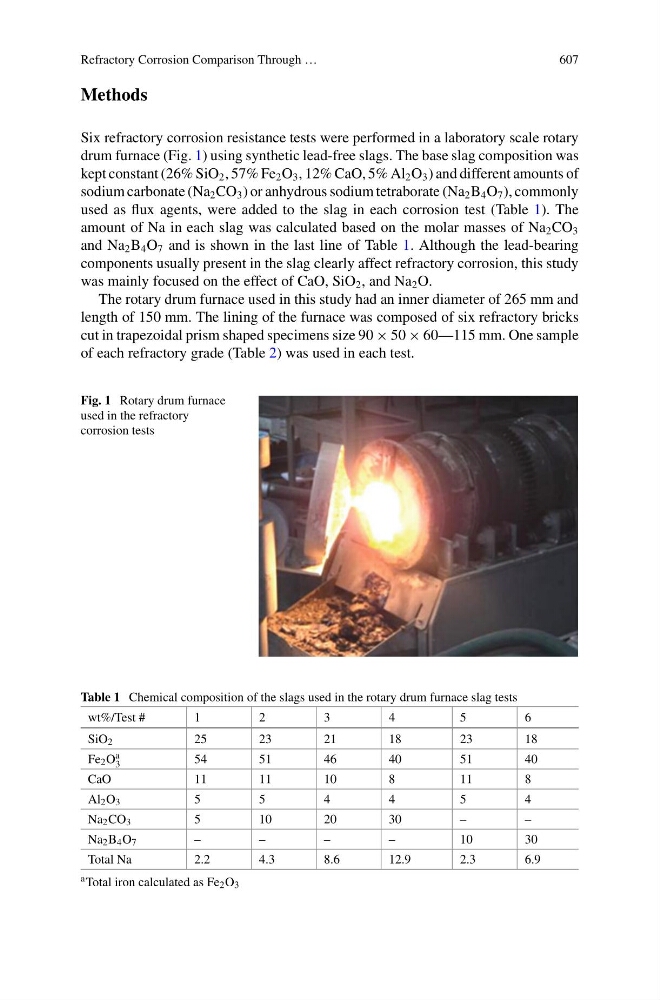
Six refractory corrosion resistance tests were performed in a laboratory scale rotary
drum furnace (Fig. 1) using synthetic lead-free slags. The base slag composition was
kept constant (26% SiO 2 , 57% Fe 2 O 3 , 12% CaO, 5% Al 2 O 3 ) and different amounts of
sodium carbonate (Na 2 CO 3 ) or anhydrous sodium tetraborate (Na 2 B 4 O 7 ), commonly
used as flux agents, were added to the slag in each corrosion test (Table 1). The
amount of Na in each slag was calculated based on the molar masses of Na 2 CO 3
and Na 2 B 4 O 7 and is shown in the last line of Table 1. Although the lead-bearing
components usually present in the slag clearly affect refractory corrosion, this study
was mainly focused on the effect of CaO, SiO 2 , and Na 2 O.
The rotary drum furnace used in this study had an inner diameter of 265 mm and
length of 150 mm. The lining of the furnace was composed of six refractory bricks
cut in trapezoidal prism shaped specimens size 90 × 50 × 60—115 mm. One sample
of each refractory grade (Table 2) was used in each test.
Fig. 1 Rotary drum furnace
used in the refractory
corrosion tests
Table 1 Chemical composition of the slags used in the rotary drum furnace slag tests
wt%/Test #
1
2
3
4
5
6
SiO 2
25
23
21
18
23
18
Fe 2 O a
3
54
51
46
40
51
40
CaO
11
11
10
8
11
8
Al 2 O 3
5
5
4
4
5
4
Na 2 CO 3
5
10
20
30
–
–
Na 2 B 4 O 7
–
–
–
–
10
30
Total Na
2.2
4.3
8.6
12.9
2.3
6.9
a Total iron calculated as Fe 2 O 3
607
Methods
Six refractory corrosion resistance tests were performed in a laboratory scale rotary
drum furnace (Fig. 1) using synthetic lead-free slags. The base slag composition was
kept constant (26% SiO 2 , 57% Fe 2 O 3 , 12% CaO, 5% Al 2 O 3 ) and different amounts of
sodium carbonate (Na 2 CO 3 ) or anhydrous sodium tetraborate (Na 2 B 4 O 7 ), commonly
used as flux agents, were added to the slag in each corrosion test (Table 1). The
amount of Na in each slag was calculated based on the molar masses of Na 2 CO 3
and Na 2 B 4 O 7 and is shown in the last line of Table 1. Although the lead-bearing
components usually present in the slag clearly affect refractory corrosion, this study
was mainly focused on the effect of CaO, SiO 2 , and Na 2 O.
The rotary drum furnace used in this study had an inner diameter of 265 mm and
length of 150 mm. The lining of the furnace was composed of six refractory bricks
cut in trapezoidal prism shaped specimens size 90 × 50 × 60—115 mm. One sample
of each refractory grade (Table 2) was used in each test.
Fig. 1 Rotary drum furnace
used in the refractory
corrosion tests
Table 1 Chemical composition of the slags used in the rotary drum furnace slag tests
wt%/Test #
1
2
3
4
5
6
SiO 2
25
23
21
18
23
18
Fe 2 O a
3
54
51
46
40
51
40
CaO
11
11
10
8
11
8
Al 2 O 3
5
5
4
4
5
4
Na 2 CO 3
5
10
20
30
–
–
Na 2 B 4 O 7
–
–
–
–
10
30
Total Na
2.2
4.3
8.6
12.9
2.3
6.9
a Total iron calculated as Fe 2 O 3