

The FAST Pb Process and Its Impact on Secondary …
583
Chloride
leach
Sulphate
control
Electrolyte
purification
Chemicals
Cement
Electrolysis
Evaporator
Lead flakes
Vapour
Sulphate
cake
Leaching
residue
NH3
N2
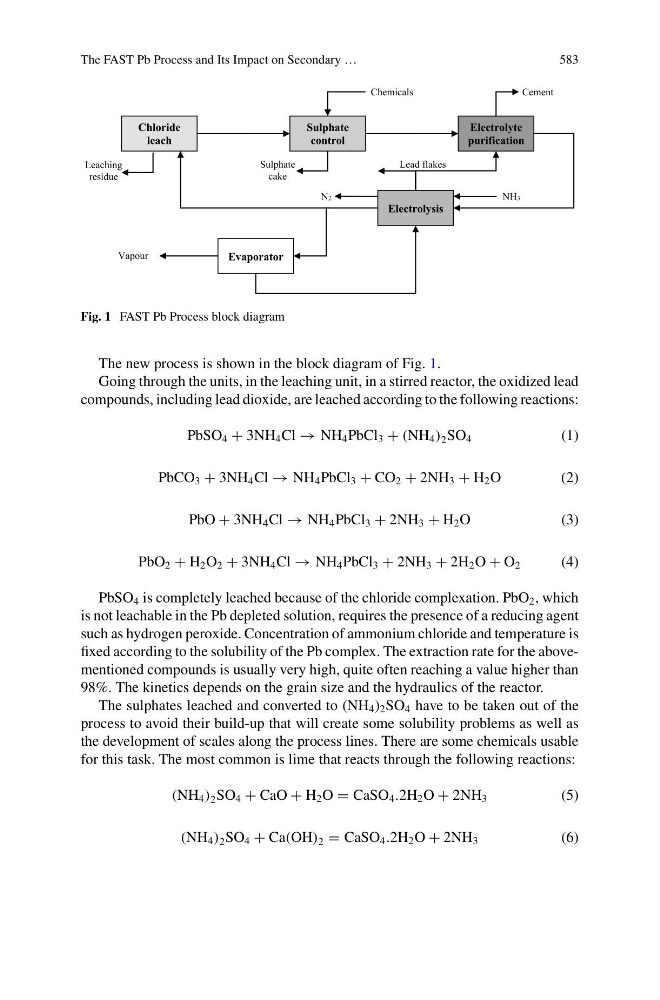
Fig. 1 FAST Pb Process block diagram
The new process is shown in the block diagram of Fig. 1.
Going through the units, in the leaching unit, in a stirred reactor, the oxidized lead
compounds, including lead dioxide, are leached according to the following reactions:
PbSO 4 + 3NH 4 Cl → NH 4 PbCl 3 + (NH 4 ) 2 SO 4
(1)
PbCO 3 + 3NH 4 Cl → NH 4 PbCl 3 + CO 2 + 2NH 3 + H 2 O
( 2 )
PbO + 3NH 4 Cl → NH 4 PbCl 3 + 2NH 3 + H 2 O
( 3 )
PbO 2 + H 2 O 2 + 3NH 4 Cl → NH 4 PbCl 3 + 2NH 3 + 2H 2 O + O 2
(4)
PbSO 4 is completely leached because of the chloride complexation. PbO 2 , which
is not leachable in the Pb depleted solution, requires the presence of a reducing agent
such as hydrogen peroxide. Concentration of ammonium chloride and temperature is
fixed according to the solubility of the Pb complex. The extraction rate for the abovementioned compounds is usually very high, quite often reaching a value higher than
98%. The kinetics depends on the grain size and the hydraulics of the reactor.
The sulphates leached and converted to (NH 4 ) 2 SO 4 have to be taken out of the
process to avoid their build-up that will create some solubility problems as well as
the development of scales along the process lines. There are some chemicals usable
for this task. The most common is lime that reacts through the following reactions:
(NH 4 ) 2 SO 4 + CaO + H 2 O = CaSO 4 .2H 2 O + 2NH 3
(5)
(NH 4 ) 2 SO 4 + Ca(OH) 2 = CaSO 4 .2H 2 O + 2NH 3
(6)
583
Chloride
leach
Sulphate
control
Electrolyte
purification
Chemicals
Cement
Electrolysis
Evaporator
Lead flakes
Vapour
Sulphate
cake
Leaching
residue
NH3
N2
Fig. 1 FAST Pb Process block diagram
The new process is shown in the block diagram of Fig. 1.
Going through the units, in the leaching unit, in a stirred reactor, the oxidized lead
compounds, including lead dioxide, are leached according to the following reactions:
PbSO 4 + 3NH 4 Cl → NH 4 PbCl 3 + (NH 4 ) 2 SO 4
(1)
PbCO 3 + 3NH 4 Cl → NH 4 PbCl 3 + CO 2 + 2NH 3 + H 2 O
( 2 )
PbO + 3NH 4 Cl → NH 4 PbCl 3 + 2NH 3 + H 2 O
( 3 )
PbO 2 + H 2 O 2 + 3NH 4 Cl → NH 4 PbCl 3 + 2NH 3 + 2H 2 O + O 2
(4)
PbSO 4 is completely leached because of the chloride complexation. PbO 2 , which
is not leachable in the Pb depleted solution, requires the presence of a reducing agent
such as hydrogen peroxide. Concentration of ammonium chloride and temperature is
fixed according to the solubility of the Pb complex. The extraction rate for the abovementioned compounds is usually very high, quite often reaching a value higher than
98%. The kinetics depends on the grain size and the hydraulics of the reactor.
The sulphates leached and converted to (NH 4 ) 2 SO 4 have to be taken out of the
process to avoid their build-up that will create some solubility problems as well as
the development of scales along the process lines. There are some chemicals usable
for this task. The most common is lime that reacts through the following reactions:
(NH 4 ) 2 SO 4 + CaO + H 2 O = CaSO 4 .2H 2 O + 2NH 3
(5)
(NH 4 ) 2 SO 4 + Ca(OH) 2 = CaSO 4 .2H 2 O + 2NH 3
(6)