

Influence of Minor Elements in Waste Lead Battery Recycling
575
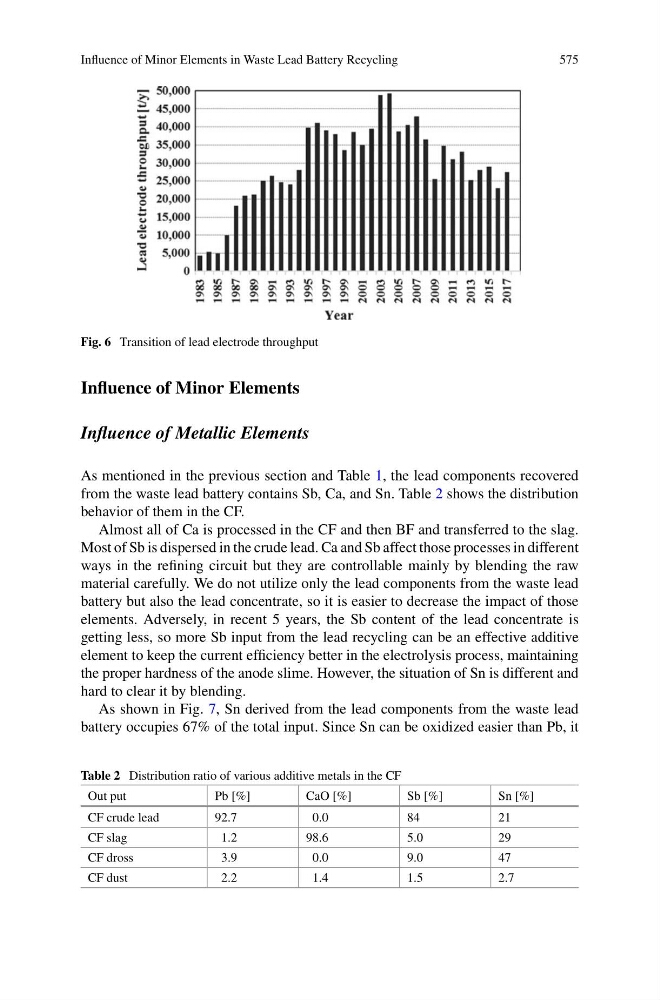
Fig. 6 Transition of lead electrode throughput
Influence of Minor Elements
Influence of Metallic Elements
As mentioned in the previous section and Table 1, the lead components recovered
from the waste lead battery contains Sb, Ca, and Sn. Table 2 shows the distribution
behavior of them in the CF.
Almost all of Ca is processed in the CF and then BF and transferred to the slag.
Most of Sb is dispersed in the crude lead. Ca and Sb affect those processes in different
ways in the refining circuit but they are controllable mainly by blending the raw
material carefully. We do not utilize only the lead components from the waste lead
battery but also the lead concentrate, so it is easier to decrease the impact of those
elements. Adversely, in recent 5 years, the Sb content of the lead concentrate is
getting less, so more Sb input from the lead recycling can be an effective additive
element to keep the current efficiency better in the electrolysis process, maintaining
the proper hardness of the anode slime. However, the situation of Sn is different and
hard to clear it by blending.
As shown in Fig. 7, Sn derived from the lead components from the waste lead
battery occupies 67% of the total input. Since Sn can be oxidized easier than Pb, it
Table 2 Distribution ratio of various additive metals in the CF
Out put
Pb [%]
CaO [%]
Sb [%]
Sn [%]
CF crude lead
92.7
0.0
84
21
CF slag
1.2
98.6
5.0
29
CF dross
3.9
0.0
9.0
47
CF dust
2.2
1.4
1.5
2.7
575
Fig. 6 Transition of lead electrode throughput
Influence of Minor Elements
Influence of Metallic Elements
As mentioned in the previous section and Table 1, the lead components recovered
from the waste lead battery contains Sb, Ca, and Sn. Table 2 shows the distribution
behavior of them in the CF.
Almost all of Ca is processed in the CF and then BF and transferred to the slag.
Most of Sb is dispersed in the crude lead. Ca and Sb affect those processes in different
ways in the refining circuit but they are controllable mainly by blending the raw
material carefully. We do not utilize only the lead components from the waste lead
battery but also the lead concentrate, so it is easier to decrease the impact of those
elements. Adversely, in recent 5 years, the Sb content of the lead concentrate is
getting less, so more Sb input from the lead recycling can be an effective additive
element to keep the current efficiency better in the electrolysis process, maintaining
the proper hardness of the anode slime. However, the situation of Sn is different and
hard to clear it by blending.
As shown in Fig. 7, Sn derived from the lead components from the waste lead
battery occupies 67% of the total input. Since Sn can be oxidized easier than Pb, it
Table 2 Distribution ratio of various additive metals in the CF
Out put
Pb [%]
CaO [%]
Sb [%]
Sn [%]
CF crude lead
92.7
0.0
84
21
CF slag
1.2
98.6
5.0
29
CF dross
3.9
0.0
9.0
47
CF dust
2.2
1.4
1.5
2.7