

Numerical Simulation of Gas–Liquid Flow …
35
k =
1
2
(u 2 + v 2 + w 2 ) =
1
2
(u
2
i )
(5)
ε =
μ
ρ
∂u
i
∂ x k
∂u
i
∂ x k
(6)
μ t = ρC μ
k
2
ε
(7)
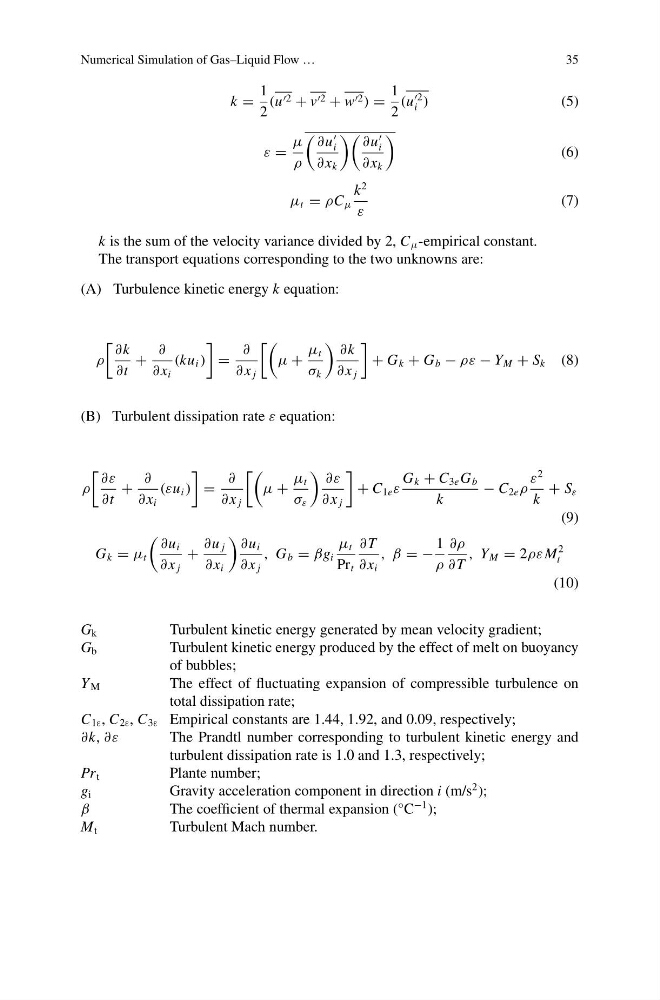
k is the sum of the velocity variance divided by 2, C μ -empirical constant.
The transport equations corresponding to the two unknowns are:
(A) Turbulence kinetic energy k equation:
ρ
∂k
∂t
+
∂
∂ x i
(ku i )
=
∂
∂ x j
μ +
μ t
σ k
∂k
∂ x j
+ G k + G b − ρε − Y M + S k (8)
(B) Turbulent dissipation rate ε equation:
ρ
∂ε
∂t
+
∂
∂ x i
(εu i )
=
∂
∂ x j
μ +
μ t
σ ε
∂ε
∂ x j
+ C 1e ε
G k + C 3e G b
k
− C 2e ρ
ε
2
k
+ S ε
(9)
G k = μ t
∂u i
∂ x j
+
∂u j
∂ x i
∂u i
∂ x j
, G b = βg i
μ t
Pr t
∂ T
∂ x i
, β = −
1
ρ
∂ρ
∂ T
, Y M = 2ρεM
2
t
(10)
G k
Turbulent kinetic energy generated by mean velocity gradient;
G b
Turbulent kinetic energy produced by the effect of melt on buoyancy
of bubbles;
Y M
The effect of fluctuating expansion of compressible turbulence on
total dissipation rate;
C 1ε , C 2ε , C 3ε Empirical constants are 1.44, 1.92, and 0.09, respectively;
∂k, ∂ε
The Prandtl number corresponding to turbulent kinetic energy and
turbulent dissipation rate is 1.0 and 1.3, respectively;
Pr t
Plante number;
g i
Gravity acceleration component in direction i (m/s
2 );
β
The coefficient of thermal expansion (°C
−1 );
M t
Turbulent Mach number.
35
k =
1
2
(u 2 + v 2 + w 2 ) =
1
2
(u
2
i )
(5)
ε =
μ
ρ
∂u
i
∂ x k
∂u
i
∂ x k
(6)
μ t = ρC μ
k
2
ε
(7)
k is the sum of the velocity variance divided by 2, C μ -empirical constant.
The transport equations corresponding to the two unknowns are:
(A) Turbulence kinetic energy k equation:
ρ
∂k
∂t
+
∂
∂ x i
(ku i )
=
∂
∂ x j
μ +
μ t
σ k
∂k
∂ x j
+ G k + G b − ρε − Y M + S k (8)
(B) Turbulent dissipation rate ε equation:
ρ
∂ε
∂t
+
∂
∂ x i
(εu i )
=
∂
∂ x j
μ +
μ t
σ ε
∂ε
∂ x j
+ C 1e ε
G k + C 3e G b
k
− C 2e ρ
ε
2
k
+ S ε
(9)
G k = μ t
∂u i
∂ x j
+
∂u j
∂ x i
∂u i
∂ x j
, G b = βg i
μ t
Pr t
∂ T
∂ x i
, β = −
1
ρ
∂ρ
∂ T
, Y M = 2ρεM
2
t
(10)
G k
Turbulent kinetic energy generated by mean velocity gradient;
G b
Turbulent kinetic energy produced by the effect of melt on buoyancy
of bubbles;
Y M
The effect of fluctuating expansion of compressible turbulence on
total dissipation rate;
C 1ε , C 2ε , C 3ε Empirical constants are 1.44, 1.92, and 0.09, respectively;
∂k, ∂ε
The Prandtl number corresponding to turbulent kinetic energy and
turbulent dissipation rate is 1.0 and 1.3, respectively;
Pr t
Plante number;
g i
Gravity acceleration component in direction i (m/s
2 );
β
The coefficient of thermal expansion (°C
−1 );
M t
Turbulent Mach number.