

Refractory Solutions by Laboratory Tests and Fieldworks …
565
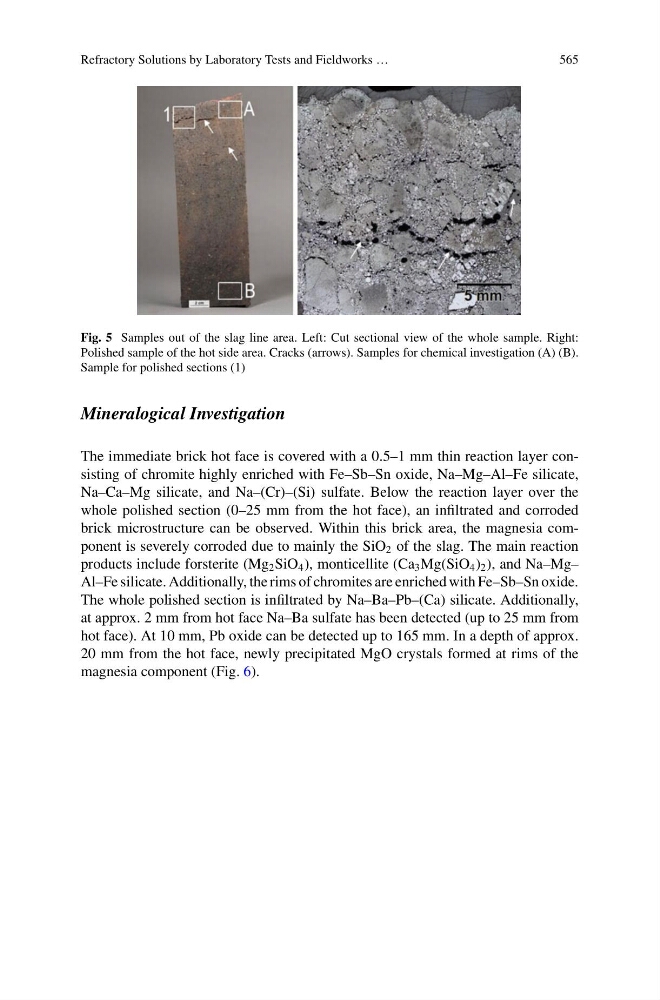
Fig. 5 Samples out of the slag line area. Left: Cut sectional view of the whole sample. Right:
Polished sample of the hot side area. Cracks (arrows). Samples for chemical investigation (A) (B).
Sample for polished sections (1)
Mineralogical Investigation
The immediate brick hot face is covered with a 0.5–1 mm thin reaction layer consisting of chromite highly enriched with Fe–Sb–Sn oxide, Na–Mg–Al–Fe silicate,
Na–Ca–Mg silicate, and Na–(Cr)–(Si) sulfate. Below the reaction layer over the
whole polished section (0–25 mm from the hot face), an infiltrated and corroded
brick microstructure can be observed. Within this brick area, the magnesia component is severely corroded due to mainly the SiO 2 of the slag. The main reaction
products include forsterite (Mg 2 SiO 4 ), monticellite (Ca 3 Mg(SiO 4 ) 2 ), and Na–Mg–
Al–Fe silicate. Additionally, the rims of chromites are enriched with Fe–Sb–Sn oxide.
The whole polished section is infiltrated by Na–Ba–Pb–(Ca) silicate. Additionally,
at approx. 2 mm from hot face Na–Ba sulfate has been detected (up to 25 mm from
hot face). At 10 mm, Pb oxide can be detected up to 165 mm. In a depth of approx.
20 mm from the hot face, newly precipitated MgO crystals formed at rims of the
magnesia component (Fig. 6).
565
Fig. 5 Samples out of the slag line area. Left: Cut sectional view of the whole sample. Right:
Polished sample of the hot side area. Cracks (arrows). Samples for chemical investigation (A) (B).
Sample for polished sections (1)
Mineralogical Investigation
The immediate brick hot face is covered with a 0.5–1 mm thin reaction layer consisting of chromite highly enriched with Fe–Sb–Sn oxide, Na–Mg–Al–Fe silicate,
Na–Ca–Mg silicate, and Na–(Cr)–(Si) sulfate. Below the reaction layer over the
whole polished section (0–25 mm from the hot face), an infiltrated and corroded
brick microstructure can be observed. Within this brick area, the magnesia component is severely corroded due to mainly the SiO 2 of the slag. The main reaction
products include forsterite (Mg 2 SiO 4 ), monticellite (Ca 3 Mg(SiO 4 ) 2 ), and Na–Mg–
Al–Fe silicate. Additionally, the rims of chromites are enriched with Fe–Sb–Sn oxide.
The whole polished section is infiltrated by Na–Ba–Pb–(Ca) silicate. Additionally,
at approx. 2 mm from hot face Na–Ba sulfate has been detected (up to 25 mm from
hot face). At 10 mm, Pb oxide can be detected up to 165 mm. In a depth of approx.
20 mm from the hot face, newly precipitated MgO crystals formed at rims of the
magnesia component (Fig. 6).