

562
K. Reinharter et al.
High-Frequency Induction Furnace (HF-IF)
To get an advanced information about the corrosion behavior, a high-frequency induction furnace (HF-IF) corrosion test is carried out on three different magnesia-chromite
brick samples (labeled as bricks 1–3).
Every brick brand was prepared with a dimension of 20 × 25 × 115 mm. As soon
as test temperature was reached (in this case, 1500 °C under controlled atmosphere),
the samples were immersed by 30 mm into the liquid slag melt. During the test, the
sample holder rotates with a frequency of 0.15 Hz (corresponds to approximately 9
rotations per min). After the pre-defined test duration (240 min), the samples were
lifted out of the melt and were subjected to a controlled cooling procedure, followed
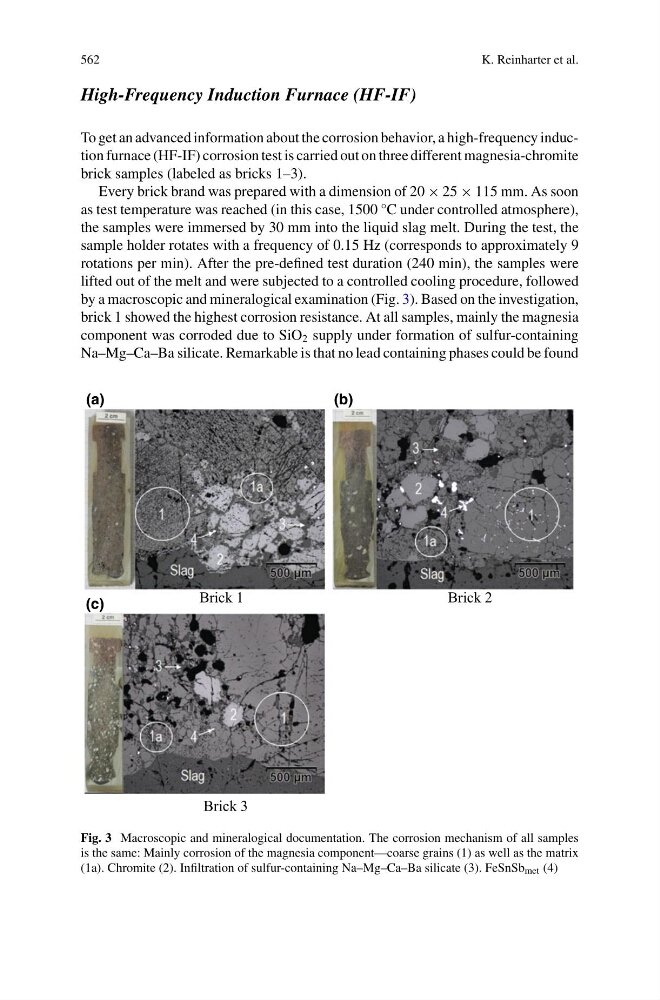
by a macroscopic and mineralogical examination (Fig. 3). Based on the investigation,
brick 1 showed the highest corrosion resistance. At all samples, mainly the magnesia
component was corroded due to SiO 2 supply under formation of sulfur-containing
Na–Mg–Ca–Ba silicate. Remarkable is that no lead containing phases could be found
(a)
Brick 1
(b)
Brick 2
(c)
Brick 3
Fig. 3 Macroscopic and mineralogical documentation. The corrosion mechanism of all samples
is the same: Mainly corrosion of the magnesia component—coarse grains (1) as well as the matrix
(1a). Chromite (2). Infiltration of sulfur-containing Na–Mg–Ca–Ba silicate (3). FeSnSb met (4)
K. Reinharter et al.
High-Frequency Induction Furnace (HF-IF)
To get an advanced information about the corrosion behavior, a high-frequency induction furnace (HF-IF) corrosion test is carried out on three different magnesia-chromite
brick samples (labeled as bricks 1–3).
Every brick brand was prepared with a dimension of 20 × 25 × 115 mm. As soon
as test temperature was reached (in this case, 1500 °C under controlled atmosphere),
the samples were immersed by 30 mm into the liquid slag melt. During the test, the
sample holder rotates with a frequency of 0.15 Hz (corresponds to approximately 9
rotations per min). After the pre-defined test duration (240 min), the samples were
lifted out of the melt and were subjected to a controlled cooling procedure, followed
by a macroscopic and mineralogical examination (Fig. 3). Based on the investigation,
brick 1 showed the highest corrosion resistance. At all samples, mainly the magnesia
component was corroded due to SiO 2 supply under formation of sulfur-containing
Na–Mg–Ca–Ba silicate. Remarkable is that no lead containing phases could be found
(a)
Brick 1
(b)
Brick 2
(c)
Brick 3
Fig. 3 Macroscopic and mineralogical documentation. The corrosion mechanism of all samples
is the same: Mainly corrosion of the magnesia component—coarse grains (1) as well as the matrix
(1a). Chromite (2). Infiltration of sulfur-containing Na–Mg–Ca–Ba silicate (3). FeSnSb met (4)