

Pb and Other Impurities Recovery …
537
This prevents the generation of sulfurous acid gas at electric furnace and reduces
the risk of environmental pollution. Lead carbonate and other raw material are treated
with electric furnace. Afterward, Sn is removed into Sn scum with Harris furnace as
shown in Eq. (3).
5Sn + 6NaOH + 4NaNO 3 → 5Na 2 SnO 3 + N 2 + 3H 2 O
2Sn + NaNO 3 + 3NaOH → 2Na 2 SnO 3 + NH 3
(3)
Even though Pb can be oxidized to Na 2 PbO 2 with NaNO 3 , it can be reduced to
Pb with Sn as shown in Eq. (4) [6]. Pb can be prevented from the distribution to Sn
scum.
Sn + 2Na 2 PbO 2 + H 2 O → Na 2 SnO 3 + 2Pb + 2NaOH
(4)
Electrolytic refining purification of Pb increases the purity from 75–85 to 99.99%.
Sulfamate is used as the electrolyte. Compared with the Betts process that uses
hexafluorosilicate, it is possible to maintain a comfortable working environment and
reduce the environmental risk. Bi and Sb are higher in the Pb anode compared with
that of conventional processes, and we could achieve a Pb purity of 99.99%.
Sb Recovery in the HMC
As shown in Fig. 3, Sb is discharged from the Cu smelting process to the HMC as a
tankhouse residue and slime treatment residue.
Sb raw materials and Pb anode slime are treated in a reduction furnace. The Pb
anode slime is an HMC intermediate. Se and Te are removed from the crude metal
as scum. When sufficient Te has been removed (≤0.2%), Sb is volatilized by air
oxidation and recovered as Sb oxide. By such treatment, Se and Te can be reduced
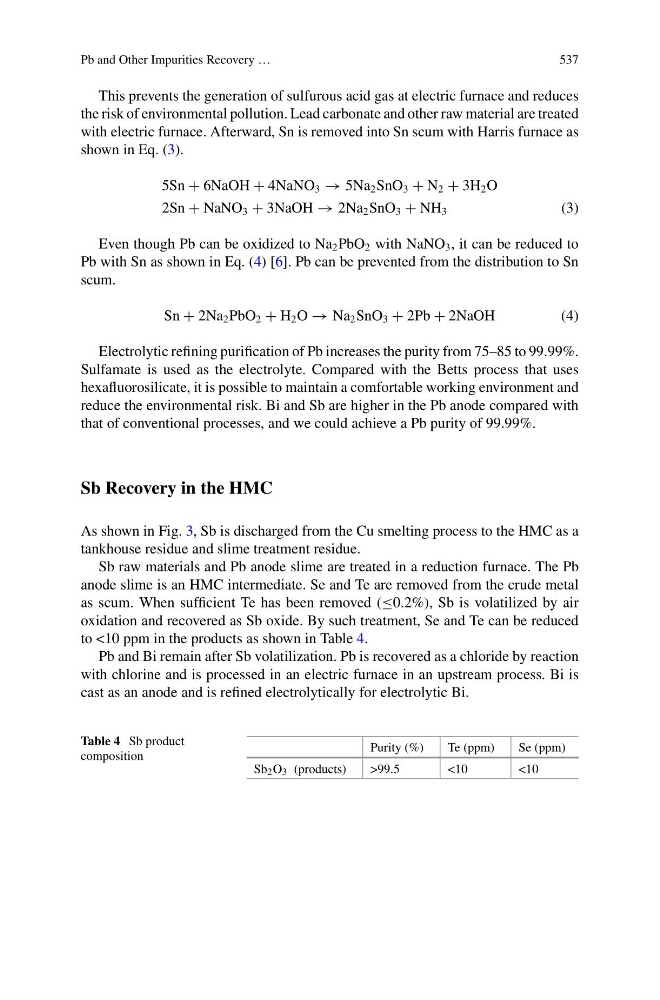
to <10 ppm in the products as shown in Table 4.
Pb and Bi remain after Sb volatilization. Pb is recovered as a chloride by reaction
with chlorine and is processed in an electric furnace in an upstream process. Bi is
cast as an anode and is refined electrolytically for electrolytic Bi.
Table 4 Sb product
composition
Purity (%)
Te (ppm)
Se (ppm)
Sb 2 O 3 (products)
>99.5
<10
<10
537
This prevents the generation of sulfurous acid gas at electric furnace and reduces
the risk of environmental pollution. Lead carbonate and other raw material are treated
with electric furnace. Afterward, Sn is removed into Sn scum with Harris furnace as
shown in Eq. (3).
5Sn + 6NaOH + 4NaNO 3 → 5Na 2 SnO 3 + N 2 + 3H 2 O
2Sn + NaNO 3 + 3NaOH → 2Na 2 SnO 3 + NH 3
(3)
Even though Pb can be oxidized to Na 2 PbO 2 with NaNO 3 , it can be reduced to
Pb with Sn as shown in Eq. (4) [6]. Pb can be prevented from the distribution to Sn
scum.
Sn + 2Na 2 PbO 2 + H 2 O → Na 2 SnO 3 + 2Pb + 2NaOH
(4)
Electrolytic refining purification of Pb increases the purity from 75–85 to 99.99%.
Sulfamate is used as the electrolyte. Compared with the Betts process that uses
hexafluorosilicate, it is possible to maintain a comfortable working environment and
reduce the environmental risk. Bi and Sb are higher in the Pb anode compared with
that of conventional processes, and we could achieve a Pb purity of 99.99%.
Sb Recovery in the HMC
As shown in Fig. 3, Sb is discharged from the Cu smelting process to the HMC as a
tankhouse residue and slime treatment residue.
Sb raw materials and Pb anode slime are treated in a reduction furnace. The Pb
anode slime is an HMC intermediate. Se and Te are removed from the crude metal
as scum. When sufficient Te has been removed (≤0.2%), Sb is volatilized by air
oxidation and recovered as Sb oxide. By such treatment, Se and Te can be reduced
to <10 ppm in the products as shown in Table 4.
Pb and Bi remain after Sb volatilization. Pb is recovered as a chloride by reaction
with chlorine and is processed in an electric furnace in an upstream process. Bi is
cast as an anode and is refined electrolytically for electrolytic Bi.
Table 4 Sb product
composition
Purity (%)
Te (ppm)
Se (ppm)
Sb 2 O 3 (products)
>99.5
<10
<10