

Pb and Other Impurities Recovery …
533
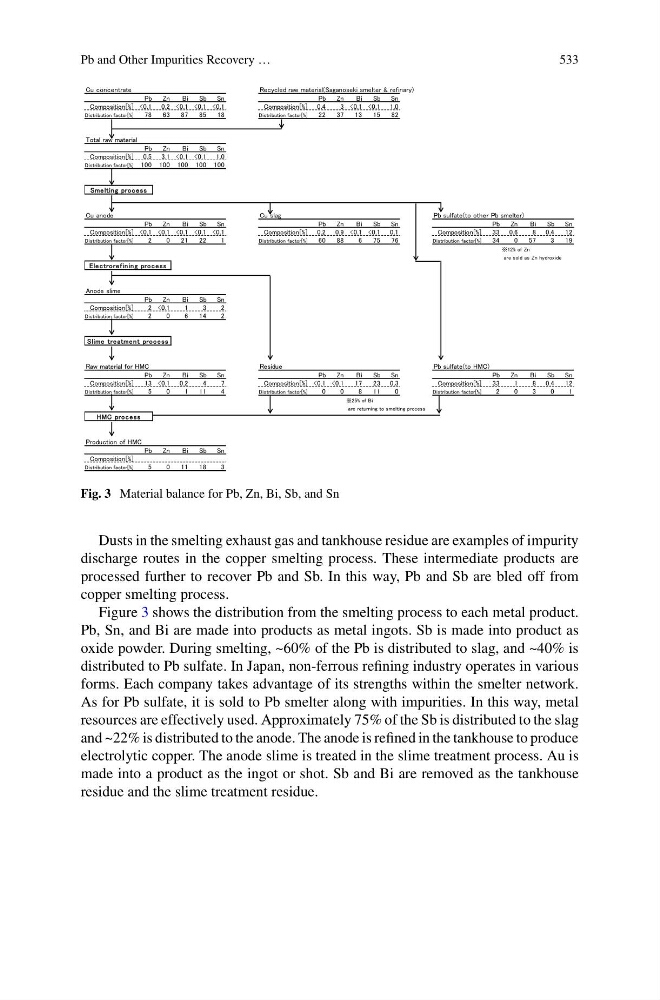
Fig. 3 Material balance for Pb, Zn, Bi, Sb, and Sn
Dusts in the smelting exhaust gas and tankhouse residue are examples of impurity
discharge routes in the copper smelting process. These intermediate products are
processed further to recover Pb and Sb. In this way, Pb and Sb are bled off from
copper smelting process.
Figure 3 shows the distribution from the smelting process to each metal product.
Pb, Sn, and Bi are made into products as metal ingots. Sb is made into product as
oxide powder. During smelting, ~60% of the Pb is distributed to slag, and ~40% is
distributed to Pb sulfate. In Japan, non-ferrous refining industry operates in various
forms. Each company takes advantage of its strengths within the smelter network.
As for Pb sulfate, it is sold to Pb smelter along with impurities. In this way, metal
resources are effectively used. Approximately 75% of the Sb is distributed to the slag
and ~22% is distributed to the anode. The anode is refined in the tankhouse to produce
electrolytic copper. The anode slime is treated in the slime treatment process. Au is
made into a product as the ingot or shot. Sb and Bi are removed as the tankhouse
residue and the slime treatment residue.
533
Fig. 3 Material balance for Pb, Zn, Bi, Sb, and Sn
Dusts in the smelting exhaust gas and tankhouse residue are examples of impurity
discharge routes in the copper smelting process. These intermediate products are
processed further to recover Pb and Sb. In this way, Pb and Sb are bled off from
copper smelting process.
Figure 3 shows the distribution from the smelting process to each metal product.
Pb, Sn, and Bi are made into products as metal ingots. Sb is made into product as
oxide powder. During smelting, ~60% of the Pb is distributed to slag, and ~40% is
distributed to Pb sulfate. In Japan, non-ferrous refining industry operates in various
forms. Each company takes advantage of its strengths within the smelter network.
As for Pb sulfate, it is sold to Pb smelter along with impurities. In this way, metal
resources are effectively used. Approximately 75% of the Sb is distributed to the slag
and ~22% is distributed to the anode. The anode is refined in the tankhouse to produce
electrolytic copper. The anode slime is treated in the slime treatment process. Au is
made into a product as the ingot or shot. Sb and Bi are removed as the tankhouse
residue and the slime treatment residue.