

524
R. Sato et al.
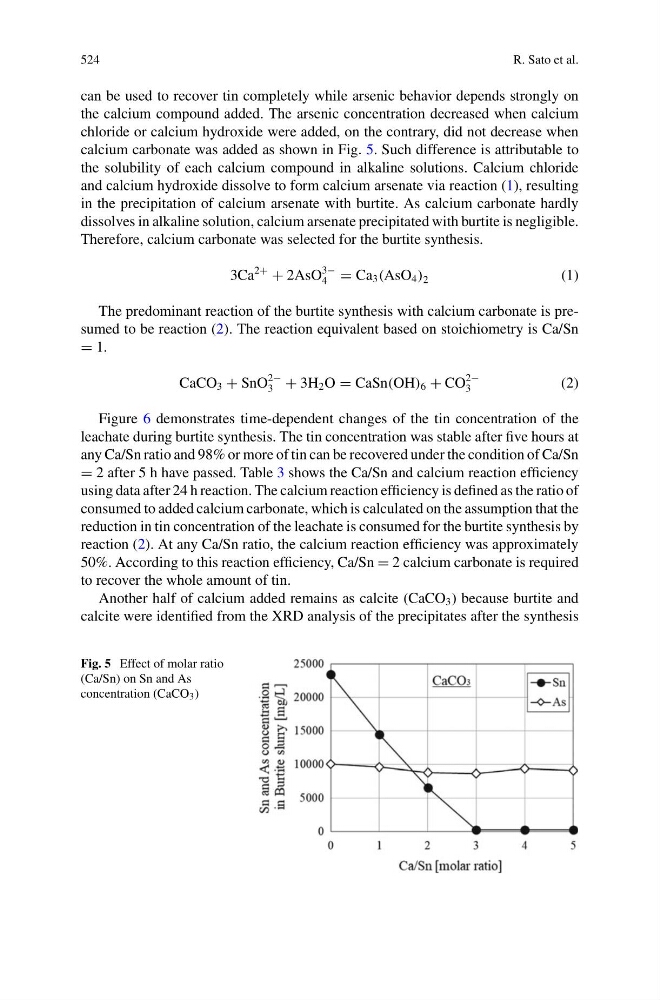
can be used to recover tin completely while arsenic behavior depends strongly on
the calcium compound added. The arsenic concentration decreased when calcium
chloride or calcium hydroxide were added, on the contrary, did not decrease when
calcium carbonate was added as shown in Fig. 5. Such difference is attributable to
the solubility of each calcium compound in alkaline solutions. Calcium chloride
and calcium hydroxide dissolve to form calcium arsenate via reaction (1), resulting
in the precipitation of calcium arsenate with burtite. As calcium carbonate hardly
dissolves in alkaline solution, calcium arsenate precipitated with burtite is negligible.
Therefore, calcium carbonate was selected for the burtite synthesis.
3Ca
2+
+ 2AsO
3−
4 = Ca 3 (AsO 4 ) 2
(1)
The predominant reaction of the burtite synthesis with calcium carbonate is presumed to be reaction (2). The reaction equivalent based on stoichiometry is Ca/Sn
= 1.
CaCO 3 + SnO
2−
3 + 3H 2 O = CaSn(OH) 6 + CO
2−
3
(2)
Figure 6 demonstrates time-dependent changes of the tin concentration of the
leachate during burtite synthesis. The tin concentration was stable after five hours at
any Ca/Sn ratio and 98% or more of tin can be recovered under the condition of Ca/Sn
= 2 after 5 h have passed. Table 3 shows the Ca/Sn and calcium reaction efficiency
using data after 24 h reaction. The calcium reaction efficiency is defined as the ratio of
consumed to added calcium carbonate, which is calculated on the assumption that the
reduction in tin concentration of the leachate is consumed for the burtite synthesis by
reaction (2). At any Ca/Sn ratio, the calcium reaction efficiency was approximately
50%. According to this reaction efficiency, Ca/Sn = 2 calcium carbonate is required
to recover the whole amount of tin.
Another half of calcium added remains as calcite (CaCO 3 ) because burtite and
calcite were identified from the XRD analysis of the precipitates after the synthesis
Fig. 5 Effect of molar ratio
(Ca/Sn) on Sn and As
concentration (CaCO 3 )
R. Sato et al.
can be used to recover tin completely while arsenic behavior depends strongly on
the calcium compound added. The arsenic concentration decreased when calcium
chloride or calcium hydroxide were added, on the contrary, did not decrease when
calcium carbonate was added as shown in Fig. 5. Such difference is attributable to
the solubility of each calcium compound in alkaline solutions. Calcium chloride
and calcium hydroxide dissolve to form calcium arsenate via reaction (1), resulting
in the precipitation of calcium arsenate with burtite. As calcium carbonate hardly
dissolves in alkaline solution, calcium arsenate precipitated with burtite is negligible.
Therefore, calcium carbonate was selected for the burtite synthesis.
3Ca
2+
+ 2AsO
3−
4 = Ca 3 (AsO 4 ) 2
(1)
The predominant reaction of the burtite synthesis with calcium carbonate is presumed to be reaction (2). The reaction equivalent based on stoichiometry is Ca/Sn
= 1.
CaCO 3 + SnO
2−
3 + 3H 2 O = CaSn(OH) 6 + CO
2−
3
(2)
Figure 6 demonstrates time-dependent changes of the tin concentration of the
leachate during burtite synthesis. The tin concentration was stable after five hours at
any Ca/Sn ratio and 98% or more of tin can be recovered under the condition of Ca/Sn
= 2 after 5 h have passed. Table 3 shows the Ca/Sn and calcium reaction efficiency
using data after 24 h reaction. The calcium reaction efficiency is defined as the ratio of
consumed to added calcium carbonate, which is calculated on the assumption that the
reduction in tin concentration of the leachate is consumed for the burtite synthesis by
reaction (2). At any Ca/Sn ratio, the calcium reaction efficiency was approximately
50%. According to this reaction efficiency, Ca/Sn = 2 calcium carbonate is required
to recover the whole amount of tin.
Another half of calcium added remains as calcite (CaCO 3 ) because burtite and
calcite were identified from the XRD analysis of the precipitates after the synthesis
Fig. 5 Effect of molar ratio
(Ca/Sn) on Sn and As
concentration (CaCO 3 )