

510
L. Reemeyer
Ag, resulting in Ag-rich lead concentrates. Fine grained SEDEX deposits (e.g. Century, McArthur River, Mt Isa) typically require fine regrinding to maximize lead and
zinc recovery and concentrate quality, increasing processing costs. MVT/Irish/CRD
tend to have high proportions of carbonate in gangue minerals, and therefore have
significantly less challenges with acid-rock drainage issues from tailings than other
deposit (e.g. VMS, SEDEX). In some cases, it is possible to produce saleable agricultural lime by-product from MVT flotation tailings (e.g. Tennessee). Epithermal
deposits, such as those in Mexico typically have high precious metal content, resulting in high-value lead concentrates with elevated Ag and Au. Such concentrates may
also be enriched in impurities such as Bi and Sb. Therefore smelters (e.g. Penoles)
may tailor their processes to manage both high precious metals and impurities. VMS
deposits can contain economic quantities of copper and precious metals, although
the head grades of these can vary considerably. For example, in some zinc containing VMS deposits, copper dominates economic value (e.g. Neves Corvo, Portugal),
some are gold rich (e.g. LaRonde, Canada, Rosebery, Australia) and some are very
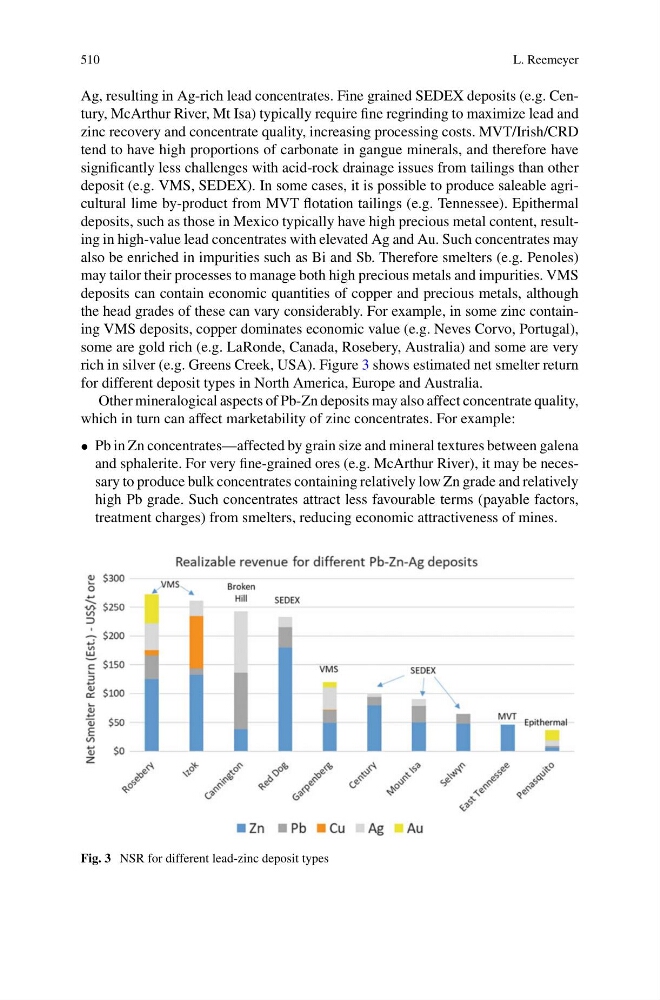
rich in silver (e.g. Greens Creek, USA). Figure 3 shows estimated net smelter return
for different deposit types in North America, Europe and Australia.
Other mineralogical aspects of Pb-Zn deposits may also affect concentrate quality,
which in turn can affect marketability of zinc concentrates. For example:
• Pb in Zn concentrates—affected by grain size and mineral textures between galena
and sphalerite. For very fine-grained ores (e.g. McArthur River), it may be necessary to produce bulk concentrates containing relatively low Zn grade and relatively
high Pb grade. Such concentrates attract less favourable terms (payable factors,
treatment charges) from smelters, reducing economic attractiveness of mines.
Fig. 3 NSR for different lead-zinc deposit types
L. Reemeyer
Ag, resulting in Ag-rich lead concentrates. Fine grained SEDEX deposits (e.g. Century, McArthur River, Mt Isa) typically require fine regrinding to maximize lead and
zinc recovery and concentrate quality, increasing processing costs. MVT/Irish/CRD
tend to have high proportions of carbonate in gangue minerals, and therefore have
significantly less challenges with acid-rock drainage issues from tailings than other
deposit (e.g. VMS, SEDEX). In some cases, it is possible to produce saleable agricultural lime by-product from MVT flotation tailings (e.g. Tennessee). Epithermal
deposits, such as those in Mexico typically have high precious metal content, resulting in high-value lead concentrates with elevated Ag and Au. Such concentrates may
also be enriched in impurities such as Bi and Sb. Therefore smelters (e.g. Penoles)
may tailor their processes to manage both high precious metals and impurities. VMS
deposits can contain economic quantities of copper and precious metals, although
the head grades of these can vary considerably. For example, in some zinc containing VMS deposits, copper dominates economic value (e.g. Neves Corvo, Portugal),
some are gold rich (e.g. LaRonde, Canada, Rosebery, Australia) and some are very
rich in silver (e.g. Greens Creek, USA). Figure 3 shows estimated net smelter return
for different deposit types in North America, Europe and Australia.
Other mineralogical aspects of Pb-Zn deposits may also affect concentrate quality,
which in turn can affect marketability of zinc concentrates. For example:
• Pb in Zn concentrates—affected by grain size and mineral textures between galena
and sphalerite. For very fine-grained ores (e.g. McArthur River), it may be necessary to produce bulk concentrates containing relatively low Zn grade and relatively
high Pb grade. Such concentrates attract less favourable terms (payable factors,
treatment charges) from smelters, reducing economic attractiveness of mines.
Fig. 3 NSR for different lead-zinc deposit types