

486
Z. Qi and Z. F. Yuan
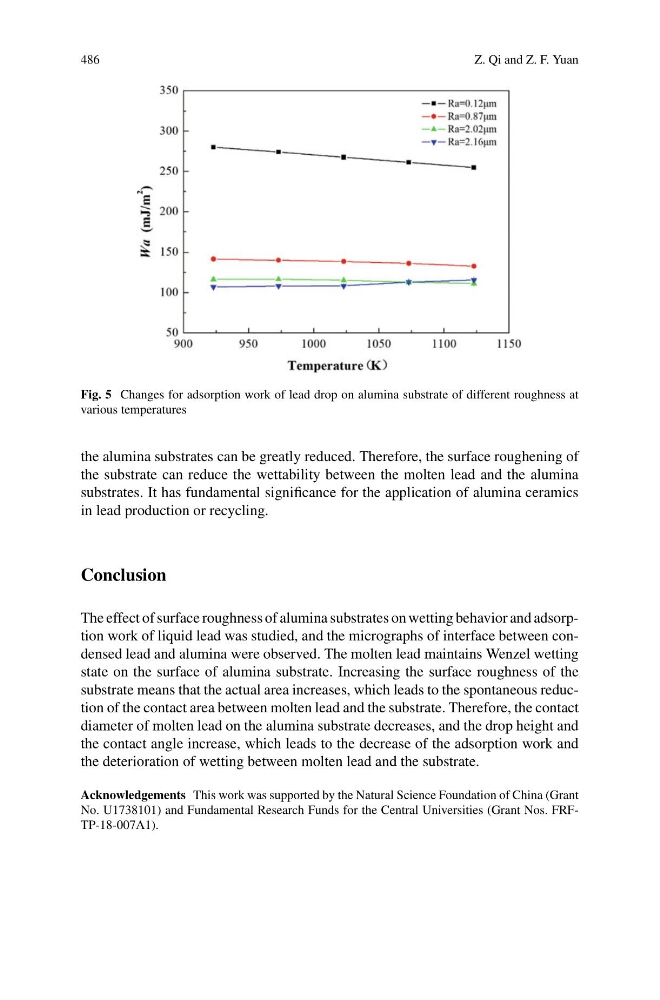
Fig. 5 Changes for adsorption work of lead drop on alumina substrate of different roughness at
various temperatures
the alumina substrates can be greatly reduced. Therefore, the surface roughening of
the substrate can reduce the wettability between the molten lead and the alumina
substrates. It has fundamental significance for the application of alumina ceramics
in lead production or recycling.
Conclusion
The effect of surface roughness of alumina substrates on wetting behavior and adsorption work of liquid lead was studied, and the micrographs of interface between condensed lead and alumina were observed. The molten lead maintains Wenzel wetting
state on the surface of alumina substrate. Increasing the surface roughness of the
substrate means that the actual area increases, which leads to the spontaneous reduction of the contact area between molten lead and the substrate. Therefore, the contact
diameter of molten lead on the alumina substrate decreases, and the drop height and
the contact angle increase, which leads to the decrease of the adsorption work and
the deterioration of wetting between molten lead and the substrate.
Acknowledgements This work was supported by the Natural Science Foundation of China (Grant
No. U1738101) and Fundamental Research Funds for the Central Universities (Grant Nos. FRFTP-18-007A1).
Z. Qi and Z. F. Yuan
Fig. 5 Changes for adsorption work of lead drop on alumina substrate of different roughness at
various temperatures
the alumina substrates can be greatly reduced. Therefore, the surface roughening of
the substrate can reduce the wettability between the molten lead and the alumina
substrates. It has fundamental significance for the application of alumina ceramics
in lead production or recycling.
Conclusion
The effect of surface roughness of alumina substrates on wetting behavior and adsorption work of liquid lead was studied, and the micrographs of interface between condensed lead and alumina were observed. The molten lead maintains Wenzel wetting
state on the surface of alumina substrate. Increasing the surface roughness of the
substrate means that the actual area increases, which leads to the spontaneous reduction of the contact area between molten lead and the substrate. Therefore, the contact
diameter of molten lead on the alumina substrate decreases, and the drop height and
the contact angle increase, which leads to the decrease of the adsorption work and
the deterioration of wetting between molten lead and the substrate.
Acknowledgements This work was supported by the Natural Science Foundation of China (Grant
No. U1738101) and Fundamental Research Funds for the Central Universities (Grant Nos. FRFTP-18-007A1).