

Leaching of Turkish Oxidized Pb–Zn Flotation Tailings …
459
Table 5 Metal dissolution with 1.0 M CA concentration at 1/10 S/L ratio at 60 and 80 °C leaching
temperatures
Citric acid (CA)
Zn (%)
As (%)
Fe (%)
Pb (%)
Time
60 °C
1.0 M
1/10 S/L
400 rpm
30 min
72.6
12.5
9.2
9.9
60 min
80.0
13.2
11.1
10.5
120 min
84.4
14.7
12.8
10.9
Metal
Dissolution
Order
Zn > As > Fe > Pb
Time
80 °C
1.0 M
1/10 S/L
400 rpm
30 min
83.5
14.0
11.0
10.0
60 min
89.1
15.0
13.0
11.0
120 min
90.6
16.0
17.0
11.0
180 min
91.0
17.0
19.0
12.0
Metal
Dissolution
Order
Zn > Fe > As > Pb
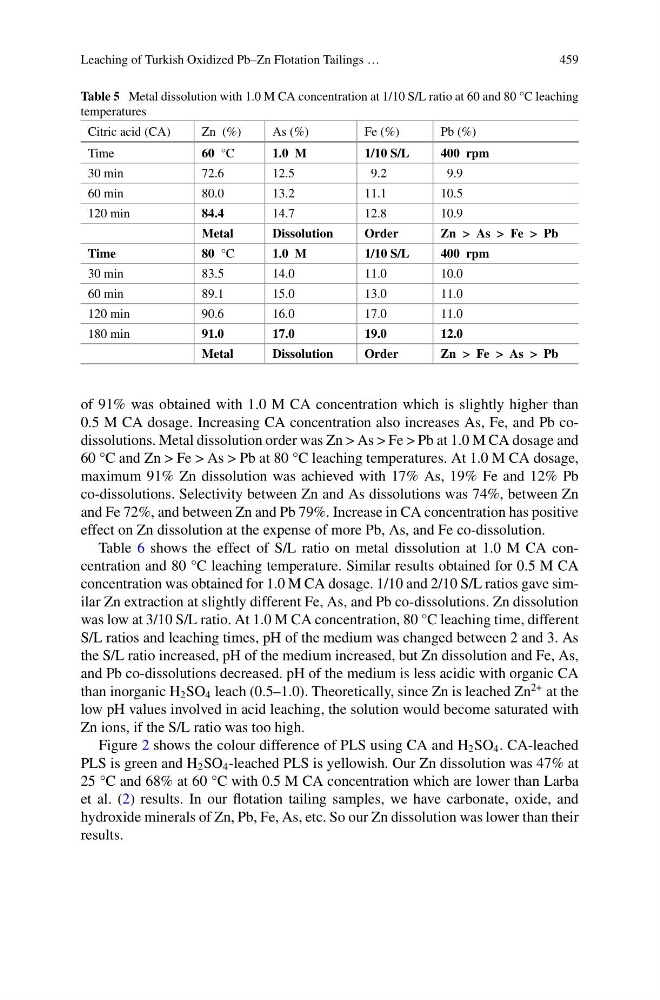
of 91% was obtained with 1.0 M CA concentration which is slightly higher than
0.5 M CA dosage. Increasing CA concentration also increases As, Fe, and Pb codissolutions. Metal dissolution order was Zn > As > Fe > Pb at 1.0 M CA dosage and
60 °C and Zn > Fe > As > Pb at 80 °C leaching temperatures. At 1.0 M CA dosage,
maximum 91% Zn dissolution was achieved with 17% As, 19% Fe and 12% Pb
co-dissolutions. Selectivity between Zn and As dissolutions was 74%, between Zn
and Fe 72%, and between Zn and Pb 79%. Increase in CA concentration has positive
effect on Zn dissolution at the expense of more Pb, As, and Fe co-dissolution.
Table 6 shows the effect of S/L ratio on metal dissolution at 1.0 M CA concentration and 80 °C leaching temperature. Similar results obtained for 0.5 M CA
concentration was obtained for 1.0 M CA dosage. 1/10 and 2/10 S/L ratios gave similar Zn extraction at slightly different Fe, As, and Pb co-dissolutions. Zn dissolution
was low at 3/10 S/L ratio. At 1.0 M CA concentration, 80 °C leaching time, different
S/L ratios and leaching times, pH of the medium was changed between 2 and 3. As
the S/L ratio increased, pH of the medium increased, but Zn dissolution and Fe, As,
and Pb co-dissolutions decreased. pH of the medium is less acidic with organic CA
than inorganic H 2 SO 4 leach (0.5–1.0). Theoretically, since Zn is leached Zn
2+ at the
low pH values involved in acid leaching, the solution would become saturated with
Zn ions, if the S/L ratio was too high.
Figure 2 shows the colour difference of PLS using CA and H 2 SO 4 . CA-leached
PLS is green and H 2 SO 4 -leached PLS is yellowish. Our Zn dissolution was 47% at
25 °C and 68% at 60 °C with 0.5 M CA concentration which are lower than Larba
et al. (2) results. In our flotation tailing samples, we have carbonate, oxide, and
hydroxide minerals of Zn, Pb, Fe, As, etc. So our Zn dissolution was lower than their
results.
459
Table 5 Metal dissolution with 1.0 M CA concentration at 1/10 S/L ratio at 60 and 80 °C leaching
temperatures
Citric acid (CA)
Zn (%)
As (%)
Fe (%)
Pb (%)
Time
60 °C
1.0 M
1/10 S/L
400 rpm
30 min
72.6
12.5
9.2
9.9
60 min
80.0
13.2
11.1
10.5
120 min
84.4
14.7
12.8
10.9
Metal
Dissolution
Order
Zn > As > Fe > Pb
Time
80 °C
1.0 M
1/10 S/L
400 rpm
30 min
83.5
14.0
11.0
10.0
60 min
89.1
15.0
13.0
11.0
120 min
90.6
16.0
17.0
11.0
180 min
91.0
17.0
19.0
12.0
Metal
Dissolution
Order
Zn > Fe > As > Pb
of 91% was obtained with 1.0 M CA concentration which is slightly higher than
0.5 M CA dosage. Increasing CA concentration also increases As, Fe, and Pb codissolutions. Metal dissolution order was Zn > As > Fe > Pb at 1.0 M CA dosage and
60 °C and Zn > Fe > As > Pb at 80 °C leaching temperatures. At 1.0 M CA dosage,
maximum 91% Zn dissolution was achieved with 17% As, 19% Fe and 12% Pb
co-dissolutions. Selectivity between Zn and As dissolutions was 74%, between Zn
and Fe 72%, and between Zn and Pb 79%. Increase in CA concentration has positive
effect on Zn dissolution at the expense of more Pb, As, and Fe co-dissolution.
Table 6 shows the effect of S/L ratio on metal dissolution at 1.0 M CA concentration and 80 °C leaching temperature. Similar results obtained for 0.5 M CA
concentration was obtained for 1.0 M CA dosage. 1/10 and 2/10 S/L ratios gave similar Zn extraction at slightly different Fe, As, and Pb co-dissolutions. Zn dissolution
was low at 3/10 S/L ratio. At 1.0 M CA concentration, 80 °C leaching time, different
S/L ratios and leaching times, pH of the medium was changed between 2 and 3. As
the S/L ratio increased, pH of the medium increased, but Zn dissolution and Fe, As,
and Pb co-dissolutions decreased. pH of the medium is less acidic with organic CA
than inorganic H 2 SO 4 leach (0.5–1.0). Theoretically, since Zn is leached Zn
2+ at the
low pH values involved in acid leaching, the solution would become saturated with
Zn ions, if the S/L ratio was too high.
Figure 2 shows the colour difference of PLS using CA and H 2 SO 4 . CA-leached
PLS is green and H 2 SO 4 -leached PLS is yellowish. Our Zn dissolution was 47% at
25 °C and 68% at 60 °C with 0.5 M CA concentration which are lower than Larba
et al. (2) results. In our flotation tailing samples, we have carbonate, oxide, and
hydroxide minerals of Zn, Pb, Fe, As, etc. So our Zn dissolution was lower than their
results.