

Leaching of Turkish Oxidized Pb–Zn Flotation Tailings …
455
dissolution order was Zn > Fe without Pb (Kaya et al. 5). At 1/10 S/L ratio, HNO 3
achieved 70% Zn + 23% Pb and 0% Fe dissolutions at 1.0 M dosage, 40 °C leaching
temperature, and 30 min leaching time; HCl succeeded 92% Zn + 10% Pb + 10%
Fe at 1.0 M dosage, 80 °C leaching temperature, and 30 min leaching time, and
90% Zn + 10% Pb and 0% Fe at 0.5 M dosage, 80 °C leaching temperature, and
30 min leaching time and H 2 SO 4 achieved 92% Zn + 0% Pb + 12% Fe at 1.0 M
dosage, 40 °C leaching temperature, and 60 min leaching time and 91% Zn + 5%
Fe + 0% Pb at 0.5 M dosage, 40 °C leaching temperature, 120 min leaching time.
Optimum leaching reagent was 1.0 M H 2 SO 4 . From three tested inorganic acids,
H 2 SO 4 achieved the maximum Zn dissolution without Pb co-dissolution at 40 °C
and 60 min leaching time.
Citric Acid (C 6 H 8 O 7 ) Leach in Absence of NaCl
Citric acid (C 6 H 8 O 7 or CH 2 COOH–C(OH)COOH–CH 2 COOH) is a natural weak
organic acid with low molecular weight. It is colorless and odorless and has crystalline
structure. At room temperature, CA is a white hygroscopic crystalline powder. The
pH of the CA is 3.5. Citric acid is an excellent chelating agent, binding metals by
making them soluble (i.e. Cu). A citrate is a derivative of CA (C 3 H 5 O(COO)
3−
3 ).
Solubility of CA in 100 mL water is 147.76 g at 20 °C, 220 g at 40 °C, and 382.48 g
at 80 °C. CA is also considered as non-persistent biodegradable organic product,
and its half-life in soil suspension is close to 8 days [2]. These characteristics are
considered as advantageous since alone, and at low concentration, it can dissolve
effectively ZnO without the risk of pollution or post-treatment. This makes it as a
good choice for a more ecological treatment of Zn. The reaction steps between zinc
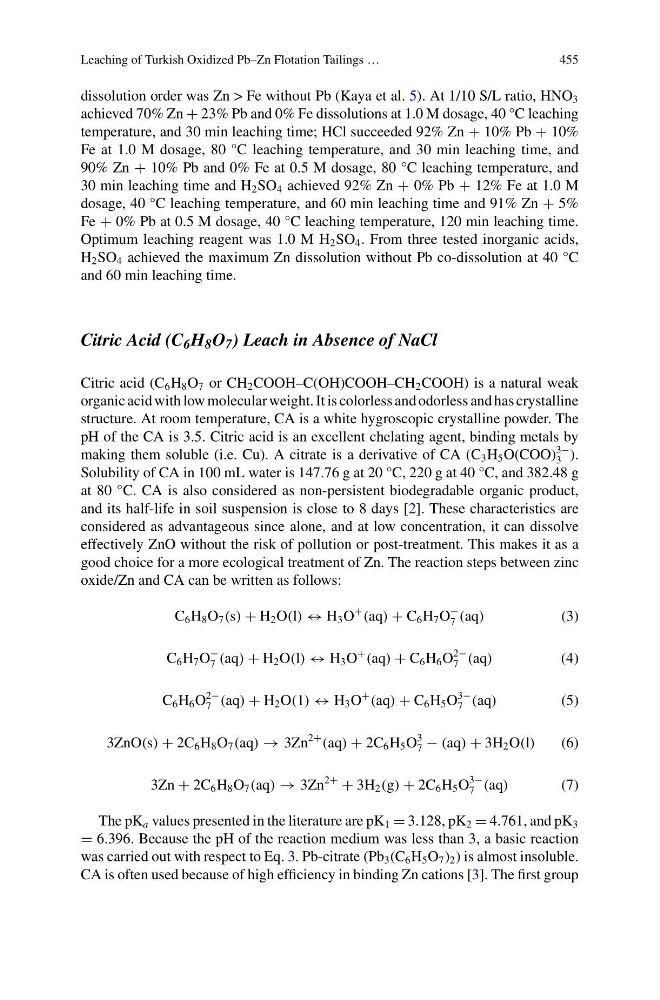
oxide/Zn and CA can be written as follows:
C 6 H 8 O 7 (s) + H 2 O(l) ↔ H 3 O
+
(aq) + C 6 H 7 O
−
7 (aq)
(3)
C 6 H 7 O
−
7 (aq) + H 2 O(l) ↔ H 3 O
+
(aq) + C 6 H 6 O
2−
7 (aq)
(4)
C 6 H 6 O
2−
7 (aq) + H 2 O(1) ↔ H 3 O
+
(aq) + C 6 H 5 O
3−
7 (aq)
(5)
3ZnO(s) + 2C 6 H 8 O 7 (aq) → 3Zn
2+
(aq) + 2C 6 H 5 O
3
7 − (aq) + 3H 2 O(l)
(6)
3Zn + 2C 6 H 8 O 7 (aq) → 3Zn
2+
+ 3H 2 (g) + 2C 6 H 5 O
3−
7 (aq)
(7)
The pK a values presented in the literature are pK 1 = 3.128, pK 2 = 4.761, and pK 3
= 6.396. Because the pH of the reaction medium was less than 3, a basic reaction
was carried out with respect to Eq. 3. Pb-citrate (Pb 3 (C 6 H 5 O 7 ) 2 ) is almost insoluble.
CA is often used because of high efficiency in binding Zn cations [3]. The first group
455
dissolution order was Zn > Fe without Pb (Kaya et al. 5). At 1/10 S/L ratio, HNO 3
achieved 70% Zn + 23% Pb and 0% Fe dissolutions at 1.0 M dosage, 40 °C leaching
temperature, and 30 min leaching time; HCl succeeded 92% Zn + 10% Pb + 10%
Fe at 1.0 M dosage, 80 °C leaching temperature, and 30 min leaching time, and
90% Zn + 10% Pb and 0% Fe at 0.5 M dosage, 80 °C leaching temperature, and
30 min leaching time and H 2 SO 4 achieved 92% Zn + 0% Pb + 12% Fe at 1.0 M
dosage, 40 °C leaching temperature, and 60 min leaching time and 91% Zn + 5%
Fe + 0% Pb at 0.5 M dosage, 40 °C leaching temperature, 120 min leaching time.
Optimum leaching reagent was 1.0 M H 2 SO 4 . From three tested inorganic acids,
H 2 SO 4 achieved the maximum Zn dissolution without Pb co-dissolution at 40 °C
and 60 min leaching time.
Citric Acid (C 6 H 8 O 7 ) Leach in Absence of NaCl
Citric acid (C 6 H 8 O 7 or CH 2 COOH–C(OH)COOH–CH 2 COOH) is a natural weak
organic acid with low molecular weight. It is colorless and odorless and has crystalline
structure. At room temperature, CA is a white hygroscopic crystalline powder. The
pH of the CA is 3.5. Citric acid is an excellent chelating agent, binding metals by
making them soluble (i.e. Cu). A citrate is a derivative of CA (C 3 H 5 O(COO)
3−
3 ).
Solubility of CA in 100 mL water is 147.76 g at 20 °C, 220 g at 40 °C, and 382.48 g
at 80 °C. CA is also considered as non-persistent biodegradable organic product,
and its half-life in soil suspension is close to 8 days [2]. These characteristics are
considered as advantageous since alone, and at low concentration, it can dissolve
effectively ZnO without the risk of pollution or post-treatment. This makes it as a
good choice for a more ecological treatment of Zn. The reaction steps between zinc
oxide/Zn and CA can be written as follows:
C 6 H 8 O 7 (s) + H 2 O(l) ↔ H 3 O
+
(aq) + C 6 H 7 O
−
7 (aq)
(3)
C 6 H 7 O
−
7 (aq) + H 2 O(l) ↔ H 3 O
+
(aq) + C 6 H 6 O
2−
7 (aq)
(4)
C 6 H 6 O
2−
7 (aq) + H 2 O(1) ↔ H 3 O
+
(aq) + C 6 H 5 O
3−
7 (aq)
(5)
3ZnO(s) + 2C 6 H 8 O 7 (aq) → 3Zn
2+
(aq) + 2C 6 H 5 O
3
7 − (aq) + 3H 2 O(l)
(6)
3Zn + 2C 6 H 8 O 7 (aq) → 3Zn
2+
+ 3H 2 (g) + 2C 6 H 5 O
3−
7 (aq)
(7)
The pK a values presented in the literature are pK 1 = 3.128, pK 2 = 4.761, and pK 3
= 6.396. Because the pH of the reaction medium was less than 3, a basic reaction
was carried out with respect to Eq. 3. Pb-citrate (Pb 3 (C 6 H 5 O 7 ) 2 ) is almost insoluble.
CA is often used because of high efficiency in binding Zn cations [3]. The first group