

444
J. Antrekowitsch and G. Hanke
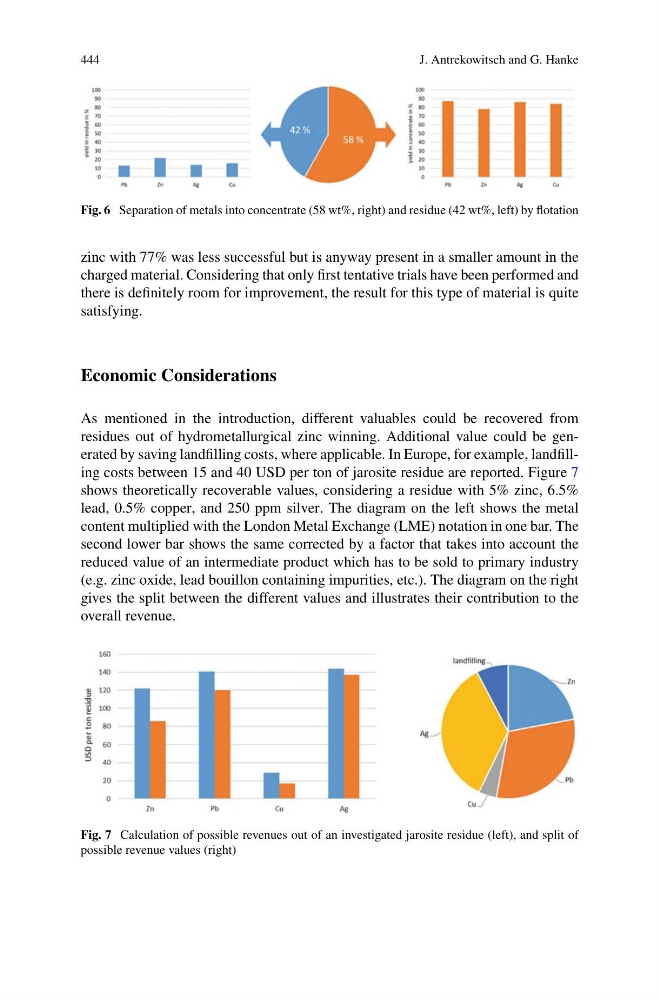
Fig. 6 Separation of metals into concentrate (58 wt%, right) and residue (42 wt%, left) by flotation
zinc with 77% was less successful but is anyway present in a smaller amount in the
charged material. Considering that only first tentative trials have been performed and
there is definitely room for improvement, the result for this type of material is quite
satisfying.
Economic Considerations
As mentioned in the introduction, different valuables could be recovered from
residues out of hydrometallurgical zinc winning. Additional value could be generated by saving landfilling costs, where applicable. In Europe, for example, landfilling costs between 15 and 40 USD per ton of jarosite residue are reported. Figure 7
shows theoretically recoverable values, considering a residue with 5% zinc, 6.5%
lead, 0.5% copper, and 250 ppm silver. The diagram on the left shows the metal
content multiplied with the London Metal Exchange (LME) notation in one bar. The
second lower bar shows the same corrected by a factor that takes into account the
reduced value of an intermediate product which has to be sold to primary industry
(e.g. zinc oxide, lead bouillon containing impurities, etc.). The diagram on the right
gives the split between the different values and illustrates their contribution to the
overall revenue.
Fig. 7 Calculation of possible revenues out of an investigated jarosite residue (left), and split of
possible revenue values (right)
J. Antrekowitsch and G. Hanke
Fig. 6 Separation of metals into concentrate (58 wt%, right) and residue (42 wt%, left) by flotation
zinc with 77% was less successful but is anyway present in a smaller amount in the
charged material. Considering that only first tentative trials have been performed and
there is definitely room for improvement, the result for this type of material is quite
satisfying.
Economic Considerations
As mentioned in the introduction, different valuables could be recovered from
residues out of hydrometallurgical zinc winning. Additional value could be generated by saving landfilling costs, where applicable. In Europe, for example, landfilling costs between 15 and 40 USD per ton of jarosite residue are reported. Figure 7
shows theoretically recoverable values, considering a residue with 5% zinc, 6.5%
lead, 0.5% copper, and 250 ppm silver. The diagram on the left shows the metal
content multiplied with the London Metal Exchange (LME) notation in one bar. The
second lower bar shows the same corrected by a factor that takes into account the
reduced value of an intermediate product which has to be sold to primary industry
(e.g. zinc oxide, lead bouillon containing impurities, etc.). The diagram on the right
gives the split between the different values and illustrates their contribution to the
overall revenue.
Fig. 7 Calculation of possible revenues out of an investigated jarosite residue (left), and split of
possible revenue values (right)