

Refractory Challenges in Lead and Zinc Furnaces
23
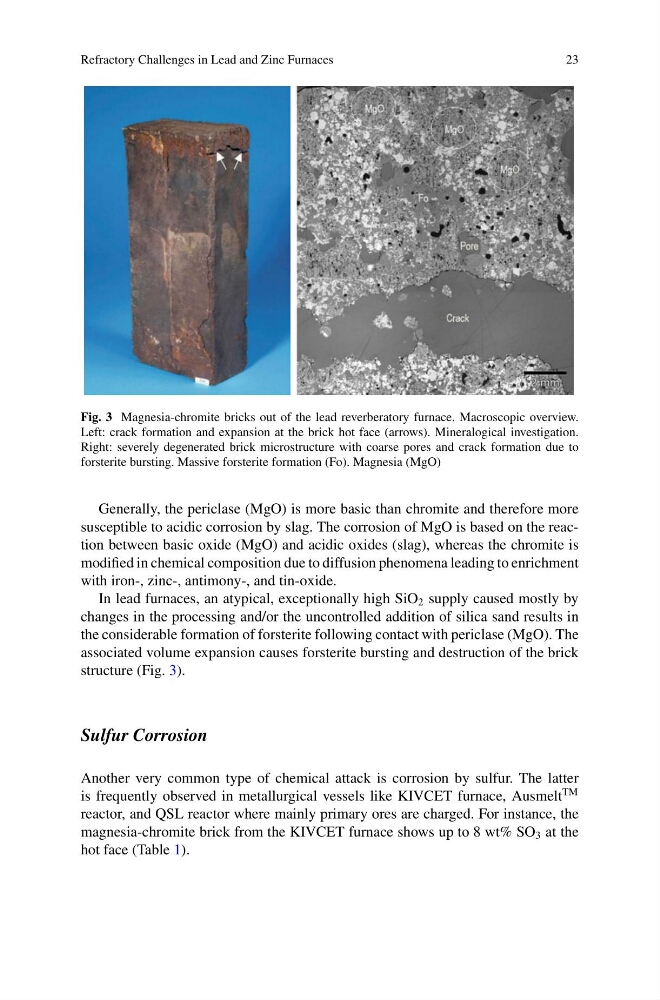
Fig. 3 Magnesia-chromite bricks out of the lead reverberatory furnace. Macroscopic overview.
Left: crack formation and expansion at the brick hot face (arrows). Mineralogical investigation.
Right: severely degenerated brick microstructure with coarse pores and crack formation due to
forsterite bursting. Massive forsterite formation (Fo). Magnesia (MgO)
Generally, the periclase (MgO) is more basic than chromite and therefore more
susceptible to acidic corrosion by slag. The corrosion of MgO is based on the reaction between basic oxide (MgO) and acidic oxides (slag), whereas the chromite is
modified in chemical composition due to diffusion phenomena leading to enrichment
with iron-, zinc-, antimony-, and tin-oxide.
In lead furnaces, an atypical, exceptionally high SiO 2 supply caused mostly by
changes in the processing and/or the uncontrolled addition of silica sand results in
the considerable formation of forsterite following contact with periclase (MgO). The
associated volume expansion causes forsterite bursting and destruction of the brick
structure (Fig. 3).
Sulfur Corrosion
Another very common type of chemical attack is corrosion by sulfur. The latter
is frequently observed in metallurgical vessels like KIVCET furnace, Ausmelt
TM
reactor, and QSL reactor where mainly primary ores are charged. For instance, the
magnesia-chromite brick from the KIVCET furnace shows up to 8 wt% SO 3 at the
hot face (Table 1).
23
Fig. 3 Magnesia-chromite bricks out of the lead reverberatory furnace. Macroscopic overview.
Left: crack formation and expansion at the brick hot face (arrows). Mineralogical investigation.
Right: severely degenerated brick microstructure with coarse pores and crack formation due to
forsterite bursting. Massive forsterite formation (Fo). Magnesia (MgO)
Generally, the periclase (MgO) is more basic than chromite and therefore more
susceptible to acidic corrosion by slag. The corrosion of MgO is based on the reaction between basic oxide (MgO) and acidic oxides (slag), whereas the chromite is
modified in chemical composition due to diffusion phenomena leading to enrichment
with iron-, zinc-, antimony-, and tin-oxide.
In lead furnaces, an atypical, exceptionally high SiO 2 supply caused mostly by
changes in the processing and/or the uncontrolled addition of silica sand results in
the considerable formation of forsterite following contact with periclase (MgO). The
associated volume expansion causes forsterite bursting and destruction of the brick
structure (Fig. 3).
Sulfur Corrosion
Another very common type of chemical attack is corrosion by sulfur. The latter
is frequently observed in metallurgical vessels like KIVCET furnace, Ausmelt
TM
reactor, and QSL reactor where mainly primary ores are charged. For instance, the
magnesia-chromite brick from the KIVCET furnace shows up to 8 wt% SO 3 at the
hot face (Table 1).