

434
R. Kh. Sharipov et al.
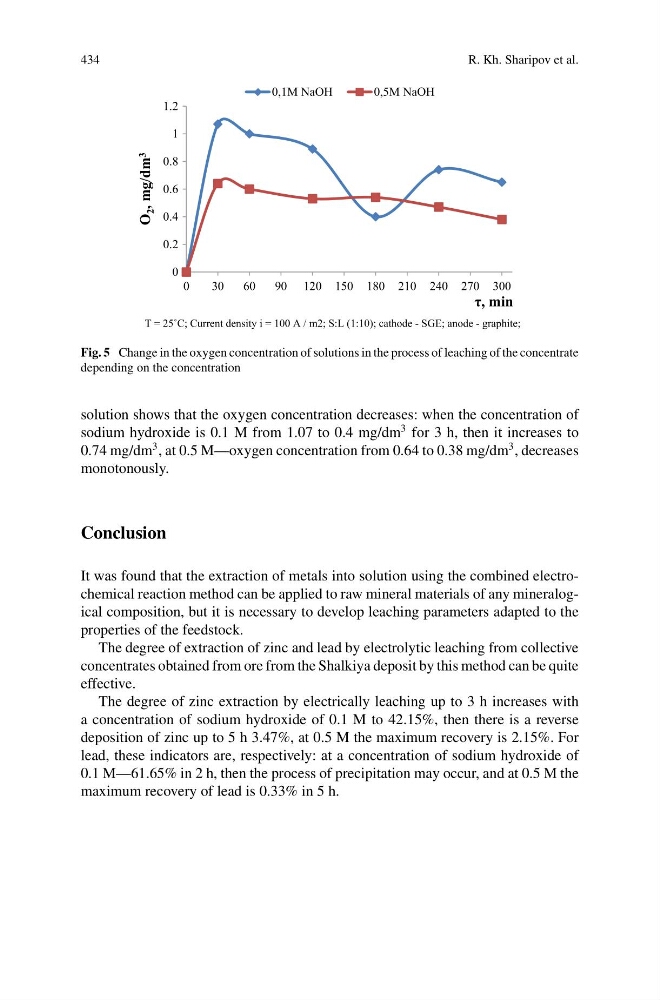
T = 25˚C; Current density i = 100 A / m2; S:L (1:10); cathode - SGE; anode - graphite;
0
0.2
0.4
0.6
0.8
1
1.2
0
30
60
90 120 150 180 210 240 270 300
O
2 , mg/dm 3
τ, min
0,1M NaOH
0,5M NaOH
Fig. 5 Change in the oxygen concentration of solutions in the process of leaching of the concentrate
depending on the concentration
solution shows that the oxygen concentration decreases: when the concentration of
sodium hydroxide is 0.1 M from 1.07 to 0.4 mg/dm
3 for 3 h, then it increases to
0.74 mg/dm
3 , at 0.5 M—oxygen concentration from 0.64 to 0.38 mg/dm
3 , decreases
monotonously.
Conclusion
It was found that the extraction of metals into solution using the combined electrochemical reaction method can be applied to raw mineral materials of any mineralogical composition, but it is necessary to develop leaching parameters adapted to the
properties of the feedstock.
The degree of extraction of zinc and lead by electrolytic leaching from collective
concentrates obtained from ore from the Shalkiya deposit by this method can be quite
effective.
The degree of zinc extraction by electrically leaching up to 3 h increases with
a concentration of sodium hydroxide of 0.1 M to 42.15%, then there is a reverse
deposition of zinc up to 5 h 3.47%, at 0.5 M the maximum recovery is 2.15%. For
lead, these indicators are, respectively: at a concentration of sodium hydroxide of
0.1 M—61.65% in 2 h, then the process of precipitation may occur, and at 0.5 M the
maximum recovery of lead is 0.33% in 5 h.
R. Kh. Sharipov et al.
T = 25˚C; Current density i = 100 A / m2; S:L (1:10); cathode - SGE; anode - graphite;
0
0.2
0.4
0.6
0.8
1
1.2
0
30
60
90 120 150 180 210 240 270 300
O
2 , mg/dm 3
τ, min
0,1M NaOH
0,5M NaOH
Fig. 5 Change in the oxygen concentration of solutions in the process of leaching of the concentrate
depending on the concentration
solution shows that the oxygen concentration decreases: when the concentration of
sodium hydroxide is 0.1 M from 1.07 to 0.4 mg/dm
3 for 3 h, then it increases to
0.74 mg/dm
3 , at 0.5 M—oxygen concentration from 0.64 to 0.38 mg/dm
3 , decreases
monotonously.
Conclusion
It was found that the extraction of metals into solution using the combined electrochemical reaction method can be applied to raw mineral materials of any mineralogical composition, but it is necessary to develop leaching parameters adapted to the
properties of the feedstock.
The degree of extraction of zinc and lead by electrolytic leaching from collective
concentrates obtained from ore from the Shalkiya deposit by this method can be quite
effective.
The degree of zinc extraction by electrically leaching up to 3 h increases with
a concentration of sodium hydroxide of 0.1 M to 42.15%, then there is a reverse
deposition of zinc up to 5 h 3.47%, at 0.5 M the maximum recovery is 2.15%. For
lead, these indicators are, respectively: at a concentration of sodium hydroxide of
0.1 M—61.65% in 2 h, then the process of precipitation may occur, and at 0.5 M the
maximum recovery of lead is 0.33% in 5 h.