

Lead and Zinc Extractive Metallurgy Research …
421
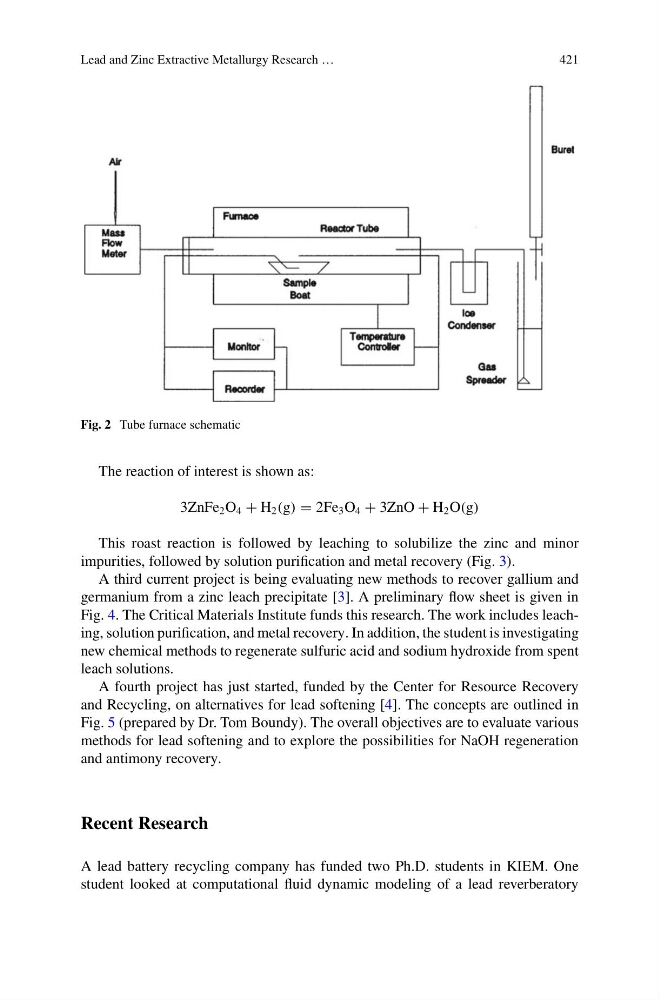
Fig. 2 Tube furnace schematic
The reaction of interest is shown as:
3ZnFe 2 O 4 + H 2 (g) = 2Fe 3 O 4 + 3ZnO + H 2 O(g)
This roast reaction is followed by leaching to solubilize the zinc and minor
impurities, followed by solution purification and metal recovery (Fig. 3).
A third current project is being evaluating new methods to recover gallium and
germanium from a zinc leach precipitate [3]. A preliminary flow sheet is given in
Fig. 4. The Critical Materials Institute funds this research. The work includes leaching, solution purification, and metal recovery. In addition, the student is investigating
new chemical methods to regenerate sulfuric acid and sodium hydroxide from spent
leach solutions.
A fourth project has just started, funded by the Center for Resource Recovery
and Recycling, on alternatives for lead softening [4]. The concepts are outlined in
Fig. 5 (prepared by Dr. Tom Boundy). The overall objectives are to evaluate various
methods for lead softening and to explore the possibilities for NaOH regeneration
and antimony recovery.
Recent Research
A lead battery recycling company has funded two Ph.D. students in KIEM. One
student looked at computational fluid dynamic modeling of a lead reverberatory
421
Fig. 2 Tube furnace schematic
The reaction of interest is shown as:
3ZnFe 2 O 4 + H 2 (g) = 2Fe 3 O 4 + 3ZnO + H 2 O(g)
This roast reaction is followed by leaching to solubilize the zinc and minor
impurities, followed by solution purification and metal recovery (Fig. 3).
A third current project is being evaluating new methods to recover gallium and
germanium from a zinc leach precipitate [3]. A preliminary flow sheet is given in
Fig. 4. The Critical Materials Institute funds this research. The work includes leaching, solution purification, and metal recovery. In addition, the student is investigating
new chemical methods to regenerate sulfuric acid and sodium hydroxide from spent
leach solutions.
A fourth project has just started, funded by the Center for Resource Recovery
and Recycling, on alternatives for lead softening [4]. The concepts are outlined in
Fig. 5 (prepared by Dr. Tom Boundy). The overall objectives are to evaluate various
methods for lead softening and to explore the possibilities for NaOH regeneration
and antimony recovery.
Recent Research
A lead battery recycling company has funded two Ph.D. students in KIEM. One
student looked at computational fluid dynamic modeling of a lead reverberatory