

Refractory Challenges in Lead and Zinc Furnaces
21
This paper gives an overview of the main wear mechanisms affecting the
refractory lining from various lead and zinc processing furnaces, such as the
QSL reactor, KIVCET furnace, Top Submerged Lance Technology (Outotec
Ausmelt
TM /Isasmelter
TM ), TBRC/Kaldo furnace, reverberatory furnace, and short
rotary furnace, as well as Waelz kiln.
Wear Phenomena
Slag Attack and Forsterite Bursting
Similar to the copper industry, the refractory lining in the lead industry is highly
affected by corrosion due to acidic slag. The main slag types for both industries
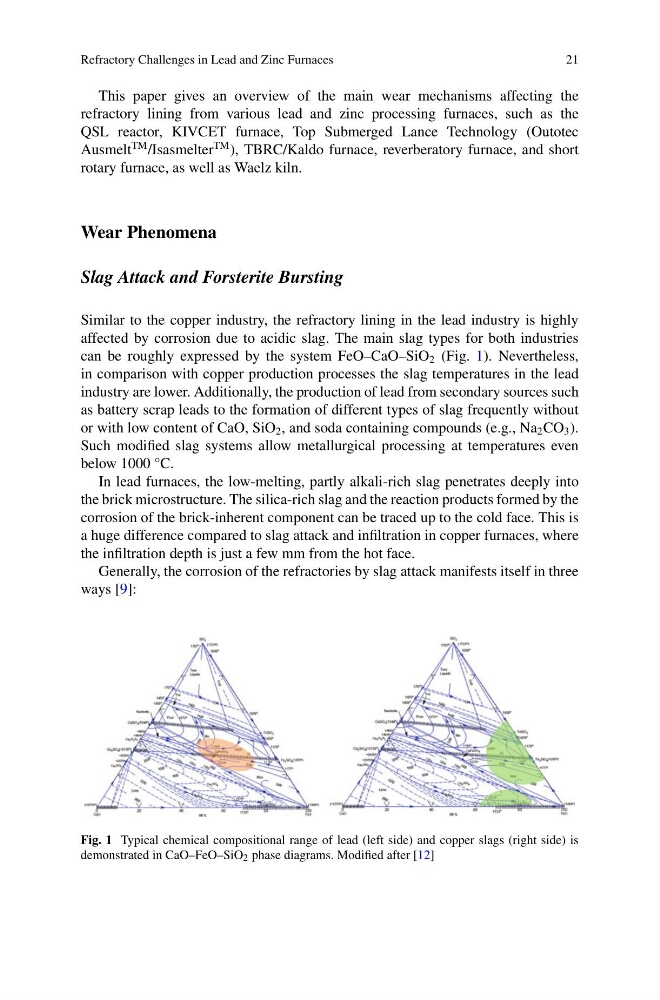
can be roughly expressed by the system FeO–CaO–SiO 2 (Fig. 1). Nevertheless,
in comparison with copper production processes the slag temperatures in the lead
industry are lower. Additionally, the production of lead from secondary sources such
as battery scrap leads to the formation of different types of slag frequently without
or with low content of CaO, SiO 2 , and soda containing compounds (e.g., Na 2 CO 3 ).
Such modified slag systems allow metallurgical processing at temperatures even
below 1000 °C.
In lead furnaces, the low-melting, partly alkali-rich slag penetrates deeply into
the brick microstructure. The silica-rich slag and the reaction products formed by the
corrosion of the brick-inherent component can be traced up to the cold face. This is
a huge difference compared to slag attack and infiltration in copper furnaces, where
the infiltration depth is just a few mm from the hot face.
Generally, the corrosion of the refractories by slag attack manifests itself in three
ways [9]:
Fig. 1 Typical chemical compositional range of lead (left side) and copper slags (right side) is
demonstrated in CaO–FeO–SiO 2 phase diagrams. Modified after [12]
21
This paper gives an overview of the main wear mechanisms affecting the
refractory lining from various lead and zinc processing furnaces, such as the
QSL reactor, KIVCET furnace, Top Submerged Lance Technology (Outotec
Ausmelt
TM /Isasmelter
TM ), TBRC/Kaldo furnace, reverberatory furnace, and short
rotary furnace, as well as Waelz kiln.
Wear Phenomena
Slag Attack and Forsterite Bursting
Similar to the copper industry, the refractory lining in the lead industry is highly
affected by corrosion due to acidic slag. The main slag types for both industries
can be roughly expressed by the system FeO–CaO–SiO 2 (Fig. 1). Nevertheless,
in comparison with copper production processes the slag temperatures in the lead
industry are lower. Additionally, the production of lead from secondary sources such
as battery scrap leads to the formation of different types of slag frequently without
or with low content of CaO, SiO 2 , and soda containing compounds (e.g., Na 2 CO 3 ).
Such modified slag systems allow metallurgical processing at temperatures even
below 1000 °C.
In lead furnaces, the low-melting, partly alkali-rich slag penetrates deeply into
the brick microstructure. The silica-rich slag and the reaction products formed by the
corrosion of the brick-inherent component can be traced up to the cold face. This is
a huge difference compared to slag attack and infiltration in copper furnaces, where
the infiltration depth is just a few mm from the hot face.
Generally, the corrosion of the refractories by slag attack manifests itself in three
ways [9]:
Fig. 1 Typical chemical compositional range of lead (left side) and copper slags (right side) is
demonstrated in CaO–FeO–SiO 2 phase diagrams. Modified after [12]