

414
C. C. S. de Oliveira and D. D. Pereira
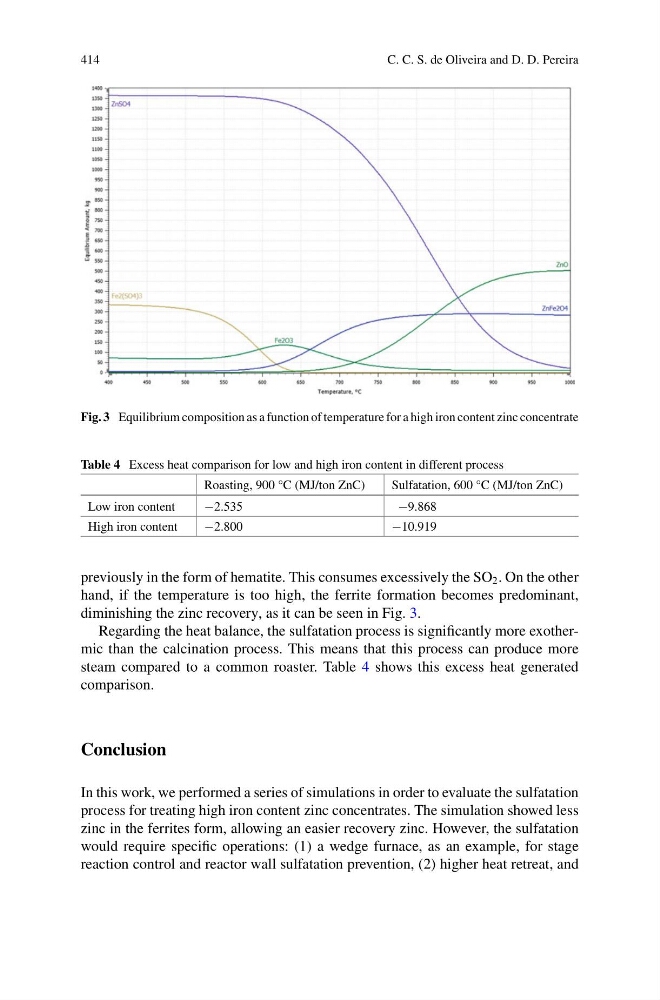
Fig. 3 Equilibrium composition as a function of temperature for a high iron content zinc concentrate
Table 4 Excess heat comparison for low and high iron content in different process
Roasting, 900 °C (MJ/ton ZnC)
Sulfatation, 600 °C (MJ/ton ZnC)
Low iron content
−2.535
−9.868
High iron content
−2.800
−10.919
previously in the form of hematite. This consumes excessively the SO 2 . On the other
hand, if the temperature is too high, the ferrite formation becomes predominant,
diminishing the zinc recovery, as it can be seen in Fig. 3.
Regarding the heat balance, the sulfatation process is significantly more exothermic than the calcination process. This means that this process can produce more
steam compared to a common roaster. Table 4 shows this excess heat generated
comparison.
Conclusion
In this work, we performed a series of simulations in order to evaluate the sulfatation
process for treating high iron content zinc concentrates. The simulation showed less
zinc in the ferrites form, allowing an easier recovery zinc. However, the sulfatation
would require specific operations: (1) a wedge furnace, as an example, for stage
reaction control and reactor wall sulfatation prevention, (2) higher heat retreat, and
C. C. S. de Oliveira and D. D. Pereira
Fig. 3 Equilibrium composition as a function of temperature for a high iron content zinc concentrate
Table 4 Excess heat comparison for low and high iron content in different process
Roasting, 900 °C (MJ/ton ZnC)
Sulfatation, 600 °C (MJ/ton ZnC)
Low iron content
−2.535
−9.868
High iron content
−2.800
−10.919
previously in the form of hematite. This consumes excessively the SO 2 . On the other
hand, if the temperature is too high, the ferrite formation becomes predominant,
diminishing the zinc recovery, as it can be seen in Fig. 3.
Regarding the heat balance, the sulfatation process is significantly more exothermic than the calcination process. This means that this process can produce more
steam compared to a common roaster. Table 4 shows this excess heat generated
comparison.
Conclusion
In this work, we performed a series of simulations in order to evaluate the sulfatation
process for treating high iron content zinc concentrates. The simulation showed less
zinc in the ferrites form, allowing an easier recovery zinc. However, the sulfatation
would require specific operations: (1) a wedge furnace, as an example, for stage
reaction control and reactor wall sulfatation prevention, (2) higher heat retreat, and