

406
C. C. S. de Oliveira and D. D. Pereira
with SO 2 from the reaction, it produced sulfuric acid. At the leaching phase, the ZnO
(often called calcine) reacts with sulfuric acid (most from the spent solution from the
electrolysis, and some recently produced—the surplus is sold), becoming ZnSO 4 .
Usually, the leaching process is divided into two stages, neutral and acid stages. At
the neutral stage, most of the ZnO is converted to zinc sulfate. At the acid stage, a
hard to leach zinc formed at the roaster is recovered by adding excess sulfuric acid.
The solution is then purified and electrolyzed, producing a cathode of pure zinc.
Usually recovering 97–98% of the zinc contained in the concentrate, the RLE
process has achieved a major acceptance in the Zn production world; its operations
are well established, and its operations can almost be purchased as shelf items.
Impurities in Zn Concentrates
Despite the beneficiation process that usually takes place in the mine sites and aims
to reduce impurities, concentrating the zinc and reducing logistics costs, the Zn concentrate contains several impurities (averaging 15% of the concentrate mass). These
impurities also react with the roaster airflow, producing their respective oxides or
sulfates. Furthermore, depending on the contamination element, it produces an enormous amount of heat while oxidizing, compromising the roaster capacity. Besides
that, many elements combine to form spinel components: A
2+ B 2
3+ X 4
2− , “A” usually
been Ca, Zn, Mg, and Cu among others; “B” can be Fe or Al and “X” predominantly
O. As zinc is the most abundant element in the concentrate, it reacts with iron to
produce zinc ferrites, the hard to leach compounds mentioned previously (Eq. 1) [1].
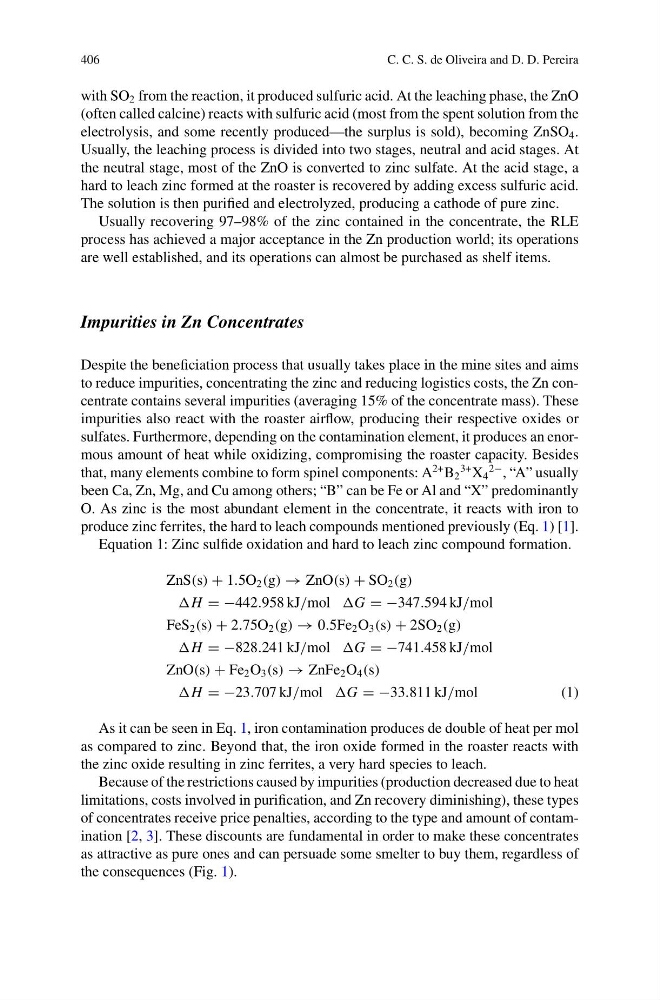
Equation 1: Zinc sulfide oxidation and hard to leach zinc compound formation.
ZnS(s) + 1.5O 2 (g) → ZnO(s) + SO 2 (g)
H = −442.958 kJ/mol G = −347.594 kJ/mol
FeS 2 (s) + 2.75O 2 (g) → 0.5Fe 2 O 3 (s) + 2SO 2 (g)
H = −828.241 kJ/mol G = −741.458 kJ/mol
ZnO(s) + Fe 2 O 3 (s) → ZnFe 2 O 4 (s)
H = −23.707 kJ/mol G = −33.811 kJ/mol
(1)
As it can be seen in Eq. 1, iron contamination produces de double of heat per mol
as compared to zinc. Beyond that, the iron oxide formed in the roaster reacts with
the zinc oxide resulting in zinc ferrites, a very hard species to leach.
Because of the restrictions caused by impurities (production decreased due to heat
limitations, costs involved in purification, and Zn recovery diminishing), these types
of concentrates receive price penalties, according to the type and amount of contamination [2, 3]. These discounts are fundamental in order to make these concentrates
as attractive as pure ones and can persuade some smelter to buy them, regardless of
the consequences (Fig. 1).
C. C. S. de Oliveira and D. D. Pereira
with SO 2 from the reaction, it produced sulfuric acid. At the leaching phase, the ZnO
(often called calcine) reacts with sulfuric acid (most from the spent solution from the
electrolysis, and some recently produced—the surplus is sold), becoming ZnSO 4 .
Usually, the leaching process is divided into two stages, neutral and acid stages. At
the neutral stage, most of the ZnO is converted to zinc sulfate. At the acid stage, a
hard to leach zinc formed at the roaster is recovered by adding excess sulfuric acid.
The solution is then purified and electrolyzed, producing a cathode of pure zinc.
Usually recovering 97–98% of the zinc contained in the concentrate, the RLE
process has achieved a major acceptance in the Zn production world; its operations
are well established, and its operations can almost be purchased as shelf items.
Impurities in Zn Concentrates
Despite the beneficiation process that usually takes place in the mine sites and aims
to reduce impurities, concentrating the zinc and reducing logistics costs, the Zn concentrate contains several impurities (averaging 15% of the concentrate mass). These
impurities also react with the roaster airflow, producing their respective oxides or
sulfates. Furthermore, depending on the contamination element, it produces an enormous amount of heat while oxidizing, compromising the roaster capacity. Besides
that, many elements combine to form spinel components: A
2+ B 2
3+ X 4
2− , “A” usually
been Ca, Zn, Mg, and Cu among others; “B” can be Fe or Al and “X” predominantly
O. As zinc is the most abundant element in the concentrate, it reacts with iron to
produce zinc ferrites, the hard to leach compounds mentioned previously (Eq. 1) [1].
Equation 1: Zinc sulfide oxidation and hard to leach zinc compound formation.
ZnS(s) + 1.5O 2 (g) → ZnO(s) + SO 2 (g)
H = −442.958 kJ/mol G = −347.594 kJ/mol
FeS 2 (s) + 2.75O 2 (g) → 0.5Fe 2 O 3 (s) + 2SO 2 (g)
H = −828.241 kJ/mol G = −741.458 kJ/mol
ZnO(s) + Fe 2 O 3 (s) → ZnFe 2 O 4 (s)
H = −23.707 kJ/mol G = −33.811 kJ/mol
(1)
As it can be seen in Eq. 1, iron contamination produces de double of heat per mol
as compared to zinc. Beyond that, the iron oxide formed in the roaster reacts with
the zinc oxide resulting in zinc ferrites, a very hard species to leach.
Because of the restrictions caused by impurities (production decreased due to heat
limitations, costs involved in purification, and Zn recovery diminishing), these types
of concentrates receive price penalties, according to the type and amount of contamination [2, 3]. These discounts are fundamental in order to make these concentrates
as attractive as pure ones and can persuade some smelter to buy them, regardless of
the consequences (Fig. 1).