

392
J. Salminen et al.
Introduction
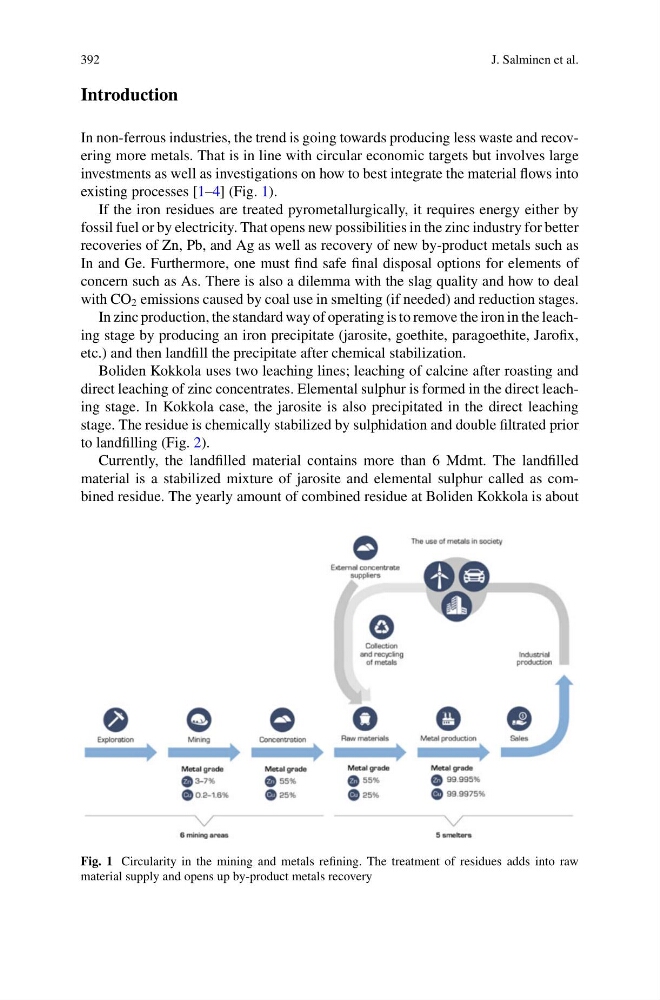
In non-ferrous industries, the trend is going towards producing less waste and recovering more metals. That is in line with circular economic targets but involves large
investments as well as investigations on how to best integrate the material flows into
existing processes [1–4] (Fig. 1).
If the iron residues are treated pyrometallurgically, it requires energy either by
fossil fuel or by electricity. That opens new possibilities in the zinc industry for better
recoveries of Zn, Pb, and Ag as well as recovery of new by-product metals such as
In and Ge. Furthermore, one must find safe final disposal options for elements of
concern such as As. There is also a dilemma with the slag quality and how to deal
with CO 2 emissions caused by coal use in smelting (if needed) and reduction stages.
In zinc production, the standard way of operating is to remove the iron in the leaching stage by producing an iron precipitate (jarosite, goethite, paragoethite, Jarofix,
etc.) and then landfill the precipitate after chemical stabilization.
Boliden Kokkola uses two leaching lines; leaching of calcine after roasting and
direct leaching of zinc concentrates. Elemental sulphur is formed in the direct leaching stage. In Kokkola case, the jarosite is also precipitated in the direct leaching
stage. The residue is chemically stabilized by sulphidation and double filtrated prior
to landfilling (Fig. 2).
Currently, the landfilled material contains more than 6 Mdmt. The landfilled
material is a stabilized mixture of jarosite and elemental sulphur called as combined residue. The yearly amount of combined residue at Boliden Kokkola is about
Fig. 1 Circularity in the mining and metals refining. The treatment of residues adds into raw
material supply and opens up by-product metals recovery
J. Salminen et al.
Introduction
In non-ferrous industries, the trend is going towards producing less waste and recovering more metals. That is in line with circular economic targets but involves large
investments as well as investigations on how to best integrate the material flows into
existing processes [1–4] (Fig. 1).
If the iron residues are treated pyrometallurgically, it requires energy either by
fossil fuel or by electricity. That opens new possibilities in the zinc industry for better
recoveries of Zn, Pb, and Ag as well as recovery of new by-product metals such as
In and Ge. Furthermore, one must find safe final disposal options for elements of
concern such as As. There is also a dilemma with the slag quality and how to deal
with CO 2 emissions caused by coal use in smelting (if needed) and reduction stages.
In zinc production, the standard way of operating is to remove the iron in the leaching stage by producing an iron precipitate (jarosite, goethite, paragoethite, Jarofix,
etc.) and then landfill the precipitate after chemical stabilization.
Boliden Kokkola uses two leaching lines; leaching of calcine after roasting and
direct leaching of zinc concentrates. Elemental sulphur is formed in the direct leaching stage. In Kokkola case, the jarosite is also precipitated in the direct leaching
stage. The residue is chemically stabilized by sulphidation and double filtrated prior
to landfilling (Fig. 2).
Currently, the landfilled material contains more than 6 Mdmt. The landfilled
material is a stabilized mixture of jarosite and elemental sulphur called as combined residue. The yearly amount of combined residue at Boliden Kokkola is about
Fig. 1 Circularity in the mining and metals refining. The treatment of residues adds into raw
material supply and opens up by-product metals recovery