

372
B. Saxén et al.
the precipitated jarosite. Zinc ferrite (ZnOFe 2 O 3 ) in the calcine is problematic, as
this will not leach under the conditions used for jarosite precipitation and needs an
acid washing stage for recovering zinc. Even more important, silver and lead in the
calcine used for neutralization will be lost to the jarosite residue because they are
not soluble in sulphuric acid. Typically, around 20% of the Ag and Pb in the feed is
lost this way.
In the process for precipitation of pure jarosite developed by Outotec, iron is
brought to ferrous (Fe
2+ ) form by reduction with zinc concentrate prior to jarosite
precipitation. In the jarosite precipitation stage, oxidation is carried out to transform
iron to ferric form (Fe
3+ ) to enable precipitation:
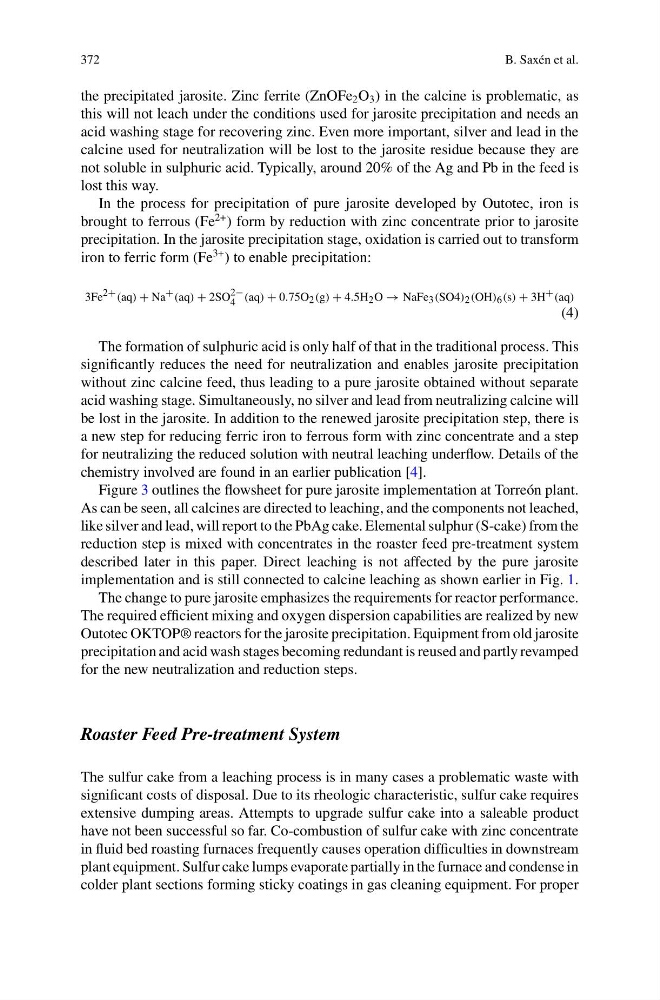
3Fe 2+ (aq) + Na + (aq) + 2SO
2−
4 (aq) + 0.75O 2 (g) + 4.5H 2 O → NaFe 3 (SO4) 2 (OH) 6 (s) + 3H + (aq)
(4)
The formation of sulphuric acid is only half of that in the traditional process. This
significantly reduces the need for neutralization and enables jarosite precipitation
without zinc calcine feed, thus leading to a pure jarosite obtained without separate
acid washing stage. Simultaneously, no silver and lead from neutralizing calcine will
be lost in the jarosite. In addition to the renewed jarosite precipitation step, there is
a new step for reducing ferric iron to ferrous form with zinc concentrate and a step
for neutralizing the reduced solution with neutral leaching underflow. Details of the
chemistry involved are found in an earlier publication [4].
Figure 3 outlines the flowsheet for pure jarosite implementation at Torreón plant.
As can be seen, all calcines are directed to leaching, and the components not leached,
like silver and lead, will report to the PbAg cake. Elemental sulphur (S-cake) from the
reduction step is mixed with concentrates in the roaster feed pre-treatment system
described later in this paper. Direct leaching is not affected by the pure jarosite
implementation and is still connected to calcine leaching as shown earlier in Fig. 1.
The change to pure jarosite emphasizes the requirements for reactor performance.
The required efficient mixing and oxygen dispersion capabilities are realized by new
Outotec OKTOP® reactors for the jarosite precipitation. Equipment from old jarosite
precipitation and acid wash stages becoming redundant is reused and partly revamped
for the new neutralization and reduction steps.
Roaster Feed Pre-treatment System
The sulfur cake from a leaching process is in many cases a problematic waste with
significant costs of disposal. Due to its rheologic characteristic, sulfur cake requires
extensive dumping areas. Attempts to upgrade sulfur cake into a saleable product
have not been successful so far. Co-combustion of sulfur cake with zinc concentrate
in fluid bed roasting furnaces frequently causes operation difficulties in downstream
plant equipment. Sulfur cake lumps evaporate partially in the furnace and condense in
colder plant sections forming sticky coatings in gas cleaning equipment. For proper
B. Saxén et al.
the precipitated jarosite. Zinc ferrite (ZnOFe 2 O 3 ) in the calcine is problematic, as
this will not leach under the conditions used for jarosite precipitation and needs an
acid washing stage for recovering zinc. Even more important, silver and lead in the
calcine used for neutralization will be lost to the jarosite residue because they are
not soluble in sulphuric acid. Typically, around 20% of the Ag and Pb in the feed is
lost this way.
In the process for precipitation of pure jarosite developed by Outotec, iron is
brought to ferrous (Fe
2+ ) form by reduction with zinc concentrate prior to jarosite
precipitation. In the jarosite precipitation stage, oxidation is carried out to transform
iron to ferric form (Fe
3+ ) to enable precipitation:
3Fe 2+ (aq) + Na + (aq) + 2SO
2−
4 (aq) + 0.75O 2 (g) + 4.5H 2 O → NaFe 3 (SO4) 2 (OH) 6 (s) + 3H + (aq)
(4)
The formation of sulphuric acid is only half of that in the traditional process. This
significantly reduces the need for neutralization and enables jarosite precipitation
without zinc calcine feed, thus leading to a pure jarosite obtained without separate
acid washing stage. Simultaneously, no silver and lead from neutralizing calcine will
be lost in the jarosite. In addition to the renewed jarosite precipitation step, there is
a new step for reducing ferric iron to ferrous form with zinc concentrate and a step
for neutralizing the reduced solution with neutral leaching underflow. Details of the
chemistry involved are found in an earlier publication [4].
Figure 3 outlines the flowsheet for pure jarosite implementation at Torreón plant.
As can be seen, all calcines are directed to leaching, and the components not leached,
like silver and lead, will report to the PbAg cake. Elemental sulphur (S-cake) from the
reduction step is mixed with concentrates in the roaster feed pre-treatment system
described later in this paper. Direct leaching is not affected by the pure jarosite
implementation and is still connected to calcine leaching as shown earlier in Fig. 1.
The change to pure jarosite emphasizes the requirements for reactor performance.
The required efficient mixing and oxygen dispersion capabilities are realized by new
Outotec OKTOP® reactors for the jarosite precipitation. Equipment from old jarosite
precipitation and acid wash stages becoming redundant is reused and partly revamped
for the new neutralization and reduction steps.
Roaster Feed Pre-treatment System
The sulfur cake from a leaching process is in many cases a problematic waste with
significant costs of disposal. Due to its rheologic characteristic, sulfur cake requires
extensive dumping areas. Attempts to upgrade sulfur cake into a saleable product
have not been successful so far. Co-combustion of sulfur cake with zinc concentrate
in fluid bed roasting furnaces frequently causes operation difficulties in downstream
plant equipment. Sulfur cake lumps evaporate partially in the furnace and condense in
colder plant sections forming sticky coatings in gas cleaning equipment. For proper